Medication Side Effect Timeline Estimator
How long will your side effects last?
Get evidence-based estimates on how long common medication side effects typically last and personalized strategies to manage your anxiety.
It’s not uncommon to feel uneasy about starting a new medication. You read the list of possible side effects-nausea, dizziness, sleep trouble, low libido-and your heart races. What if this one makes you feel worse? What if it’s permanent? You’re not alone. In fact, 60% of people on long-term medications report feeling anxious about side effects, even before they start taking them. For many, the fear of what might happen becomes worse than the actual symptoms. But here’s the truth: most side effects aren’t dangerous, and they don’t last. The real problem isn’t the drug-it’s the anxiety around it.
Why Your Mind Makes Side Effects Feel Worse
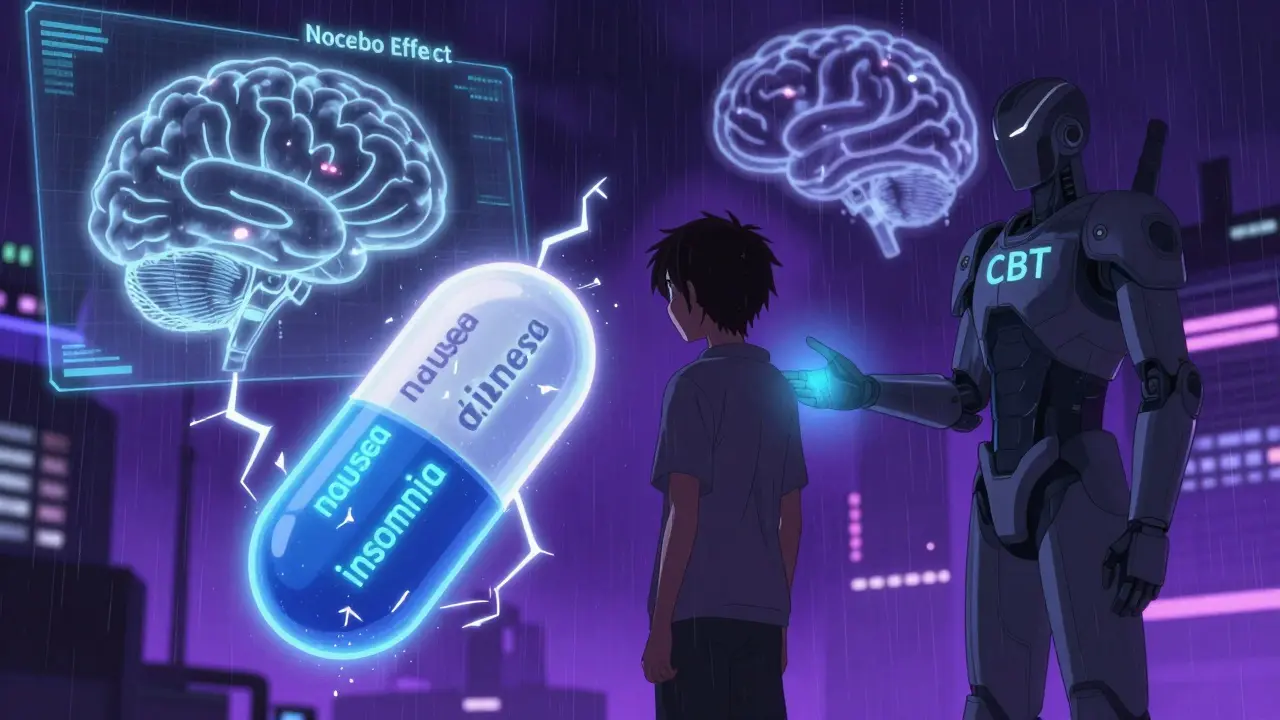
Your brain is wired to protect you. When you hear a list of possible side effects, it doesn’t just process the facts-it imagines the worst. This isn’t irrational; it’s biology. The phenomenon is called the nocebo effect, first documented by researchers in the 1980s. It’s the opposite of the placebo effect: instead of expecting relief and feeling better, you expect harm-and your body responds as if it’s already happening. A 2022 meta-analysis found that patients who were told about potential side effects were twice as likely to report them, even when taking a sugar pill.For example, someone prescribed an SSRI for anxiety might be told, “Some people feel nauseous at first.” But in their mind, it becomes: “I’m going to be sick all day, every day, and I’ll never be able to work again.” That thought triggers real physical stress-muscle tension, stomach clenching, racing heartbeat-which then gets misread as the medication causing the problem. It’s a loop: fear → physical symptoms → more fear → more symptoms.
How Cognitive Behavioral Therapy (CBT) Breaks the Cycle
The most proven way to stop this cycle is cognitive behavioral therapy, or CBT. Unlike just being told “it’ll pass,” CBT gives you tools to rewire how you think about side effects. A 2022 study showed that patients who received CBT specifically for medication anxiety were 58% less likely to quit their treatment early compared to those who only got medical advice.Here’s how it works in practice:
- Identify the catastrophic thought: “If I get dizzy, I’ll fall and break my hip.”
- Challenge it with facts: “Dizziness from SSRIs is mild and usually goes away in 7-10 days. Falls from this are extremely rare.”
- Test the belief: “What’s the actual chance this will happen? 1 in 100? 1 in 1,000?”
- Replace it: “I might feel a little off for a week, but I’ve handled this before. I’m not in danger.”
Studies show that 70-80% of common side effects like nausea, fatigue, and headaches improve within 2-4 weeks. That’s not a guess-it’s clinical data from the Mayo Clinic. But if you don’t know that, your brain fills the gap with fear. CBT fills it with facts.
Simple Tactics That Work Right Away
You don’t need weeks of therapy to start feeling better. These are proven, everyday strategies backed by real patient results:- Take meds with food: If nausea is your issue, eating a small snack with your pill cuts severity by 65%, according to 2024 clinical trials.
- Move your dose to the morning: If you’re having trouble sleeping, switching from nighttime to morning dosing reduces insomnia by more than half in most patients.
- Use the two-week rule: Commit to taking the medication for 14 days before deciding if it’s right for you. Most side effects peak around day 3-5 and fade by day 14. If you quit too soon, you’ll never know.
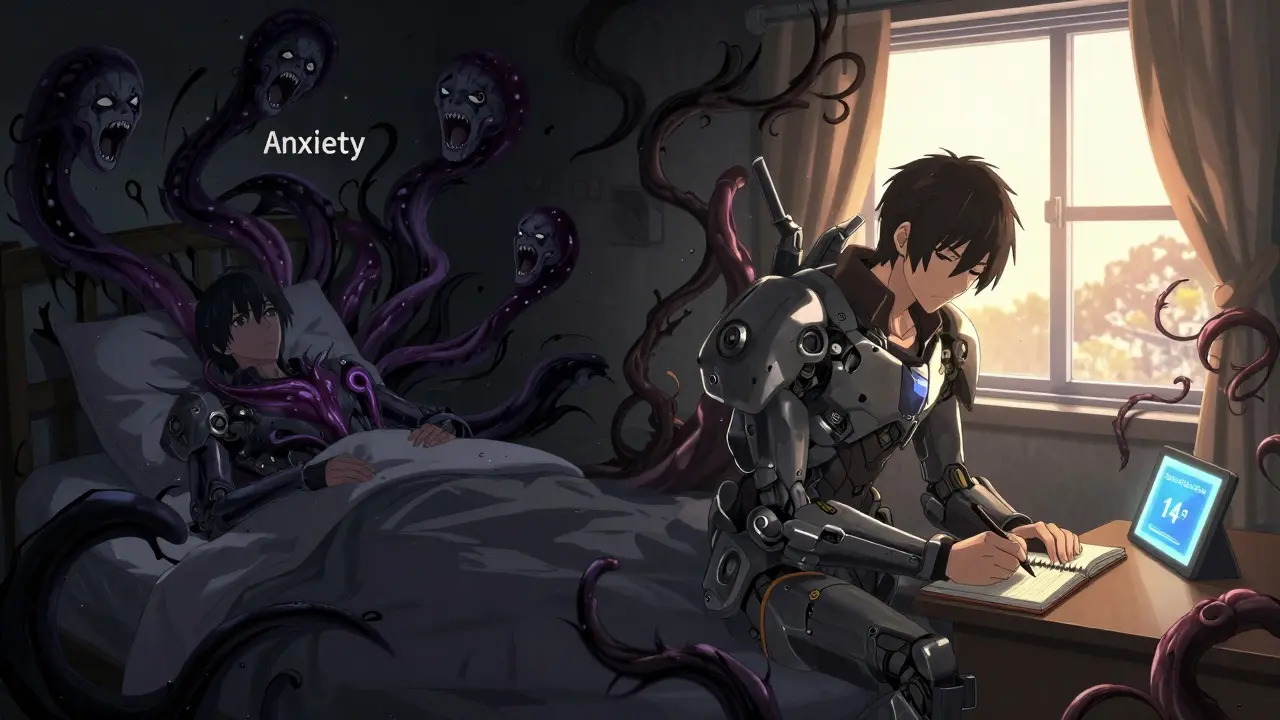
- Track symptoms, not feelings: Keep a simple journal: “Day 3: Nausea-level 3/10, lasted 2 hours after pill.” Seeing patterns kills the fear of the unknown.
- Ground yourself during panic: When anxiety spikes, use the 5-4-3-2-1 technique: Name 5 things you see, 4 you can touch, 3 you hear, 2 you smell, 1 you taste. It resets your nervous system in under a minute.
One woman in Durban, 45, with generalized anxiety disorder, used this exact method. She’d tried three different SSRIs before, quitting each within days because she thought the side effects were unbearable. After learning the timeline of side effects and tracking them daily, she stayed on her fourth medication for over a year. “I didn’t feel better right away,” she said. “But I stopped fighting my body. That made all the difference.”
What Other Therapies Can Help
CBT isn’t the only option. Depending on your style, other approaches can be just as effective:- Acceptance and Commitment Therapy (ACT): Instead of fighting anxious thoughts, you learn to let them pass like clouds. It’s less about changing your mind and more about changing your relationship with it. At six months, ACT users maintain their progress better than CBT users.
- Mindfulness-Based Stress Reduction (MBSR): An 8-week program that teaches breathing and body awareness. It’s less intensive than CBT and works well for people who find talking therapy overwhelming. Research shows it matches the results of 6 CBT sessions.
- Support groups: Online communities like the 14,500+ member Facebook group “Medication Anxiety Support” give people real stories, not just theory. Hearing someone say, “I felt the same way, and here’s how I got through it,” reduces isolation-and fear.
When to Trust Your Gut vs. When to Call Your Doctor
It’s important to know when anxiety is distorting your view-and when your body is sending a real signal. Here’s a simple guide:| Side Effect | Usually Temporary | Call Your Doctor If |
|---|---|---|
| Nausea | Yes (peaks at days 3-5, fades by day 14) | Vomiting, dehydration, lasts over 3 weeks |
| Dizziness | Yes (often resolves in 7-10 days) | Loss of balance, fainting, chest pain |
| Insomnia | Yes (if medication taken at night) | Severe sleep loss for over 10 days, hallucinations |
| Low libido | Yes (common with SSRIs) | Complete loss of interest, depression worsening |
| Headaches | Yes (often mild and short-term) | Severe, sudden, or accompanied by vision changes |
Dr. John Greden, a leading psychiatrist, says: “Addressing medication side effect anxiety is now standard of care. It reduces dropout rates by nearly half.” But he also warns: “Don’t confuse anxiety with a real reaction. If something feels wrong, speak up.” The goal isn’t to push through pain-it’s to stop mistaking normal adjustment for danger.

Why Most People Give Up Too Soon
The biggest reason people stop their medication isn’t because it doesn’t work. It’s because they quit before it has time to work. A 2023 survey found that 42% of negative reviews on Drugs.com blamed doctors for “dismissing concerns” instead of offering tools to manage anxiety. That’s the gap. Many providers still treat side effects as purely medical-prescribing a new drug instead of addressing the fear behind the reaction.But that’s changing. Since 2021, Kaiser Permanente has trained all its providers to use a standardized “medication anxiety protocol.” They now give patients a printed timeline of expected side effects and a checklist of coping strategies. Result? A 27% drop in early discontinuation across 39 centers.
Even the government is catching on. As of January 2023, U.S. Medicare rules require that medication education include “strategies for managing treatment-related anxiety.” That’s huge. It means this isn’t just a nice-to-have-it’s now part of medical standards.
What’s New in 2026
The field is moving fast. In March 2024, the FDA approved the first digital therapy app-SideEffectCope-designed to deliver CBT for medication anxiety. In clinical trials, it cut treatment dropouts by 53%. Telehealth platforms are now rolling out integrated anxiety management tools. By 2026, 78% of major health systems plan to offer these tools through virtual visits.Still, access isn’t equal. Only 22% of rural clinics offer specialized psychological support, compared to 67% in cities. If you’re in a remote area, start with free resources: the Mayo Clinic’s online guides, the Anxiety and Depression Association of America’s worksheets, or the “Managing Medication Anxiety” workbook by Dr. Martin Antony. Self-guided CBT works for 55% of people who stick with it for 8 weeks.
And here’s the bottom line: medication anxiety is not weakness. It’s a normal human response to uncertainty. The goal isn’t to be fearless-it’s to be informed. To know the difference between fear and fact. To give your body time to adjust. And to know that you’re not alone in feeling this way.
How long do medication side effects usually last?
Most common side effects like nausea, dizziness, fatigue, and sleep issues peak within the first 3-5 days and begin to fade by day 7-10. By 2-4 weeks, 70-80% of patients report significant improvement. This is true for SSRIs, blood pressure meds, and many other common prescriptions. If symptoms last longer than 4 weeks or get worse, talk to your doctor.
Can anxiety make side effects worse?
Yes. The nocebo effect means that expecting side effects can trigger or intensify them. Studies show patients who are told about possible side effects report them more often-even if they’re taking a placebo. Anxiety raises stress hormones like cortisol, which can cause physical symptoms like nausea, headaches, or heart palpitations that mimic drug side effects. Managing anxiety isn’t ignoring the problem-it’s removing the amplifier.
Is it safe to stop my medication if side effects are bad?
Never stop abruptly without talking to your doctor. Some medications can cause dangerous withdrawal symptoms. Instead, use the two-week rule: commit to taking the medication for 14 days while using coping strategies. If symptoms are truly severe (vomiting, fainting, chest pain), contact your provider immediately. But for mild to moderate symptoms like fatigue or nausea, give it time. Most improve quickly.
What if my doctor doesn’t take my anxiety seriously?
You’re not being dramatic-you’re being human. If your doctor dismisses your concerns, ask for a referral to a therapist trained in CBT for medication anxiety. Bring printouts from reputable sources like Mayo Clinic or HelpGuide.org. You can also request a second opinion. Many clinics now offer integrated care; if yours doesn’t, you can still use self-guided tools like workbooks or apps like SideEffectCope.
Are there free resources I can use right now?
Yes. The Mayo Clinic’s website has free, clear guides on managing side effects for common medications. HelpGuide.org offers downloadable worksheets on cognitive restructuring. The Anxiety and Depression Association of America provides printable CBT exercises. The “Managing Medication Anxiety” workbook by Dr. Martin Antony is available as a PDF from Oxford University Press. And there are active online support groups on Facebook and Reddit with thousands of people sharing real experiences.
Will I ever feel normal again on this medication?
Yes-most people do. The goal of medication isn’t to make you feel perfect. It’s to help you feel like yourself again, without the weight of anxiety or depression. Side effects are temporary. The relief you’re seeking isn’t just possible-it’s predictable. You just need to give your body the time it needs to adjust, and your mind the tools to stop fighting itself.
What to Do Next
If you’re currently struggling with medication anxiety, start here:- Write down your biggest fear about your medication.
- Look up the real timeline for side effects from Mayo Clinic or HelpGuide.org.
- Commit to one coping strategy for the next 14 days-take it with food, track symptoms, or use grounding techniques.
- Reach out to one person who’s been through this. You’ll find them online.
- Call your doctor and say: “I’m having anxiety about side effects. Can we talk about how to manage it?”
You don’t have to choose between feeling better and feeling safe. You can have both. It just takes the right tools-and a little patience.



Dolores Rider
January 24, 2026 AT 06:39venkatesh karumanchi
January 26, 2026 AT 00:48Jenna Allison
January 26, 2026 AT 07:44Vatsal Patel
January 27, 2026 AT 04:35Sharon Biggins
January 28, 2026 AT 21:21John McGuirk
January 28, 2026 AT 23:03Darren Links
January 29, 2026 AT 07:45Kat Peterson
January 30, 2026 AT 09:13Husain Atther
January 30, 2026 AT 09:49Helen Leite
January 31, 2026 AT 20:41Elizabeth Cannon
February 1, 2026 AT 11:58Marlon Mentolaroc
February 2, 2026 AT 17:44Jenna Allison
February 4, 2026 AT 05:18