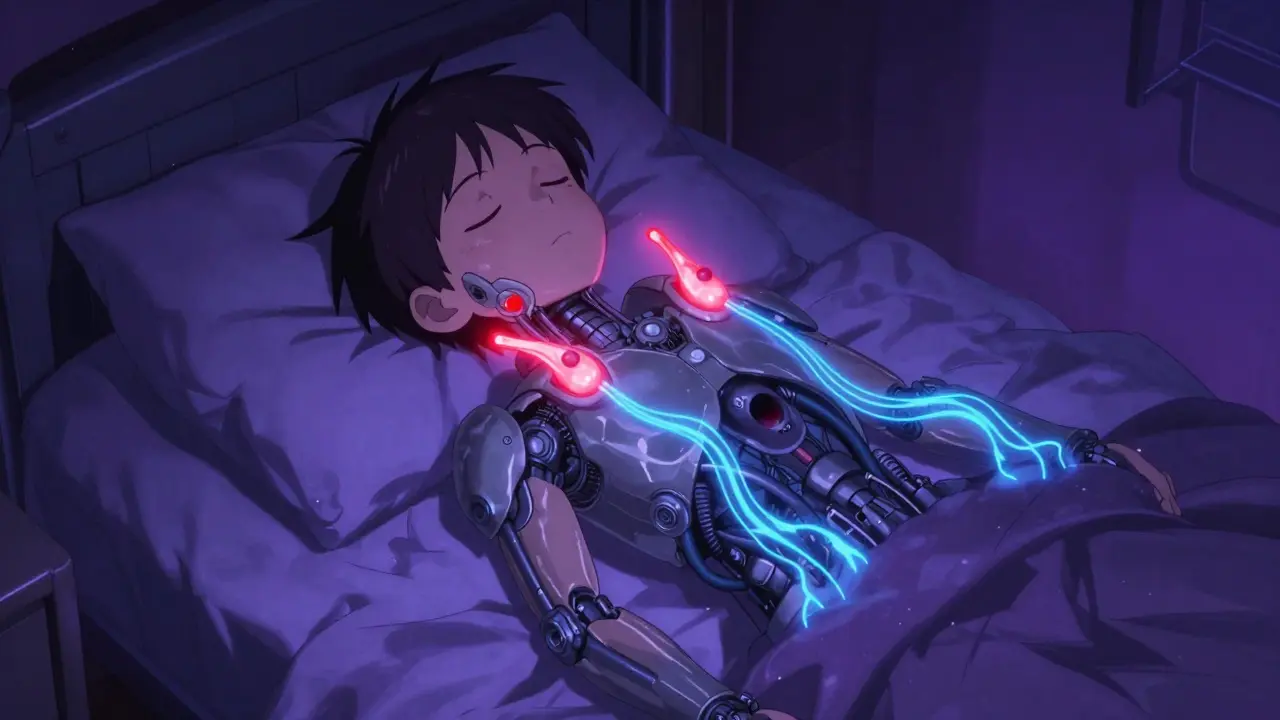
When a child snores loudly, stops breathing for a few seconds during sleep, or wakes up gasping, it’s not just noise-it’s a sign something serious might be happening. Pediatric obstructive sleep apnea (OSA) affects 1-5% of all children, mostly between ages 2 and 6. The root cause? Often, it’s enlarged tonsils and adenoids blocking the airway. This isn’t just about bad sleep. Left untreated, it can lead to learning problems, behavioral issues, high blood pressure, and even slowed growth. The good news? We know exactly how to fix it-and the solutions are clearer than ever.
Why Tonsils and Adenoids Cause Sleep Apnea in Kids
Tonsils and adenoids are part of the immune system, helping fight infections. But in young children, they grow larger relative to the size of their airways. When they get swollen from repeated colds or allergies, they can block the back of the throat during sleep. That’s when breathing stops-sometimes dozens of times an hour.
Unlike adults, where obesity is the main cause of sleep apnea, kids most often have this problem because of physical blockage. A child with grade 3 or 4 tonsil enlargement (covering most of the airway) has a very high chance of having OSA. Even if only the adenoids are enlarged-those are the tissue behind the nose, not visible when you look in the mouth-they can still shut off airflow. That’s why doctors check both when diagnosing sleep apnea.
Studies show that children with severe OSA can have 15 to 30 breathing pauses per hour. Each pause drops oxygen levels, wakes the brain slightly, and fragments sleep. Over time, this rewires how the brain functions. Kids may struggle to focus in school, act out, or even grow slower because their bodies aren’t getting the deep rest needed for growth hormone release.
The Gold Standard: Adenotonsillectomy
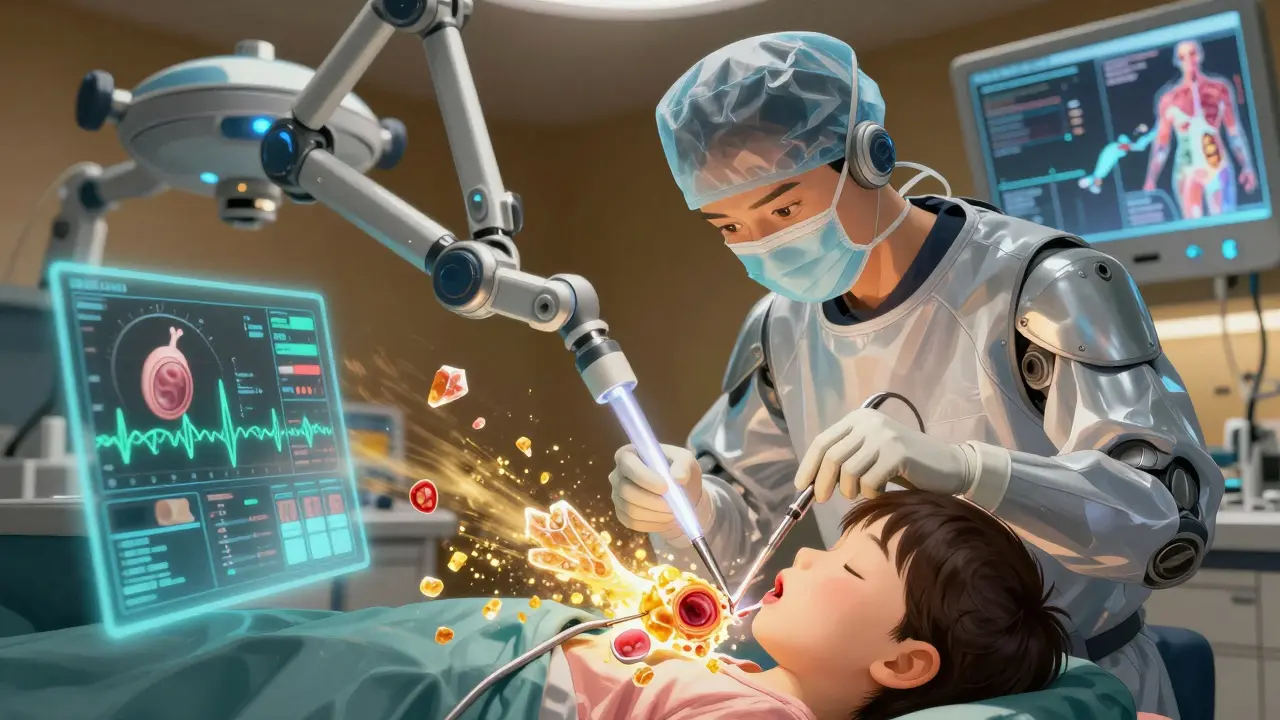
The American Academy of Pediatrics says the first step for most kids with moderate to severe OSA is surgery to remove both the tonsils and adenoids. This is called adenotonsillectomy. It’s not a minor procedure, but it’s common-over 85% of pediatric OSA cases start here.
The success rate? Between 70% and 80% in otherwise healthy kids. That means most children stop snoring, sleep through the night, and their behavior and school performance improve. But it’s not a guarantee. In 20% to 30% of cases, the apnea comes back. Why? Sometimes the airway is narrow for other reasons-like a small jaw, obesity, or neuromuscular issues. Other times, not all the tissue was removed.
That’s why surgeons now often remove both tonsils and adenoids together-even if one looks bigger. Removing just one leaves the other as a potential blockage. Research from the NIH shows recurrence rates are much higher when only one is taken out.
There’s also a newer technique called partial tonsillectomy. Instead of removing the whole tonsil, the surgeon takes out only the swollen inner part. This cuts recovery time by about 30%, reduces pain, and lowers bleeding risk. But it’s only available at specialized centers. Most hospitals still do full removals.
Recovery takes 7 to 14 days. Kids need soft foods, lots of fluids, and quiet time. Some parents report their child seems more alert and cheerful within days. Others notice changes over weeks. Either way, a follow-up sleep study is usually recommended 2 to 3 months after surgery to make sure the problem is truly gone.
When CPAP Is the Answer
Not every child is a candidate for surgery. If a child has a neuromuscular disorder like cerebral palsy, a craniofacial abnormality, or severe obesity, removing tonsils might not help. In those cases, CPAP-continuous positive airway pressure-is the next best option.
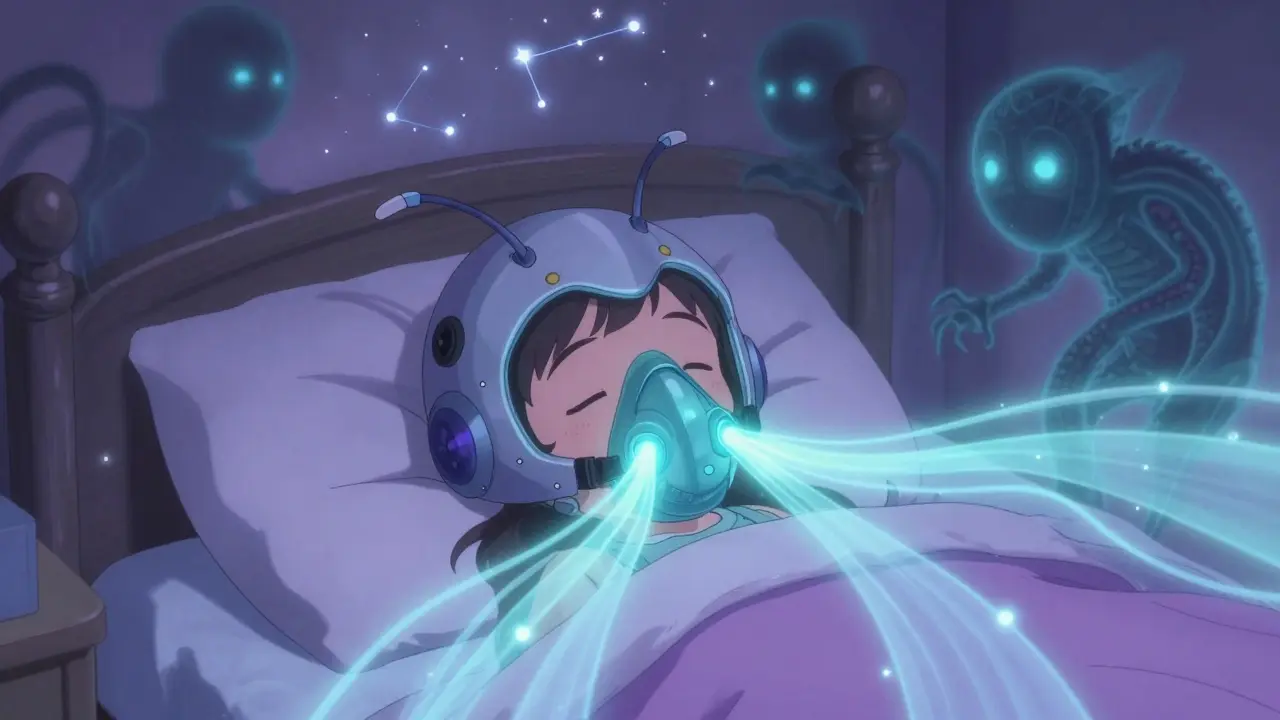
CPAP works by blowing a steady stream of air through a mask worn during sleep. This air keeps the throat open, like a balloon holding a tube open. For kids, the pressure is usually set between 5 and 12 cm H2O, calibrated during a special sleep study called a titration study.
When used correctly, CPAP is 85% to 95% effective at stopping apneas. That’s better than surgery for some kids. But here’s the catch: kids hate wearing masks. About 30% to 50% of children won’t use it consistently. Why? The mask feels weird, it’s claustrophobic, or it leaks. Some kids wake up because it’s noisy. Others get skin sores.
Success depends on fit and patience. Pediatric CPAP masks are smaller, softer, and come in different styles-nasal pillows, full face, or nasal prongs. Many kids need 2 to 8 weeks to adjust. Parents who stick with it, use positive reinforcement, and work with a sleep specialist see better results. And because kids grow fast, the mask needs to be refitted every 6 to 12 months.
CPAP is also used after surgery if apnea doesn’t go away. About 15% to 20% of kids still have symptoms after tonsil removal. In those cases, CPAP isn’t a failure-it’s the next step.
Other Treatments That Might Help
Surgery and CPAP aren’t the only options. For mild cases, doctors sometimes try less invasive approaches first.
Inhaled corticosteroids-like fluticasone nasal spray-are used to shrink swollen adenoids. A daily dose of 88 to 440 mcg can reduce obstruction in 30% to 50% of mild OSA cases. But it takes 3 to 6 months to see results. It’s not a cure, but it can buy time or avoid surgery in borderline cases.
Rapid maxillary expansion is an orthodontic device that widens the upper jaw over 6 to 12 months. It works best for kids with narrow palates, which is common in those with mouth breathing and OSA. Success rates are 60% to 70%. It’s not a quick fix, but it can open the airway permanently.
Montelukast, a daily pill used for asthma and allergies, is being studied for OSA. It blocks leukotrienes-chemicals that cause tonsil swelling. Some studies show it reduces symptoms in mild cases, especially when allergies are involved. But again, it takes months to work and isn’t FDA-approved for this use in kids.
There’s also emerging tech like hypoglossal nerve stimulation, a device implanted in the chest that gently stimulates the tongue to keep it from blocking the airway. It got FDA approval for limited pediatric use in 2022, but it’s still rare and only for severe, complex cases.
What Happens If Nothing Is Done?
Ignoring pediatric OSA isn’t an option. This isn’t just about snoring. Chronic low oxygen and fragmented sleep damage developing brains. Kids with untreated OSA are more likely to have:
- Attention deficit and hyperactivity symptoms
- Lower IQ scores and poor school performance
- High blood pressure and heart strain
- Delayed growth and weight gain issues
- Bedwetting
Some of these changes can become permanent. The brain doesn’t fully recover if the sleep disruption lasts too long. That’s why early diagnosis matters. If your child snores loudly, breathes through the mouth, has frequent night sweats, or seems tired even after a full night’s sleep, get it checked.
How Diagnosis Works
Diagnosis starts with a sleep study-polysomnography. This isn’t like a hospital stay. The child sleeps overnight in a quiet room with sensors on their head, chest, and face. The machine records:
- Brain waves
- Heart rhythm
- Oxygen levels
- Carbon dioxide levels
- Chest and belly movement
- Muscle activity
- Airflow through nose and mouth
The result? A detailed report showing how many times breathing stopped, how low oxygen dropped, and how often the child woke up. This tells doctors whether it’s mild, moderate, or severe-and guides treatment.
Some centers now use drug-induced sleep endoscopy (DISE). A light sedative helps the child fall asleep, then a tiny camera is passed through the nose to watch the airway collapse in real time. This helps surgeons plan exactly where to operate.
Choosing the Right Path
There’s no one-size-fits-all. Here’s how most doctors decide:
- Healthy child, 2-6 years old, big tonsils/adenoids? → Adenotonsillectomy first.
- Obese child, BMI over 95th percentile? → CPAP is often better than surgery.
- Child with Down syndrome, cerebral palsy, or facial differences? → CPAP or other non-surgical options.
- Mild snoring, no daytime symptoms? → Try steroids or watchful waiting.
- Surgery didn’t help? → CPAP or orthodontic expansion.
The key is not just treating the symptoms-but fixing the root cause. A child with small jaws and narrow airways might need orthodontics. A child with allergies might need better control of nasal swelling. And a child with persistent OSA after surgery? That’s when CPAP becomes a lifeline.
What’s clear is this: sleep matters. And for kids, fixing their sleep isn’t a luxury-it’s essential for their brain, body, and future.


Gregory Clayton
January 9, 2026 AT 06:44Bro, I swear every kid these days is diagnosed with sleep apnea just because they snore a little. My nephew used to sound like a chainsaw, but we just put him on allergy meds and boom - quiet nights. Why do we rush to cut out tonsils like it’s some medieval ritual? This country’s obsessed with surgery when simple fixes exist. 🤦♂️
Catherine Scutt
January 10, 2026 AT 20:02Actually, if you read the studies, untreated OSA in kids leads to permanent cognitive deficits. It’s not ‘overdiagnosis’ - it’s negligence. I work in pediatrics. Saw a 5-year-old with an IQ drop of 15 points after two years of untreated apnea. Don’t gamble with a child’s brain.
Diana Stoyanova
January 12, 2026 AT 09:02Okay but imagine this - your kid’s brain is rewiring itself every night because it’s gasping for air like a fish out of water. That’s not just ‘bad sleep,’ that’s a slow-motion trauma. And yeah, surgery sounds scary, but think about it: removing two tiny glands to give your child a whole future? That’s not a risk - that’s a gift. I’ve seen kids turn from zombie mode to full-on giggly, hyper-focused little humans after adenotonsillectomy. It’s magic. ✨ And CPAP? Yeah, it’s a nightmare at first - masks, leaks, tears - but once they get used to it? They’ll beg for it. I’m not joking. My daughter used to cry every night. Now she puts the mask on herself. 💪
Jenci Spradlin
January 12, 2026 AT 22:55Just a heads up - if your kid’s got allergies, try fluticasone before surgery. It’s cheaper and less scary. My son used it for 4 months and his tonsils shrunk enough that the doc said we could skip surgery. Not a cure, but it bought us time. Also, CPAP masks for kids? Get the nasal pillows, not the full-face ones. Way less creepy. And yeah, they’ll fight it at first - but if you make it a ‘superhero bedtime ritual’ with stickers and rewards? They’ll rock it. 😎
Elisha Muwanga
January 13, 2026 AT 07:12It’s disturbing how quickly medicine has abandoned patience in favor of intervention. In my day, we let kids grow into their bodies. Now, we cut, zap, and pump them full of drugs at the first sign of snoring. This is not progress - it’s pharmaceutical-industrial complex exploitation disguised as care. A child’s body is not a machine to be fixed. It’s a developing organism. Let it breathe. Let it grow. Let it be.
Maggie Noe
January 13, 2026 AT 09:08My cousin’s daughter had OSA after surgery - CPAP saved her. 🥹 But the real hero? The sleep tech who spent 3 weeks teaching us how to fit the mask without causing a toddler tantrum. It’s not just about the machine - it’s about the human touch. And honestly? The fact that we now have hypoglossal nerve stimulators for kids? That’s sci-fi becoming real. We’re living in the future, folks. 🤖💤
Kiruthiga Udayakumar
January 14, 2026 AT 16:13Why do Americans always think surgery is the answer? In India, we use home remedies - turmeric milk, steam inhalation, even sleeping on the side. Kids grow out of it. You don’t need to cut everything out. This is overmedicalization at its worst. And CPAP? For a child? That’s cruel. Let nature take its course.
Patty Walters
January 15, 2026 AT 10:15Just wanted to add - if your kid’s on CPAP and hates the mask, try the DreamWear nasal prongs. They’re like little nose tubes, not a full mask. And if they’re still resisting, get a humidifier with it - dry noses = more crying. Also, sleep studies aren’t scary. They’re like a sleepover with sensors. My daughter thought it was a ‘space mission.’ She slept better than she had in years. 🛸
Phil Kemling
January 17, 2026 AT 02:21What if the real issue isn’t the tonsils… but the way we’ve built our world? Kids breathe through their mouths because they’re always indoors, exposed to allergens, sitting too much, breathing stale air. Maybe the solution isn’t removing tissue - but restoring natural development. Fresh air, outdoor play, nasal breathing exercises. Maybe we’re treating symptoms because we’re too afraid to fix the environment that caused them in the first place.