
When the temperature rises, your body knows what to do: sweat. That’s how you cool down. But if you’re taking certain medications, your body might not be able to sweat at all - even when it desperately needs to. This isn’t just uncomfortable. It’s dangerous. Heat intolerance from medications is a real, growing threat, especially as summers get hotter and more people are on long-term prescriptions. You might not realize your drug is silently blocking your body’s natural cooling system until it’s too late.
How Medications Break Your Body’s Cooling System
Your body cools itself through three main tricks: sweating, blood flow to the skin, and staying hydrated. Medications can mess with any or all of these. Some stop your sweat glands from working. Others keep blood from reaching your skin to release heat. Some make you pee so much you get dehydrated. And a few even trick your brain into thinking you’re not thirsty. The biggest offenders fall into a few key groups. Anticholinergics - like oxybutynin for overactive bladder, diphenhydramine (Benadryl), and many older antidepressants - block a chemical called acetylcholine. That’s the signal your sweat glands need to turn on. Without it, sweating drops by 60% to 80%. That means even on a mild 27°C (80°F) day, your core temperature can climb dangerously high. Diuretics like hydrochlorothiazide and chlorthalidone make you lose 1.5 to 2.5 liters of fluid every day. Less fluid means less sweat. Studies show this cuts your sweat output by 30% to 50%. And because you’re losing salt and water, your body can’t regulate temperature properly. This isn’t just a minor inconvenience - it’s linked to 2.3 times higher risk of heat exhaustion during summer heat waves, according to Kaiser Permanente data. Beta blockers - such as metoprolol and propranolol - don’t stop sweating. They stop your blood vessels from opening up. Normally, when you get hot, your skin’s blood vessels widen to let heat escape. Beta blockers prevent that. Research shows they reduce skin blood flow by 25% to 40%. Your body traps heat inside, and your core temperature rises faster than normal. Combine this with a diuretic, and the risk spikes even more. Stimulants like Adderall and Ritalin work differently. They don’t stop cooling - they make your body produce way more heat. These drugs boost your metabolism by 15% to 25%. That’s like running a small furnace inside you. At the same time, they can reduce your ability to sweat and make you forget to drink water. It’s a double hit: more heat, less cooling. And then there’s the new kid on the block: GLP-1 agonists like Ozempic and Wegovy. These drugs are popular for weight loss, but they suppress your thirst signal by 40% to 50%. You might not feel thirsty even when you’re losing fluids. That means you can get dehydrated without realizing it - and your body can’t sweat if it doesn’t have the water to make it.Who’s at the Highest Risk?
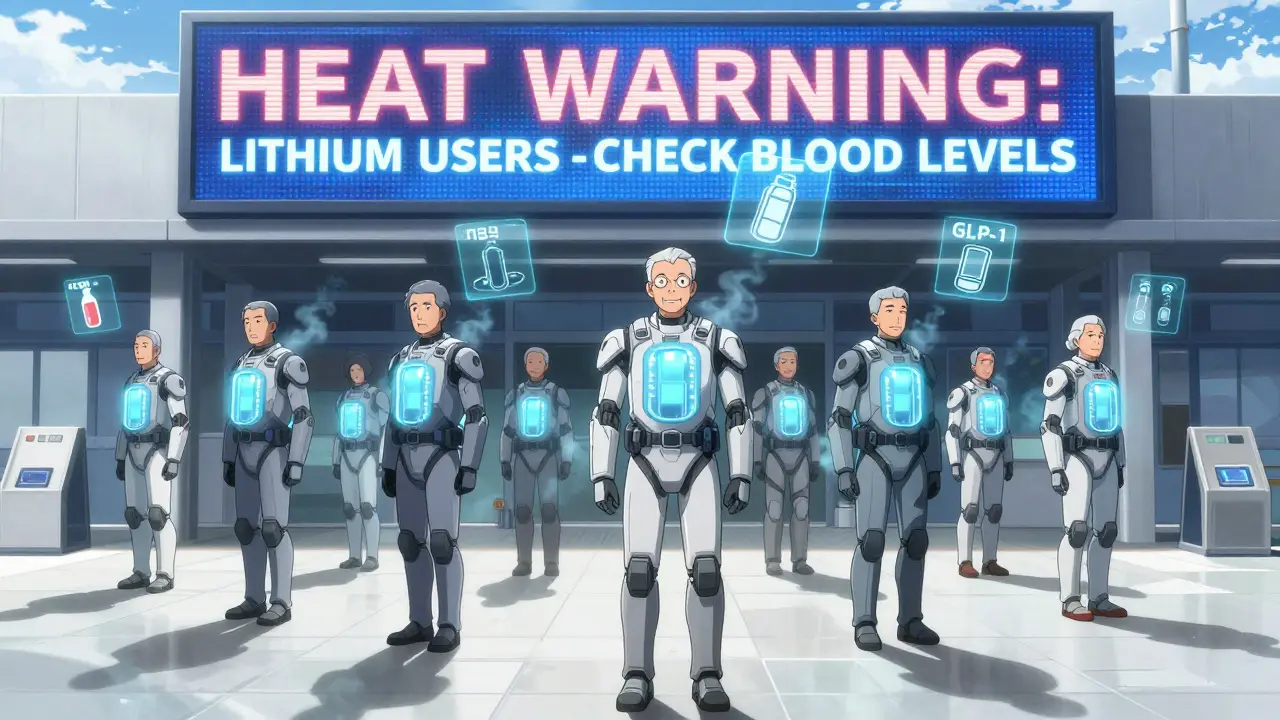
It’s not just about the drug. It’s about how many you’re taking and who you are. People over 65 are at the highest risk. As we age, our sweat glands naturally slow down. Add in five or more medications, and your risk of heat stroke jumps 300%, according to the American Geriatrics Society. That’s not a small number. That’s a life-or-death gap. People taking three or more heat-affecting drugs at once are the most vulnerable. A 2022 study found that 18% to 22% of all heat-related ER visits among adults over 50 were tied to medication combinations. Think about it: someone on hydrochlorothiazide (diuretic), oxybutynin (anticholinergic), and metoprolol (beta blocker) is getting hit from three different angles. Their body has almost no way to cool down. Antipsychotics like olanzapine, risperidone, and haloperidol are especially dangerous. They don’t just reduce sweating - they interfere with the brain’s thermostat. The hypothalamus, which controls body temperature, gets confused. This can lead to heat stroke even when the outside temperature is only 27°C to 32°C (80°F to 90°F). That’s not a heat wave. That’s a normal summer day in many parts of the U.S. Lithium is another silent killer. It’s used for bipolar disorder, but it’s stored in your body like salt. When you lose fluids through sweat or urine, lithium becomes more concentrated. A 25% to 35% spike in lithium levels can trigger toxicity - confusion, tremors, seizures - even at temperatures above 29°C (85°F). The CDC specifically warns that lithium users need blood tests during heat waves.What the Symptoms Look Like
You can’t wait for heat stroke to show up. By then, it’s too late. The early signs come fast - often within 30 to 90 minutes of being in the heat.- Cramps: Occur in 65% of cases. Muscle spasms in arms, legs, or stomach.
- Dizziness or lightheadedness: 55% of people feel this. It’s your brain not getting enough blood.
- Flushed skin: 45% have red, hot skin - but not always. Some people have dry skin because they’re not sweating.
- Headache: 70% report this. It’s often a sign your body is overheating.
- Lack of sweating: 85% of people with medication-induced heat intolerance stop sweating - or sweat very little.
- Nausea or vomiting: 35% experience this. It’s your body’s last-ditch effort to cool down.
- Weakness: 60% feel exhausted, even if they haven’t moved.
What You Can Do to Stay Safe
You don’t have to give up your meds. But you do need to change how you live in hot weather.- Drink more water - even if you’re not thirsty. Add 500 to 1,000 mL (about 2 to 4 cups) to your daily intake during heat advisories. Don’t wait for thirst. That signal is broken on drugs like Ozempic.
- Avoid the sun between 10 a.m. and 4 p.m. That’s when UV radiation is strongest. Up to 80% of daily heat exposure happens in those six hours.
- Use air conditioning. If your home doesn’t have it, go to a library, mall, or cooling center. Even a fan won’t help if you’re not sweating.
- Check your weight daily. A drop of 2% or more in body weight means you’re dehydrated. For a 150-pound person, that’s just 3 pounds - less than a bottle of water.
- Wear a cooling vest. If you’re on antipsychotics or anticholinergics, these vests can lower your core temperature by 0.5°C to 1.0°C. That’s enough to prevent heat stroke.
- Use SPF 30+ sunscreen. Some blood pressure meds (like calcium channel blockers and ACE inhibitors) make your skin more sensitive to sunburn, which adds heat stress.
What Your Doctor Should Be Doing
Your doctor should know about your risk. But many don’t ask. That’s changing. The CDC updated its Heat and Medications Guidance for Clinicians in March 2023. Electronic health records like Epic now auto-flag patients on 14 high-risk drug classes during summer months. That’s progress. But you still need to speak up. Bring up heat intolerance at your next appointment. Ask: “Could any of my medications affect how I handle heat?” If you’re on lithium, ask about blood tests during hot weather. If you’re on multiple drugs, ask if any of them interact dangerously in heat. The American Heart Association now recommends that patients on beta blockers and diuretics monitor their temperature during heat waves. That’s not something you can do alone. You need a thermometer. A simple oral or armpit thermometer works. If your temperature hits 38.3°C (101°F) or higher, seek help.
The Bigger Picture: Climate Change Makes This Worse
This isn’t just a medical issue - it’s a climate issue. 2023 was the hottest year on record, 1.18°C above the 20th-century average. Heat waves are longer, stronger, and more frequent. And the number of people on medications that impair cooling is rising. The Lancet Countdown projects a 40% to 60% increase in medication-related heat complications by 2050. That’s not a guess. It’s based on current trends in drug use and global warming. Research is moving fast. The FDA approved the first wearable core temperature monitor, TempTraq, in December 2023 - specifically for people on heat-risk drugs. The NIH is funding a $2.5 million study to build AI tools that predict your personal heat risk based on your medication list. You’re not alone in this. But you have to be the one to act. No one else will check your temperature. No one else will remind you to drink water. No one else will notice if you stop sweating.When to Call for Help
If you’re on a high-risk medication and you have:- A body temperature above 38.3°C (101°F)
- Confusion, slurred speech, or loss of consciousness
- Hot, dry skin with no sweating
- Rapid heartbeat or breathing
Can I stop my medication if it causes heat intolerance?
No. Never stop a prescription medication without talking to your doctor. Many of these drugs treat serious conditions like high blood pressure, depression, or bipolar disorder. Stopping them suddenly can be dangerous. Instead, work with your doctor to find ways to manage the heat risk - like adjusting your schedule, increasing fluids, or switching to a safer drug if possible.
Do all antihistamines cause decreased sweating?
No. Only older antihistamines like diphenhydramine (Benadryl) and chlorpheniramine have strong anticholinergic effects. Newer ones like loratadine (Claritin) and cetirizine (Zyrtec) don’t affect sweating. If you’re using an antihistamine for allergies and live in a hot climate, ask your doctor if you can switch to a non-drowsy, non-anticholinergic option.
Is heat intolerance permanent if I’m on these medications?
No. The effect lasts only as long as you’re taking the drug. Once you stop - and only under medical supervision - your body’s ability to sweat and regulate temperature usually returns. But until then, you must treat every hot day as a potential danger zone.
Can I still exercise if I’m on a medication that causes heat intolerance?
You can, but you must be extremely careful. Avoid outdoor exercise during peak heat hours. Stick to indoor, air-conditioned spaces. Reduce intensity and duration. Drink water before, during, and after. Monitor your heart rate and body temperature. If you feel dizzy, stop immediately. Consider low-impact activities like swimming or yoga in cool environments.
Are there any medications that help with heat tolerance?
Not directly. But some medications are safer than others. For example, SSRIs like fluoxetine and sertraline may actually increase sweating slightly, while tricyclic antidepressants like amitriptyline severely reduce it. If you’re on a high-risk drug and have alternatives, ask your doctor about switching. Also, non-stimulant ADHD meds like atomoxetine don’t affect heat tolerance the way stimulants do.
How do I know if my medication is on the high-risk list?
Check your prescription label or ask your pharmacist. High-risk classes include diuretics, anticholinergics, beta blockers, antipsychotics, lithium, stimulants, and GLP-1 agonists. If you’re taking any of these, assume you’re at risk unless proven otherwise. Your doctor should have flagged this during your last visit - if they didn’t, bring it up.
Should I wear a medical alert bracelet if I’m on these medications?
Yes, especially if you’re on multiple high-risk drugs or have a history of heat-related issues. In an emergency, paramedics need to know your meds are affecting your body’s ability to cool down. A simple bracelet that says “Medication-Induced Heat Intolerance” could save your life.



Maggie Noe
January 10, 2026 AT 03:38Gregory Clayton
January 11, 2026 AT 03:10Catherine Scutt
January 13, 2026 AT 02:40Ashley Kronenwetter
January 14, 2026 AT 07:42Drew Pearlman
January 15, 2026 AT 12:54Patty Walters
January 16, 2026 AT 11:36Phil Kemling
January 18, 2026 AT 06:00tali murah
January 18, 2026 AT 16:10Diana Stoyanova
January 18, 2026 AT 18:02Darren McGuff
January 19, 2026 AT 03:44Alicia Hasö
January 20, 2026 AT 16:06Jeffrey Hu
January 21, 2026 AT 22:23Meghan Hammack
January 22, 2026 AT 17:03