Every year, millions of people around the world take medication without ever checking if it’s real. That’s a dangerous habit. Counterfeit drugs don’t just waste your money-they can kill you. A pill that looks exactly like your prescription might contain chalk, drywall dust, or nothing at all. In some countries, one in ten medicines are fake. Even in places with strong regulations, fake packaging is getting harder to spot. And it’s not just happening overseas. Online pharmacies, shady resellers, and even stolen supply chains are feeding fake drugs into local markets.
What Makes Packaging Fake?
Counterfeiters aren’t amateurs anymore. They use high-end printers, real packaging materials, and even copy the exact fonts and colors used by big drug companies. Some fakes are so good, even pharmacists miss them without the right tools. But they still make mistakes-tiny ones. These mistakes are your best chance to catch them before you swallow something dangerous.Real medication packaging follows strict standards. The paper weight, ink type, seal texture, and even the way the blister pack is heat-sealed are all controlled. Counterfeiters cut corners. They use cheaper paper. They print colors slightly off. They glue seals unevenly. These differences are subtle-but they’re there.
Start With the Basics: Visual Inspection
Before you even think about fancy gadgets, check the box with your eyes. This takes less than a minute and catches most obvious fakes.- Spelling and grammar: Real drug labels are professionally printed. No typos. No awkward capitalization. If you see "Viatris" misspelled as "Viatris" or "Take once daily" written as "Take ones daily," walk away.
- Font differences: Compare the font on the box to an image of the real product online. Fake packaging often uses slightly thicker or thinner fonts. Even a 2% difference in letter width can mean it’s fake.
- Color accuracy: Hold the package next to a known genuine one. Fake packaging often uses the wrong shade of blue, red, or white. For example, genuine Lipitor packaging used Pantone 286C blue until 2002. Counterfeiters still use it today-because they don’t know it’s outdated.
- Barcodes and QR codes: Scan the barcode with your phone. If it doesn’t link to the manufacturer’s official site, or if it leads to a random URL like "xyzpharma.com," it’s fake. Real QR codes for medications always point to verified portals like the company’s official drug verification page.
- Seal integrity: Look at the tamper-evident seal. Is it perfectly aligned? Is there a gap? Does it look like it was re-glued? Real seals are applied with industrial machines. Fake ones are often crooked or bubbled.
Don’t trust your memory. Always compare to a new, unopened package you bought from a trusted pharmacy. If you don’t have one, search the manufacturer’s website for a product image. Many companies like Pfizer and Novartis post high-res photos of their real packaging online.
Use a Magnifying Glass: Look Closer
A simple 10x loupe-like the kind jewelers use-can reveal what your eyes can’t. Many counterfeit pills have imprints that are too shallow or too deep. Real tablets are stamped with precise pressure. Fake ones are often pressed with low-quality molds.Check the print on the blister pack. Real printing is sharp. Letters have clean edges. Fake printing looks fuzzy or slightly blurred. Look at the tiny text around the edges of the packaging. Real manufacturers use microtext-letters so small they look like a solid line to the naked eye. Counterfeiters can’t replicate this. If you can’t see the microtext, even under magnification, the package is fake.
Also check the alignment of the blister cells. In real packaging, every cell is spaced exactly the same. In fakes, they’re uneven. One cell might be 0.5mm too wide. It’s a small thing-but it’s a tell.
Check the Hologram and Security Features
Holograms used to be a gold standard. Now? They’re almost useless. Counterfeiters bought the same machines that make real holograms. But even they mess up.Real holograms shift color smoothly when you tilt them. Fake ones often flash between two colors too quickly. Or they don’t change at all. Some fakes are printed with metallic ink that looks shiny but doesn’t have the depth of a real hologram.
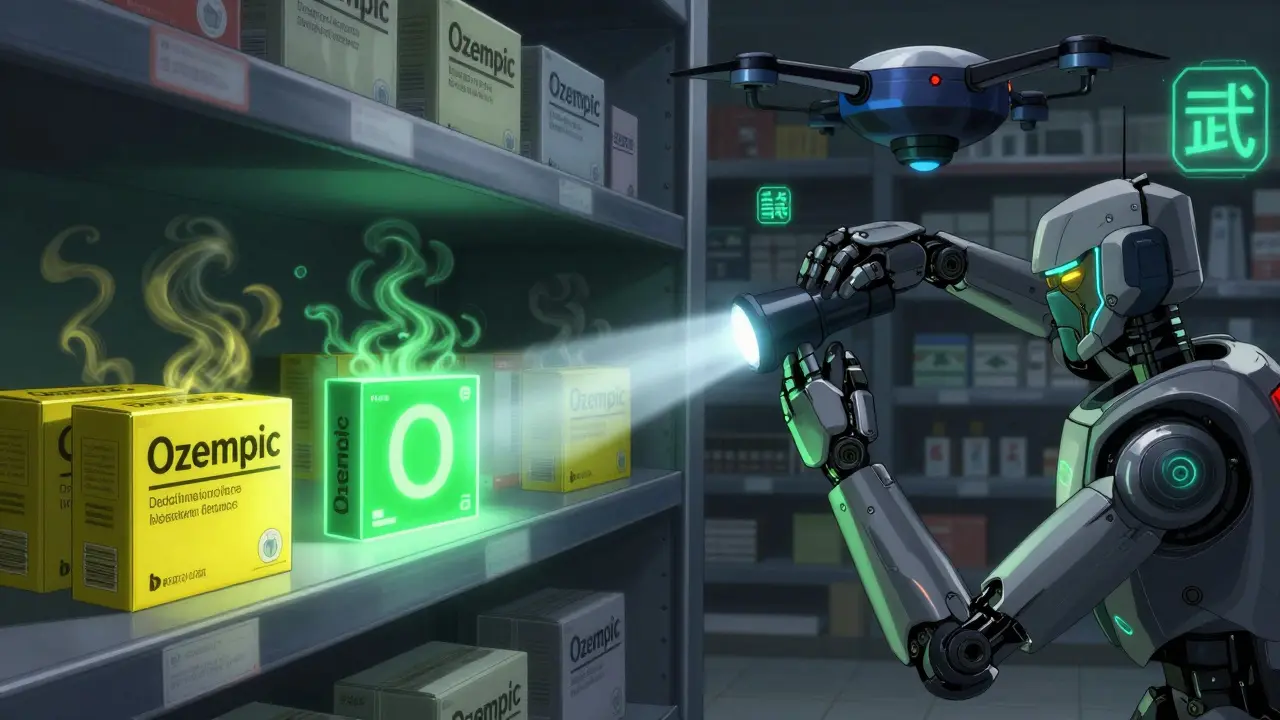
Look for UV-reactive ink. Shine a cheap UV flashlight (available online for under $10) on the package. Real packaging often has hidden symbols, logos, or text that only appear under UV light. Fake packaging either doesn’t glow at all-or glows in the wrong color. For example, genuine Ozempic packaging has a hidden "O" that glows green under UV. Fakes either skip it or make it glow yellow.
Feel the Packaging
Paper quality matters. Real pharmaceutical packaging uses specific paper weights. For example, genuine Adderall boxes use 114gsm paper. Counterfeit versions often use 120gsm or heavier. It feels thicker, stiffer, less flexible.Touch the seal. Real seals are smooth and slightly tacky. Fake seals can feel waxy, sticky, or brittle. If the seal peels off too easily-or doesn’t peel at all-it’s a red flag.
Check the box’s corners. Real boxes are folded with precision. Fake boxes often have crushed or uneven corners. That’s because counterfeiters use cheaper, faster packaging machines that don’t fold cleanly.
Use Technology: Raman Spectrometers and Apps
If you’re a pharmacist, hospital worker, or someone who handles meds regularly, you should know about handheld Raman spectrometers. These devices cost $15,000-$25,000, but they’re used in pharmacies and clinics across the U.S. and Europe. They shine a laser on the pill or packaging and analyze the chemical signature. In seconds, they show a green checkmark for real or a red X for fake.For consumers, there are emerging apps. Some companies are testing smartphone-based tools that use the camera and AI to compare packaging against a database. These aren’t perfect yet, but they’re improving. The FDA’s new Pharmaceutical Packaging Authentication Network (launched in late 2023) allows users to scan barcodes and instantly verify authenticity through a secure blockchain system.
Don’t rely on apps alone. But if you’re buying online and have doubts, try them. They’re better than nothing.
Know the High-Risk Drugs
Not all drugs are targeted equally. Fake medications are most common for:- Weight loss drugs (Ozempic, Wegovy, Saxenda)
- Erectile dysfunction pills (Viagra, Cialis)
- Painkillers (OxyContin, Fentanyl patches)
- Antibiotics and antivirals
- Insulin and diabetes meds
These are high-profit, high-demand drugs. Counterfeiters know people will pay anything for them. If you’re buying these online, you’re taking a huge risk.
Where Are Fakes Coming From?
Most fake drugs come from unregulated online pharmacies. Websites that look professional, with real logos and SSL certificates, are still fake. They buy bulk packaging from criminal labs in China, India, or Eastern Europe, then repackage it with fake labels.Even legitimate pharmacies can be compromised. Stolen shipments, employee theft, and supply chain leaks happen. That’s why you should never buy from a pharmacy that:
- Doesn’t require a prescription
- Offers drugs at 80% off retail
- Isn’t licensed in your country
- Has no physical address or phone number
Check your pharmacy’s license. In the U.S., use the National Association of Boards of Pharmacy’s Verified Internet Pharmacy Practice Sites (VIPPS) database. In South Africa, check with the South African Health Products Regulatory Authority (SAHPRA).
What to Do If You Find a Fake
Don’t throw it away. Don’t take it. Don’t tell your friend about it.Report it.
- In the U.S.: Call 1-800-FDA-1088 or file a report at medwatch.fda.gov
- In South Africa: Report to SAHPRA via their website or email [email protected]
- In the EU: Use the EudraVigilance system
Take a photo of the packaging. Keep the product. Authorities need it to trace the source. Your report could save someone’s life.
How to Stay Safe
- Only buy from licensed pharmacies-preferably ones you’ve used before.
- Never buy from social media ads or influencers selling "miracle pills."
- Ask your pharmacist to show you the original packaging before dispensing.
- Keep your meds in their original containers. Don’t transfer them to pill organizers unless you’re sure they’re real.
- Be suspicious of sudden price drops. If your insulin costs 30% less than last month, it’s a red flag.
- Join your local pharmacy’s patient safety program. Many now offer free verification checks.
The best defense? Be curious. If something feels off, it probably is. Trust your gut. Take a second look. Ask questions. You’re not paranoid-you’re protecting your health.
Can I tell if a pill is fake just by looking at it?
Sometimes, but not always. Many fake pills look identical to the real ones. The most reliable signs are in the packaging-spelling errors, wrong colors, poor print quality, or misaligned seals. Even then, sophisticated fakes can pass a quick glance. Always check multiple features and compare with a known authentic package.
Are fake pills dangerous even if they contain the right drug?
Yes. Even if the active ingredient is correct, fake pills often have incorrect dosages-too little to work, or too much and cause overdose. They may also contain toxic fillers like drywall dust, rat poison, or industrial chemicals. One study found counterfeit diabetes pills with no insulin at all-just sugar and chalk.
Can I trust online pharmacies that offer discounts?
No. Legitimate pharmacies don’t offer 80% discounts on brand-name drugs. If a website offers Ozempic for $20 a vial when it normally costs $1,000, it’s fake. The same goes for "free shipping" or "no prescription needed." These are red flags. Always verify the pharmacy’s license before buying.
What should I do if I already took a fake pill?
Stop taking the medication immediately. Contact your doctor or go to the nearest emergency room. Tell them you suspect a counterfeit drug. Bring the packaging with you. Even if you feel fine, some fake drugs cause delayed damage-like liver failure from toxic fillers. Don’t wait for symptoms.
Is it worth buying a Raman spectrometer to check my meds at home?
No. These devices cost $15,000-$25,000 and require training to use properly. They’re meant for pharmacies and labs, not consumers. For personal use, stick to visual inspection, UV lights, and verifying through official pharmacy channels. If you’re concerned, ask your pharmacist to check it for you.
How common are counterfeit medications in South Africa?
South Africa has a lower rate than many African countries, but counterfeit drugs are still a problem-especially for high-demand medications like HIV antiretrovirals, insulin, and painkillers. The WHO estimates around 7% of medicines in Southern Africa are falsified. Most come from illegal online sources or unlicensed street vendors. Always buy from registered pharmacies.
Next Steps: Protect Yourself
Start today. Pick one medication you take regularly. Open the box. Look at the packaging. Compare it to the manufacturer’s official image online. Check the seal. Scan the QR code. Feel the paper. If anything seems off, don’t take it. Call your pharmacist. Report it.Real medicine saves lives. Fake medicine ends them. You don’t need a lab to spot the difference. You just need to look closely-and care enough to act.


April Williams
January 26, 2026 AT 11:54People still buy meds off Instagram like it’s a flea market? 🤦♀️ I saw a woman take fake Ozempic last year-she ended up in the ER with kidney failure. If you’re not checking the seal, you’re not just careless-you’re suicidal. Stop being lazy and learn how to spot fakes before you kill yourself.
Kirstin Santiago
January 26, 2026 AT 15:22This is such an important guide. I work in a clinic and we’ve had patients bring in fake insulin vials that looked almost identical. The biggest red flag? The seal was too shiny, like plastic wrap glued on. Always compare with the manufacturer’s website-Pfizer and Novartis post high-res images for exactly this reason. And if you’re unsure, ask your pharmacist to verify it with you. No shame in double-checking.
Andrew Clausen
January 26, 2026 AT 18:11The article incorrectly states that Lipitor packaging used Pantone 286C blue until 2002. This is factually inaccurate. Lipitor’s primary color has been Pantone 286C since its 1996 launch and remains so today. Counterfeiters may use outdated references, but the original packaging has not changed. Precision matters when discussing forensic packaging details. Also, "Viatris" misspelled as "Viatris" is a tautology, not an error. Please correct this before further dissemination.
Anjula Jyala
January 26, 2026 AT 22:19UV microtext hologram spectral analysis is non-negotiable for high-risk pharma. If you dont validate via blockchain-verified QR with FDA’s PPAN you are playing russian roulette with your hepatocytes. No excuses. Just scan or die.
Kegan Powell
January 28, 2026 AT 09:56It’s wild how much we trust medicine without thinking about it like we do our food or our car 🤯 I used to just grab my pills and go but now I always check the seal and scan the code. It’s not paranoia-it’s self-respect. And if you’re buying from a site that says "no prescription needed"? That’s not a deal, that’s a death sentence. I’m glad someone wrote this. We need more of this awareness
Harry Henderson
January 28, 2026 AT 14:18STOP BUYING FROM ONLINE PHARMACIES. That’s it. No more excuses. If you’re saving $900 on insulin by buying it off some sketchy site, you’re not being smart-you’re being a corpse waiting to happen. I’ve seen the尸检 reports. Don’t be the next one.
suhail ahmed
January 30, 2026 AT 01:50Back home in Kerala, my uncle got fake Viagra from a "pharmacy" that looked like a temple gift shop. The pills were dust and chalk wrapped in glitter. He ended up in the hospital with a stroke. Now I carry a UV pen everywhere I travel. A $10 light saved his life. If you’re traveling, don’t just trust the pharmacy sign-ask for the batch number and call the manufacturer. It’s not hard. It’s just not taught.
Candice Hartley
January 30, 2026 AT 21:12I just checked my metformin. The seal was slightly bubbled. I called my pharmacy. They said to bring it in. They’re sending it to the lab. Thank you for this.