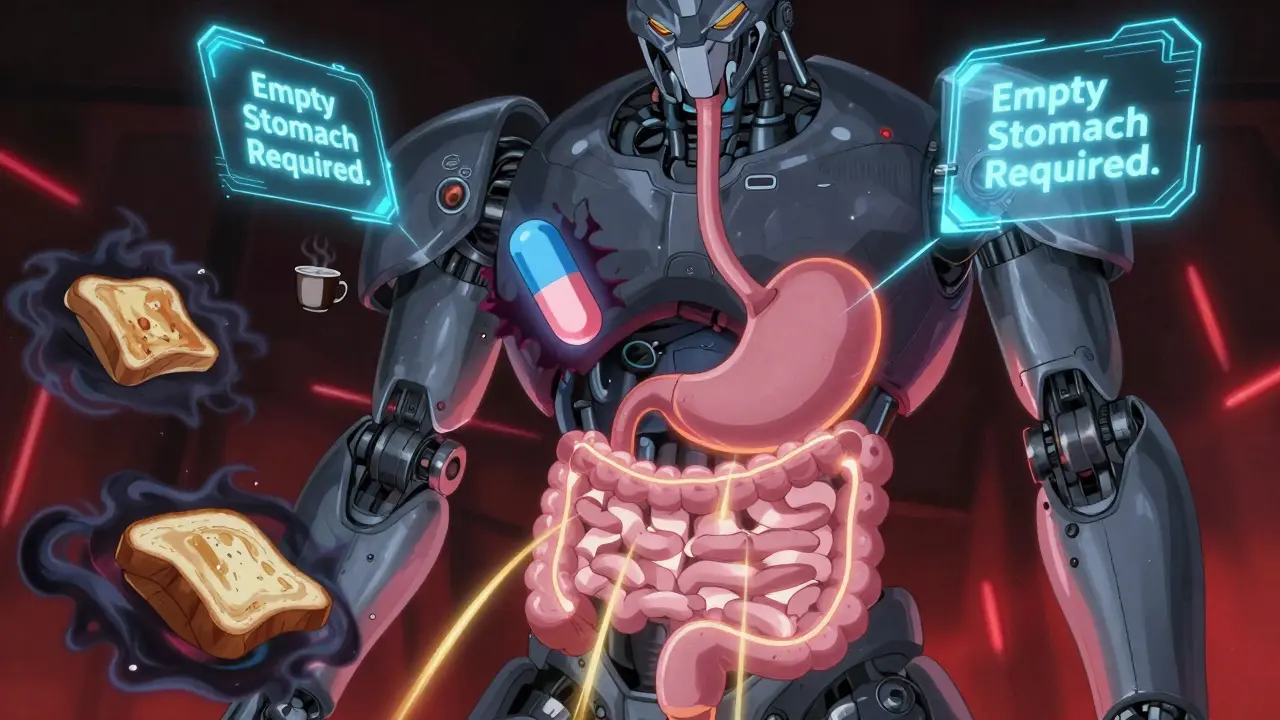
Have you ever taken a pill and wondered if it really mattered whether you did it with breakfast or on an empty stomach? You’re not alone. Millions of people take prescription meds every day, and most don’t realize that what they eat-or don’t eat-can make the difference between a drug working as it should, or not working at all. Some medications can even become harmful if taken the wrong way. The label on your bottle might say "take with food" or "take on an empty stomach," but few people know why. And that gap in understanding leads to mistakes, side effects, and wasted medicine.
Why Food Changes How Your Medicine Works
Your digestive system isn’t just a pipe for food. It’s a complex chemical factory. When you eat, your stomach starts pumping out acid, your gallbladder releases bile, and your gut slows down to digest. All of that changes how your body absorbs medicine. Some drugs need that acid to dissolve. Others get blocked by calcium in milk or fats in avocado. And some can’t handle the sudden flood of nutrients that come with a meal.
Take levothyroxine, the standard treatment for hypothyroidism. Studies show that eating even a small breakfast just 30 minutes after taking it can cut its absorption by up to 55%. That means your thyroid hormone levels stay low, your energy stays down, and your weight might not budge-even if you’re taking the right dose. On the flip side, saquinavir, an HIV medication, absorbs 40% better when taken with a high-fat meal. Skip the cheese toast, and you risk the drug not working well enough to suppress the virus.
This isn’t guesswork. The U.S. Food and Drug Administration now requires food-effect studies for nearly 80% of new drugs approved in 2023. That’s up from just 62% in 2018. These aren’t just lab tests-they’re real-world studies that track how blood levels of the drug change when taken with different meals. The results are clear: food isn’t just a comfort. It’s a key part of the treatment.
Medications That Must Be Taken With Food
Some drugs are designed to be taken with food-not because they taste better, but because they’re safer and more effective that way.
- NSAIDs like ibuprofen, naproxen, and aspirin: These can irritate your stomach lining, especially if taken on an empty stomach. Taking them with food reduces the risk of ulcers and bleeding. A 2021 study in the Journal of Antimicrobial Chemotherapy found that taking Augmentin (amoxicillin/clavulanate) with food lowered nausea by 20%. For older adults or those with sensitive stomachs, this isn’t optional-it’s protective.
- Antiretrovirals like ritonavir and zidovudine: These drugs often cause nausea and vomiting. A small, high-fat snack-like peanut butter on toast or a spoonful of full-fat yogurt-can cut nausea by more than half, according to patient reports from Reddit’s r/HIV community in 2024. One user shared that taking ritonavir with a banana and almond butter reduced their nausea from 45% to 18%.
- Antibiotics like nitrofurantoin and rifabutin: Food helps buffer the gut and keeps these drugs from causing diarrhea or cramping. The NHS England guidelines note that taking these with food can extend their effective window from under an hour to up to two hours after ingestion.
Even the type of food matters. A high-fat meal boosts absorption of certain drugs because fat helps dissolve them. That’s why some labels now say "take with a high-fat meal" instead of just "with food." A simple bowl of cereal won’t cut it-you need something like eggs, cheese, nuts, or avocado.
Medications That Must Be Taken on an Empty Stomach
Other drugs are like delicate instruments-they get ruined by food. Taking them with a meal isn’t just ineffective. It can be dangerous.
- Tetracycline and doxycycline: These antibiotics bind to calcium in dairy products, antacids, and even fortified orange juice. That binding blocks absorption by up to 50%. If you take doxycycline with yogurt, you might as well have taken a sugar pill.
- Levothyroxine: As mentioned earlier, food, coffee, and even water with minerals can interfere. The Mayo Clinic recommends taking it 60 minutes before breakfast, with only water. Many patients skip this rule-until their TSH levels stay stubbornly high despite taking the right dose.
- Didanosine: This HIV drug is destroyed by stomach acid. Food increases acid production, so it must be taken at least 30 minutes before eating. Missing this window can make the drug useless.
- Bisphosphonates like alendronate (Fosamax): These osteoporosis drugs need a full glass of water and at least 30 minutes of standing upright after taking them-with no food, coffee, or supplements for at least an hour. Otherwise, they can burn your esophagus.
The timing matters as much as the food itself. For empty-stomach meds, "1 hour before meals or 2 hours after" isn’t a suggestion-it’s the minimum. Many people think "I ate a snack an hour ago, so it’s fine." But even a handful of crackers can trigger enough digestive activity to interfere.

What About Grapefruit? And Other Surprising Interactions
Food isn’t just about meals. Some drinks and fruits can mess with your meds in ways you’d never expect.
Grapefruit juice is the most famous offender. It blocks an enzyme in your gut (CYP3A4) that normally breaks down certain drugs. That means more of the drug enters your bloodstream-sometimes dangerously more. This affects statins like simvastatin (risk of muscle damage), some blood pressure meds, and HIV drugs like saquinavir. One glass can have effects that last over 24 hours. Orange juice? Usually safe. But grapefruit? Never mix it with your pills unless your pharmacist says otherwise.
Other surprises: Calcium supplements can interfere with thyroid meds and antibiotics. Iron supplements don’t absorb well if taken with tea or coffee. Dairy can block fluoroquinolone antibiotics like ciprofloxacin. And even fiber-rich foods like oatmeal can slow absorption of some drugs, making them less effective.
Why People Get It Wrong-and How to Fix It
A 2023 GoodRx survey of 5,000 patients found that 42% admitted to taking their meds incorrectly regarding food. The highest errors? Among people taking five or more medications. When you’re juggling pills for blood pressure, diabetes, cholesterol, arthritis, and depression, remembering which one goes with toast and which one needs a 2-hour fast is overwhelming.
But there’s hope. A 2023 pilot study by Express Scripts introduced a color-coded labeling system: red for empty stomach, green for with food, yellow for with high-fat meal. Patients using these labels improved adherence by 31%. Even better? Explaining why matters. The American Pharmacists Association found that when pharmacists took 5 extra minutes to explain the science behind the instructions, patient compliance jumped 44%.
Simple tricks help: Set phone alarms labeled "Take Levothyroxine-Water Only" or "Take Ibuprofen-After Lunch." Keep a small notebook next to your pill organizer. Write down each med and whether it needs food, and what kind. Some patients use a single water bottle filled each morning-hydration helps with absorption and reminds them to take their pills.
What’s Changing in 2026
The rules are getting more precise. In April 2024, the FDA issued new draft guidance requiring drug labels to specify not just "with food," but the type of meal-like "take with a high-fat breakfast" or "avoid dairy for 2 hours."
Researchers at UCSF are testing machine learning models that predict how your gut microbiome affects drug absorption. In early trials, the model guessed food-drug interactions with 87% accuracy. Imagine a future where your app tells you, "Your gut bacteria break down this antibiotic faster when you eat kale. Try taking it with rice instead."
And the WHO now includes food-administration instructions in its Essential Medicines List-especially for HIV and TB drugs in low-income countries. This isn’t just a Western concern. It’s a global health priority.
What You Should Do Today
You don’t need to memorize every drug interaction. But you do need to take action.
- Look at every prescription you’re taking. Check the label. If it says "with food" or "on empty stomach," don’t ignore it.
- Ask your pharmacist: "Is there a specific food I should avoid or include with this?" Most don’t ask-but pharmacists are trained to answer this.
- Use color-coded reminders or phone alarms. Don’t rely on memory.
- Keep a food-medication log for a week. Note what you ate and when you took each pill. You might spot a pattern-like nausea after taking a pill with coffee.
- If you’re on five or more meds, ask for a medication review. Many pharmacies offer free consultations.
Medications are powerful. But they’re not magic. They need the right conditions to work. Food isn’t just fuel-it’s part of the formula. Getting it right doesn’t just help you feel better. It can save your life.
Can I take my pill with just a sip of water if it says "with food"?
No. A sip of water isn’t enough. "With food" means a full snack or meal-something with fat, protein, or fiber to trigger digestive changes. A glass of water alone won’t help absorption or protect your stomach. Even a small banana, a few crackers, or a spoonful of peanut butter counts. Don’t skip it.
What if I forget and take my medicine with food when it should be on an empty stomach?
Don’t panic. Don’t double the dose. Just wait until your next scheduled time and take it correctly then. For most meds, one mistake won’t cause harm-but repeated mistakes can. If it’s a critical drug like levothyroxine or an antibiotic, call your pharmacist. They can tell you if you need to adjust your next dose.
Why does my doctor say to take my pill in the morning, but the label says "with food"?
That’s because timing and food rules are two separate things. Your doctor wants it in the morning for consistency and to avoid sleep disruption (like with some blood pressure meds). But if it needs food, you still need to eat something. Take it with a light breakfast, not just coffee. For example: take levothyroxine 30 minutes before breakfast, then eat your toast after.
Can I take all my pills at once with one meal?
No. Some meds need empty stomachs, others need food, and some can’t be taken together at all. For example, iron and calcium supplements block each other’s absorption. Antibiotics like doxycycline can’t be taken with dairy. Spreading them out across meals-like taking one with breakfast, another with lunch, and one on an empty stomach at night-is often necessary. Ask your pharmacist to map out your schedule.
Are generic drugs affected by food the same way as brand-name ones?
Yes. Generic drugs must meet the same absorption standards as brand-name versions. The FDA requires them to have the same food-effect profile. So if your brand-name drug says "take with food," your generic does too. Don’t assume generics are less sensitive-they’re chemically identical in how they interact with food.
Does alcohol count as food when taking medicine?
No. Alcohol is not food. It can interfere with liver metabolism and increase side effects like dizziness or liver damage. Even if your medicine says "take with food," alcohol doesn’t count. In fact, many meds warn against alcohol entirely. Always treat alcohol as a separate risk, not a meal substitute.
Final Thought: Follow the Label, Not the Guess
There’s no universal rule. One pill needs food. Another needs fasting. One can’t touch dairy. Another needs fat. It’s confusing-and that’s by design. Drug makers test these interactions for a reason: because getting it wrong has real consequences.
Don’t rely on old habits. Don’t ask your neighbor. Don’t assume it’s "probably fine." The label is your best tool. If you’re unsure, call your pharmacy. Take the extra minute. It’s not just about taking your medicine. It’s about making sure it works.


Brian Anaz
January 6, 2026 AT 07:46This whole post is just corporate fluff dressed up as science. You think people care about CYP3A4 enzymes? Nah. They just want to not throw up after taking their pills. The FDA doesn't give a damn about your 'food-effect studies'-they just want pharma companies to stop getting sued. I take my levothyroxine with coffee and a donut. My TSH is fine. If your doctor can't fix you, blame the system, not your breakfast.
Saylor Frye
January 7, 2026 AT 00:14Actually, the pharmacokinetics here are fascinating-but you're missing the real issue: the medical-industrial complex deliberately obscures these details to keep patients dependent on professional guidance. The fact that 42% of people mess this up isn't ignorance-it's design. Why would Big Pharma want you to self-manage absorption profiles? They'd rather you pay for monthly reviews, apps, and color-coded pill boxes. The real innovation isn't the labeling-it's the profit model behind it.
Kiran Plaha
January 7, 2026 AT 04:47I live in India and we don't always have access to fancy labels or pharmacies. My dad takes his blood pressure pill with chapati and tea-no one told him it should be empty stomach. He's been fine for 8 years. Maybe the rules are too rigid for real life? Not everyone has time to wait 60 minutes before breakfast. Is it better to take it wrong or not at all?
Ryan Barr
January 8, 2026 AT 13:14Food matters. Grapefruit kills. Don't be stupid.
Dana Termini
January 9, 2026 AT 13:55I used to take my antibiotics with yogurt because I thought probiotics would help. Turns out, they canceled out the whole dose. I didn't realize until my UTI came back worse. Now I keep a little note taped to my medicine cabinet: 'No dairy with cipro.' Simple. Clear. Saved my health. Thanks for the reminder that details matter-even the boring ones.
Wesley Pereira
January 10, 2026 AT 18:53Oh wow, so you're telling me my 3am doxycycline with a handful of trail mix was a bad idea? Who knew calcium in almonds could outsmart a 25-year-old who thinks 'eating' means chewing something that isn't a protein bar? My pharmacist laughed so hard she cried. Now I take it with water, stand like a statue for 30 mins, and pretend I'm in a spy movie. Also, grapefruit juice is now banned from my kitchen. Even my cat knows not to touch it. #PharmacistGang
Isaac Jules
January 12, 2026 AT 17:29LOL at all these 'just ask your pharmacist' takes. Most pharmacists are overworked and read from a script. And don't get me started on 'color-coded labels'-those are just marketing gimmicks to sell you $12 pill organizers. Real talk: if you're on 5+ meds, you're already a walking clinical trial. Your body's a mess. The system is broken. Stop pretending a sticky note fixes systemic neglect. And yes, I took my statin with grapefruit yesterday. I'm fine. Probably.
Stuart Shield
January 14, 2026 AT 13:51I used to be the guy who took everything with coffee and a laugh. Then my mate got hospitalized after mixing his heart med with grapefruit juice-he thought it was 'just orange juice with a twist.' He’s okay now, but it scared the hell out of me. Since then, I’ve started writing each med’s rules on a little card in my wallet. Not because I’m smart, but because I’m too lazy to remember. Sometimes, the simplest thing-like writing it down-keeps you alive. And yeah, I still call my pharmacist. They’re the unsung heroes in white coats.