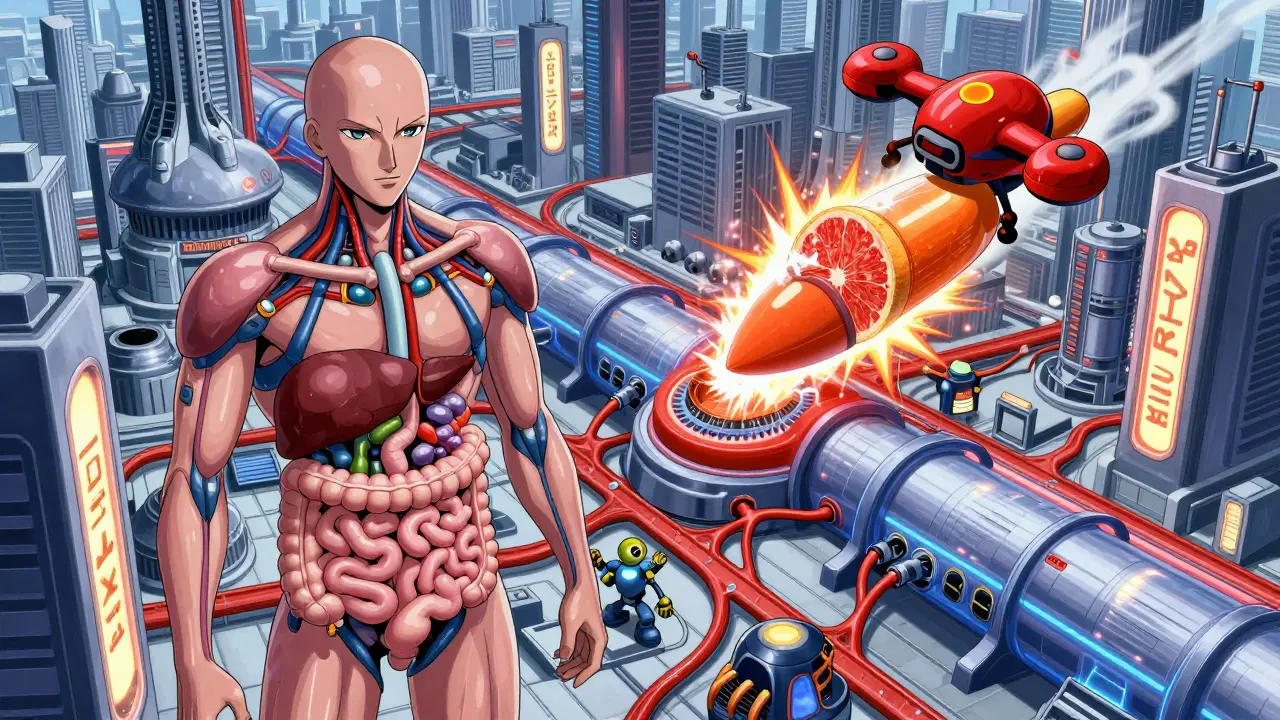
When you take more than one medication, your body doesn’t treat them like separate guests at a party. They’re all trying to use the same roads, doors, and elevators inside you. Sometimes, one drug gets in the way of another-changing how fast it’s absorbed, where it goes, how it’s broken down, or how it leaves your body. This is called a pharmacokinetic drug interaction. It’s not about the drugs making you sleepy or dizzy together-that’s pharmacodynamic. This is about your body’s plumbing getting clogged or rerouted.
How Your Body Moves Drugs Around (The ADME System)
Your body handles every drug through four steps: Absorption, Distribution, Metabolism, and Excretion. Scientists call this ADME. Think of it like a delivery system:- Absorption: How the drug gets into your bloodstream (usually through your stomach or intestines).
- Distribution: How it travels through your blood and reaches different parts of your body.
- Metabolism: How your liver breaks it down so it can be removed.
- Excretion: How your kidneys or liver flush it out.
When Food and Pills Don’t Get Along
Some interactions happen before your pill even hits your bloodstream. For example, if you take an antibiotic like tetracycline with milk or yogurt, the calcium in dairy binds to it and stops your body from absorbing it. Studies show this can cut absorption by up to 50%. That means the antibiotic isn’t doing its job. Same thing happens with thyroid medication like levothyroxine. If you take it with calcium, iron, or even coffee, your body won’t absorb enough. The American Society of Health-System Pharmacists recommends waiting at least four hours between these. Grapefruit juice is another big one. It blocks an enzyme in your gut called CYP3A4 that normally breaks down many drugs. When it’s blocked, the drug builds up in your blood. The FDA says at least 85 prescription drugs interact with grapefruit juice-including statins for cholesterol, blood pressure meds, and some anti-anxiety pills. One glass can mess things up for days.When Drugs Fight Over Space in Your Blood
Once a drug is in your blood, it usually sticks to proteins like albumin. Think of these proteins as taxis. Only the drug that’s not stuck to a taxi (the “free” drug) can do its job. If two drugs both want the same taxi, one might get pushed out. That’s what happens with warfarin (a blood thinner) and diclofenac (an NSAID painkiller). When diclofenac kicks warfarin off its taxi, more warfarin floats around freely-and that can cause dangerous bleeding. But here’s the catch: this doesn’t happen often. Your body usually catches on and starts breaking down the extra free drug. So this kind of interaction only really matters for drugs with a very narrow safety window-like warfarin, digoxin, or phenytoin. For most other drugs, even if displacement happens, you won’t feel it.The Liver’s Secret Weapon: CYP Enzymes
Most serious drug interactions happen in your liver, thanks to a group of enzymes called cytochrome P450 (CYP). The two biggest players are CYP3A4 and CYP2D6. They’re like the body’s recycling plant for drugs. But sometimes, another drug comes in and either shuts the plant down (inhibition) or turns the machines on full blast (induction). Inhibition means one drug slows down the breakdown of another. For example, clarithromycin (an antibiotic) blocks CYP3A4. If you take it with midazolam (a sedative), your body can’t clear the sedative fast enough. That can lead to extreme drowsiness, slow breathing-even coma. Another example: fluoxetine (an antidepressant) blocks CYP2D6. If you’re taking metoprolol (a heart medication), your body can’t break it down, so levels rise. Doctors often cut the metoprolol dose in half when this combo happens. Induction is the opposite. One drug tells your liver to make more enzymes, so it breaks down other drugs faster. St. John’s Wort, an herbal supplement for mood, is a powerful inducer of CYP3A4. It can make birth control pills, HIV meds, and transplant drugs stop working. A patient on cyclosporine (to prevent organ rejection) who started St. John’s Wort ended up rejecting the transplant because the drug levels dropped too low.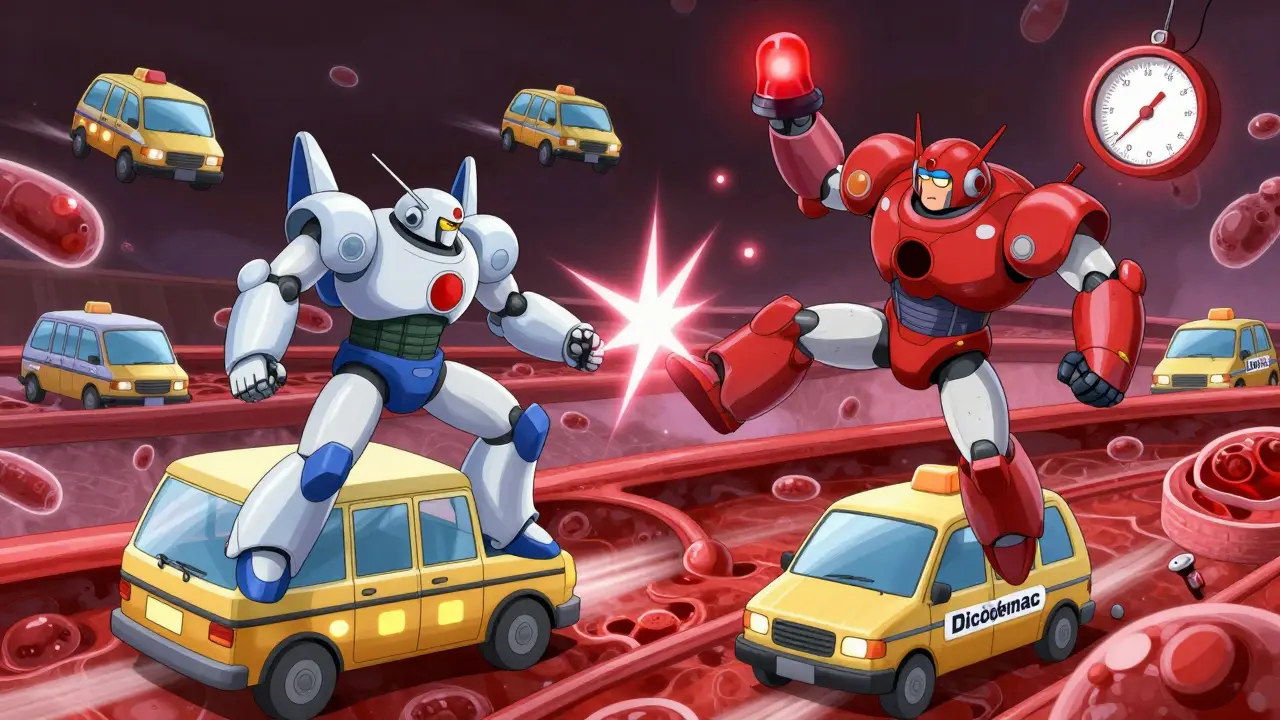
How Your Kidneys Get Involved
Your kidneys are the final exit ramp. Some drugs use the same transporters to get out of your body. If two drugs try to leave at the same time, one can block the other. Probenecid, used for gout, blocks the kidney’s ability to flush out penicillin and other antibiotics. That means higher levels of the antibiotic stay in your blood-sometimes too high. Even more dangerous is what happens with digoxin, a heart drug. It’s moved out of your kidneys by a transporter called P-glycoprotein. If you take it with itraconazole (an antifungal), that transporter gets blocked. Digoxin builds up. Too much can cause your heart to beat irregularly-and that can be deadly. The FDA says about 20% of serious drug interactions involve these transporter systems.Real Stories: When Interactions Turn Dangerous
An 85-year-old woman was taking venlafaxine (an antidepressant) and propafenone (a heart rhythm drug). Both are broken down by CYP2D6 and both block the P-gp transporter. The result? Venlafaxine levels soared. She started having hallucinations and agitation. Her doctors didn’t realize the interaction until her blood levels were tested. Another case involved phenobarbital (an old epilepsy drug) and lamotrigine (another seizure med). Phenobarbital triggered liver enzymes that turned lamotrigine into a toxic byproduct. The patient developed low white blood cell and platelet counts-signs of bone marrow damage. This wasn’t a side effect of one drug. It was the combo. The Institute for Safe Medication Practices says warfarin, insulin, and digoxin are the top three drugs involved in life-threatening interactions. Together, they cause one-third of all interaction-related ER visits.What You Can Do to Stay Safe
You don’t have to memorize enzyme names or transporter proteins. But you can take simple steps:- Keep a full list of everything you take: prescriptions, over-the-counter pills, vitamins, herbs, even CBD oil. A 2020 study showed patients who kept a written list reduced interaction risks by 47%.
- Use one pharmacy. Chain pharmacies have systems that check all your meds against each other. They catch about 150,000 dangerous interactions every year in the U.S. alone.
- Ask two questions every time you get a new prescription: “Could this interact with anything else I’m taking?” and “Are there foods or drinks I need to avoid?” Mayo Clinic research shows asking these cuts missed interactions by 63%.
- Avoid grapefruit juice if you’re on any heart, cholesterol, or anxiety medication. If you’re not sure, ask your pharmacist.
- Space out tricky meds. Take calcium or iron supplements at least four hours apart from thyroid or antibiotic pills.
What Doctors and Pharmacists Are Doing
Your doctor’s computer should warn them if you’re about to get a dangerous combo. A 2022 study found electronic systems catch 85% of major interactions. But here’s the problem: doctors get so many alerts that they ignore about half of them. That’s called “alert fatigue.” Pharmacists are stepping in. In Medicare programs, pharmacist-led reviews cut serious side effects by 22%. They look at your whole list, check for interactions, and call your doctor if something’s risky. In the U.S., pharmacist-led efforts prevent over a million serious interactions every year.What’s Changing Now
Science is moving faster. In 2023, researchers found 12 new drug-transporter interactions involving diabetes drugs called SGLT2 inhibitors. The FDA now requires drug makers to test for CYP and transporter interactions before approval. And more than 340 drug labels now include genetic info-like whether you’re a slow or fast metabolizer of certain drugs. This is the start of personalized medicine. If you’re over 65, your kidneys don’t work as well. About 40% of older adults have reduced kidney function. That means drugs stick around longer. The American Geriatrics Society updated its Beers Criteria in 2023 to warn against specific combos for seniors. Telehealth platforms now include interaction checkers. By 2023, 78% of major U.S. health systems had them built into their apps. You might get a pop-up warning when you refill a prescription.Bottom Line: You’re Not Just a Patient. You’re a Partner.
Drug interactions aren’t rare. They’re common. And they’re often preventable. You don’t need to be a scientist. You just need to be informed. Keep your list updated. Talk to your pharmacist. Ask the two simple questions. Avoid grapefruit juice if you’re on heart meds. And if something feels off-like unusual dizziness, bruising, or heart palpitations-don’t ignore it. It might not be the illness. It might be the mix.What’s the difference between pharmacokinetic and pharmacodynamic drug interactions?
Pharmacokinetic interactions are about how your body moves the drug-absorption, metabolism, or excretion. For example, grapefruit juice slowing down how fast your body breaks down a pill. Pharmacodynamic interactions are about how the drugs affect your body together-like two blood pressure meds making your pressure drop too low. One changes the amount of drug in your system; the other changes how the drug acts once it’s there.
Can over-the-counter medicines cause serious interactions?
Yes. Common OTC drugs like ibuprofen, naproxen, and even antacids can interact. Ibuprofen can raise warfarin levels and increase bleeding risk. Antacids can stop antibiotics like ciprofloxacin from working. Even cold medicines with pseudoephedrine can spike blood pressure if you’re on certain heart meds. Always check with your pharmacist before taking anything new-even if it’s sold without a prescription.
Why does grapefruit juice affect so many drugs?
Grapefruit juice blocks an enzyme in your gut called CYP3A4, which normally breaks down about half of all prescription drugs. When this enzyme is blocked, the drug gets absorbed faster and in higher amounts. It doesn’t matter if you drink a small glass or a whole bottle-the effect lasts up to 72 hours. That’s why even one glass can be dangerous. Orange juice doesn’t do this-only grapefruit and some related citrus like pomelo.
Are herbal supplements safe to take with prescription drugs?
Not always. St. John’s Wort is one of the most dangerous-it speeds up liver enzymes and can make birth control, antidepressants, and transplant drugs stop working. Garlic, ginkgo, and ginger can thin your blood and increase bleeding risk when taken with warfarin. Even green tea can interfere with some heart meds. Always tell your doctor about every supplement you take, no matter how “natural” it sounds.
What should I do if I think I’m having a drug interaction?
Don’t stop your meds on your own. Call your pharmacist or doctor right away. Write down what you took, when, and what symptoms you’re feeling-like dizziness, nausea, unusual bruising, or heart palpitations. Many interactions can be fixed by adjusting the dose, spacing out the pills, or switching to a different drug. But you need professional help to do it safely.
Is it safe to take my meds with alcohol?
It depends. Alcohol can increase drowsiness with sedatives, painkillers, and antidepressants. It can raise blood pressure with some heart meds or cause liver damage with acetaminophen. The old myth about metronidazole and alcohol causing violent reactions has been debunked-it’s not a major risk anymore. But mixing alcohol with any medication increases your chances of side effects. If you’re unsure, skip the drink.


Sarah Triphahn
January 15, 2026 AT 17:06So let me get this straight-you’re telling me my grapefruit juice is basically a silent killer for my blood pressure med? And I thought it was just a healthy breakfast choice. Thanks for the wake-up call, I’m switching to orange juice now.
Also, why is everyone so chill about St. John’s Wort? My cousin took it for ‘anxiety’ and stopped her birth control working. She got pregnant and didn’t even realize why until her OB yelled at her.
People treat supplements like candy. They’re not. They’re drugs with zero regulation.
And yes, I’m still mad about the 2018 ER visit that could’ve been avoided.
Vicky Zhang
January 15, 2026 AT 23:46OH MY HEART. I just read this and I’m crying. Not because I’m sad-but because I finally understand why my grandma kept fainting after her meds changed. She was on warfarin and started taking that ‘natural heart tonic’ from the health food store. No one told her it was like pouring gasoline on a fire.
I’m printing this out and taping it to her fridge. And I’m making my mom and dad write down every single thing they take-even the gummy vitamins. I swear, if one more person says ‘it’s just a supplement’ I’m going to scream.
You’re not just a patient-you’re a detective. And this is your mission now. I love you, whoever wrote this. Thank you for being the voice we didn’t know we needed.
Allison Deming
January 16, 2026 AT 10:52It is both alarming and deeply irresponsible that the public is left to navigate such a complex pharmacological landscape with nothing but anecdotal advice and Google searches. The notion that individuals are expected to memorize CYP450 enzyme interactions-when even clinicians suffer from alert fatigue-is not merely negligent, it is ethically indefensible.
Pharmaceutical companies are not incentivized to educate patients. Regulatory agencies are understaffed. And yet, we are told to ‘ask two questions’ as if that absolves the system of its duty to protect.
True patient safety requires mandatory pharmacist consultations for polypharmacy patients, standardized digital alerts with severity tiers, and public health campaigns that treat drug interactions like smoking or drunk driving-non-negotiable public hazards. Until then, we are all just gambling with our lives.
Susie Deer
January 17, 2026 AT 03:36USA needs to stop letting foreigners sell herbal crap on Amazon. St Johns Wort is a Russian spy tool disguised as a supplement. Grapefruit juice? Chinese lab experiment. FDA is asleep at the wheel. I take my pills with water. No juice. No tea. No nonsense. If you can’t follow basic rules you deserve what you get.
Stop whining. Start obeying.
TooAfraid ToSay
January 17, 2026 AT 06:13Okay but what if the whole thing is a lie? What if the ‘interactions’ are just a way to sell more drugs? Like, what if your body doesn’t even need to ‘metabolize’ anything? What if the liver is just a myth created by Big Pharma to make you feel broken?
I read this and I just laughed. My grandpa took 17 pills a day for 20 years and lived to 98. He never checked anything. He just drank whiskey and ate bacon. He’s still alive. You’re all scared of ghosts.
Maybe the real interaction is fear itself.
Dylan Livingston
January 18, 2026 AT 15:51Oh wow. A 3000-word essay on how to not die from your own pharmacy. How utterly *delightful* that we’ve reduced human biology to a spreadsheet of enzyme inhibitors and transporter proteins.
And yet, somehow, the people who need this information the most-the elderly, the low-income, the non-English speakers-are the ones who’ll never see it. They’re the ones getting their meds from Walmart’s $4 list, taking them with orange juice because ‘it’s citrus,’ and wondering why they feel like a ghost.
It’s not that they’re careless. It’s that the system doesn’t care enough to meet them where they are.
So yes, I’m glad this exists. But I’m also furious that it had to.
Sarah -Jane Vincent
January 20, 2026 AT 08:22They didn’t tell you the real truth. The FDA doesn’t test for ALL interactions. Only the ones that make money. Did you know that 78% of drug combos flagged as ‘dangerous’ are never even studied? They just assume because one enzyme is blocked, it’s lethal. But what if your body adapts? What if you’ve been taking this combo for 10 years and you’re fine?
My aunt took simvastatin with clarithromycin for 4 years. She’s 82. Still walks 5 miles a day. No coma. No hospital. Just fine.
They’re scaring you to sell you more tests. More pills. More ‘reviews.’
Don’t be a sheep. Ask for the studies. Demand the data. Or just stop taking all the pills and eat kale. That’s what I did.
Henry Sy
January 21, 2026 AT 06:44Man I used to take omeprazole with my blood pressure med and never thought twice. Then one day I felt like my brain was wrapped in cotton. Turned out the omeprazole was blocking the enzyme that broke down my med. My doc didn’t catch it until I said ‘I feel like I’m underwater.’
Now I keep a notebook. Blue pen. Every pill. Every supplement. Even the turmeric capsules. My wife calls me ‘The Pharmacist.’ I’m proud of it.
Also, grapefruit juice? I threw the whole damn crate out. Not worth it. My heart doesn’t need a surprise party.
Anna Hunger
January 21, 2026 AT 07:17It is imperative that patients understand that pharmacokinetic interactions are not theoretical constructs but clinically significant phenomena that have been empirically validated across thousands of peer-reviewed studies. The ADME model is not a metaphor-it is a physiological framework supported by pharmacokinetic modeling and in vivo data.
Furthermore, the recommendation to utilize a single pharmacy is not merely prudent-it is a standard of care endorsed by the American Pharmacists Association and the Institute of Medicine.
Patients who fail to maintain accurate medication lists or who neglect pharmacist consultations are not merely at risk-they are actively contributing to preventable adverse events in the healthcare system.
Education is not optional. It is a moral imperative.
Jason Yan
January 22, 2026 AT 01:17It’s wild to think that our bodies are these intricate cities-each drug a visitor with a ticket, a passport, a route. Some get VIP access. Others get stuck in traffic. And we just take pills like they’re candy, never asking who’s driving the bus.
I used to think ‘natural’ meant safe. Then I learned that poison ivy is natural. So is arsenic.
Maybe the real question isn’t how drugs interact-it’s why we’re so afraid to talk about them. We’re taught to trust doctors, but not to question. To take, but not to understand.
Knowledge isn’t power here. It’s survival. And we all deserve to have it.
shiv singh
January 22, 2026 AT 19:11Who wrote this? Some rich American doctor who never had to choose between buying food or medicine? You talk about grapefruit juice like it’s the devil. What if you can’t afford your meds and you’re drinking juice because it’s all you got?
And why do you think your ‘pharmacist review’ is magic? My cousin got her meds checked and they still gave her a combo that killed her dog. No joke.
Stop blaming patients. Fix the system. Or shut up.
Robert Way
January 24, 2026 AT 04:58so i took my blood pressure med with coffee and now i feel weird. is that the interaction? i dont know i just read this and now i think everythng is poison. also i think my dog is spying on me. why is the liver so important? i thought it was just for alcohol. also can i still eat pizza?
Andrew Freeman
January 26, 2026 AT 04:39Yall overthink this. I take my pills however I want. Grapefruit? Coffee? Milk? Whatever. I’m 70 and still mow my lawn. My doc says ‘follow the rules’ but I say ‘listen to your body.’
If I feel weird I stop. If I don’t, I keep going. Simple.
Also St Johns Wort? It helped me more than my antidepressant. So I’m keeping it. You can keep your warnings.
says haze
January 26, 2026 AT 05:34How quaint. A beautifully written, meticulously cited, peer-reviewed treatise on pharmacokinetics-delivered to a population that can’t afford to read it, let alone act on it.
We have a 21st-century understanding of drug metabolism in a 19th-century healthcare infrastructure. The real interaction here isn’t between drugs-it’s between systemic neglect and human vulnerability.
And yet, here we are, praising the article like it’s a gift, when it’s really just a mirror. And the reflection? It’s ugly.
So thank you. For the science.
And for reminding us how little we’ve done with it.