
When you take a pill for high blood pressure, diabetes, or even a vaccine for your child, there’s a good chance it came from India. The country doesn’t just make medicines - it supplies the world. With over 60,000 generic drugs produced annually and exports reaching 150 countries, India is the backbone of affordable healthcare for billions. This isn’t luck. It’s the result of deliberate policy, massive infrastructure, and decades of focused execution.
How India Became the Pharmacy of the World
In the 1970s, India changed the rules. It scrapped product patents for drugs, allowing local companies to copy patented medicines and sell them at a fraction of the cost. This wasn’t piracy - it was a legal, strategic move under the World Trade Organization’s rules at the time. Suddenly, a life-saving HIV drug that cost $10,000 a year in the U.S. dropped to $100 in India. That shift didn’t just help Indians - it changed global health.
By 2024, India was producing over 20% of all pharmaceuticals shipped worldwide by volume. It supplies 40% of the U.S.’s generic drugs, 33% of the UK’s, and nearly half of all medicines used in Sub-Saharan Africa. The World Health Organization calls it the largest vaccine manufacturer on Earth, responsible for over 60% of global vaccine output. That’s not a claim - it’s a fact backed by government data and international agencies.
The Scale of India’s Pharma Machine
India doesn’t have one big factory. It has more than 10,000 manufacturing units and over 3,000 pharmaceutical companies. Among them, 650 are approved by the U.S. Food and Drug Administration (FDA) - more than any country outside the U.S. There are also over 2,000 facilities certified under WHO-GMP standards, which lets them export to Europe, Canada, Australia, and dozens of developing nations.
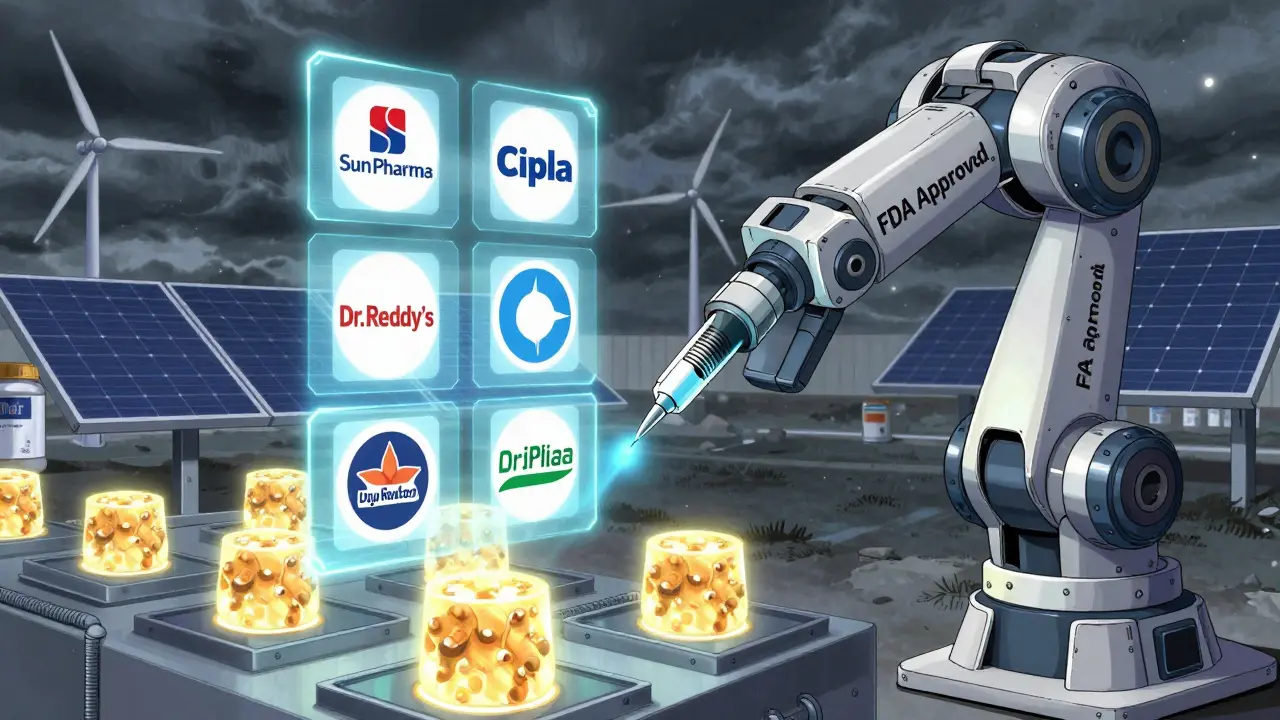
These plants don’t just make simple tablets. They produce complex drugs: extended-release capsules, injectable biologics, transdermal patches, and sterile solutions used in hospitals. Companies like Sun Pharma, Cipla, and Dr. Reddy’s invest 6-8% of their revenue into R&D - higher than many Western generics firms. In 2024, biosimilars (copycat versions of expensive biologic drugs) made up 8% of India’s export value, up from just 3% in 2020.
India produces over 500 active pharmaceutical ingredients (APIs) - the core chemical components of drugs. But here’s the catch: 70% of those APIs still come from China. That’s a vulnerability. The Indian government is spending $400 million through its Production Linked Incentive (PLI) scheme to fix this. The goal? Self-sufficiency in 53% of APIs by 2026.
Why India’s Drugs Are So Cheap - And Still Safe
Indian generics cost 30% to 80% less than branded drugs. Why? Lower labor costs, economies of scale, and decades of experience. But cheap doesn’t mean low quality. FDA inspection compliance rates for Indian facilities have jumped from 60% in 2015 to 85-90% today. That’s on par with global averages.
Take the U.S. market. Nine out of every ten prescriptions filled there are for generics. Of those, about 40% come from India. A 2024 survey on PharmacyChecker.com found 87% of American users were satisfied with Indian generics. The main reason? Price. The secondary reason? Effectiveness.
Same story in Africa. Doctors Without Borders reported that Indian-sourced antimalarials cut treatment costs by 65% while maintaining 95% efficacy. In the UK’s National Health Service, Indian generics make up a third of all prescriptions. Patient satisfaction scores average 4.2 out of 5. Complaints? Mostly about taste differences or packaging - not safety.
Where the System Still Has Gaps
It’s not perfect. In 2023, the Bureau of Investigative Journalism found isolated cases of dangerous drugs linked to Indian manufacturers. But these were rare - less than 0.1% of total exports. Most failures come from small, unregulated factories that shouldn’t be exporting at all. The real issue? Regulatory consistency.
Some manufacturers still struggle with documentation. In 2023, 22% of FDA Form 483 observations (which flag quality issues) were due to translation errors in regulatory filings. Another common problem? Inconsistent dissolution rates - how fast a drug breaks down in the body. One Reddit thread from May 2024 detailed problems with a batch of Indian-made levothyroxine, a thyroid medication. While only a few cases were reported, they highlight the need for tighter batch control.
Shipping delays and packaging inconsistencies are also frequent complaints. Trustpilot reviews for Indian generic exporters average 3.8 out of 5. Twenty-three percent of negative reviews mention delays. Seventeen percent complain about mismatched labels or broken blister packs. These aren’t safety issues - they’re logistics problems. And they’re being addressed.
India vs. The Rest of the World
China makes cheaper APIs, but only has 153 FDA-approved plants. Europe has strong brands like Teva and Sandoz, but they charge more. South Korea is catching up in biosimilars. But no one else matches India’s combination of scale, compliance, and price.
Here’s the twist: India supplies 20% of global volume - but only 10% of global value. Why? Because it sells mostly low-cost, off-patent drugs. A $100 heart medication from India might cost $500 from a U.S. manufacturer. But the U.S. company isn’t just selling the pill - it’s selling brand trust, marketing, and patent protection. India sells the pill - nothing more.
That’s changing. With the launch of Pharma Vision 2047, India aims to hit $190 billion in exports by 2047. That’s not just more pills - it’s more high-value biosimilars, complex injectables, and even novel drug delivery systems. Sun Pharma, Biocon, and Cipla are already investing billions in biologics. The goal isn’t just to be the world’s pharmacy. It’s to become its innovation engine.
What’s Next for Indian Generic Manufacturers
The road ahead has clear milestones:
- API self-sufficiency: Reduce reliance on China from 70% to under 30% by 2030.
- Regulatory compliance: Raise FDA inspection pass rates from 85% to 95%+.
- Export value: Shift from volume to value - increase biosimilars from 8% to 25% of export revenue by 2035.
- Domestic market growth: Expand from $28 billion in 2024 to over $50 billion by 2033.
The Indian government’s revised Schedule M guidelines, implemented in early 2024, are a major step. They tighten cleaning protocols, require real-time monitoring of production, and mandate electronic records. Companies that can’t meet these standards won’t be allowed to export.
Meanwhile, the U.S. and EU are tightening import rules. But India’s advantage remains: it can produce high-quality drugs cheaper than anyone else. And with over 10,000 factories already built, the capacity is there.
By 2030, India will likely supply more than 25% of global generic drug volume. The real question isn’t whether it can - but whether it can make the leap from being the world’s pharmacy to becoming its most trusted pharmaceutical partner.
Are Indian generic drugs safe to use?
Yes, the vast majority are. Over 650 Indian manufacturing plants are FDA-approved, and compliance rates now match global averages at 85-90%. Indian generics make up 40% of U.S. prescriptions and 33% of UK NHS prescriptions, with high patient satisfaction scores. While isolated cases of quality issues have been reported, they represent less than 0.1% of total exports. Regulatory standards have improved dramatically since 2015.
Why are Indian generic drugs so much cheaper?
They’re cheaper because India eliminated product patents in the 1970s, allowing local companies to produce copies of branded drugs without paying licensing fees. Combined with lower labor costs, massive scale, and decades of manufacturing experience, this allows Indian firms to produce drugs at 30-80% lower cost than Western manufacturers. They don’t spend money on advertising or patent protection - just on making the medicine.
Does India make all of its own drug ingredients?
No. India still imports about 70% of its active pharmaceutical ingredients (APIs) from China. This is a major vulnerability, especially after supply chain disruptions during COVID-19. To fix this, the Indian government launched a $400 million PLI scheme to boost domestic API production. The goal is to reach 53% self-sufficiency by 2026 and under 30% reliance on China by 2030.
Do Indian generics work as well as branded drugs?
In most cases, yes. Regulatory agencies like the FDA and EMA require Indian generics to prove they are bioequivalent to the branded version - meaning they deliver the same amount of active ingredient into the bloodstream at the same rate. Studies show 95%+ efficacy for Indian-made antimalarials, antibiotics, and antiretrovirals in real-world use. A few patients report taste differences or minor variations in absorption, but these rarely affect clinical outcomes.
What’s the future of Indian generic manufacturers?
The future is moving beyond simple generics. Companies are investing billions in biosimilars, complex injectables, and novel drug delivery systems. India aims to increase its export value from $13 billion to $190 billion by 2047. The focus is shifting from selling millions of cheap pills to exporting high-value, technologically advanced medicines. If India succeeds, it won’t just be the pharmacy of the world - it’ll be the engine of its next-generation healthcare.



Korn Deno
March 24, 2026 AT 16:03Rama Rish
March 25, 2026 AT 06:00James Moreau
March 27, 2026 AT 01:57Donna Fogelsong
March 28, 2026 AT 17:42Sean Bechtelheimer
March 30, 2026 AT 08:41Seth Eugenne
April 1, 2026 AT 02:17Caroline Dennis
April 1, 2026 AT 19:16Kenneth Jones
April 2, 2026 AT 18:08Mihir Patel
April 4, 2026 AT 03:21