When you fill a prescription for a generic drug, you’re not just getting a cheaper version of a brand-name medicine-you’re benefiting from a hidden battle between manufacturers, regulators, and buyers. That price drop? It didn’t happen by accident. It’s the result of buyers-like Medicare, insurance companies, and government health programs-using the very existence of generic alternatives to force lower prices across the board. This isn’t just about saving a few dollars at the pharmacy. It’s a powerful economic lever that’s reshaping how drugs are priced in the U.S. and around the world.
Why Generic Drugs Are the Secret Weapon in Price Negotiations
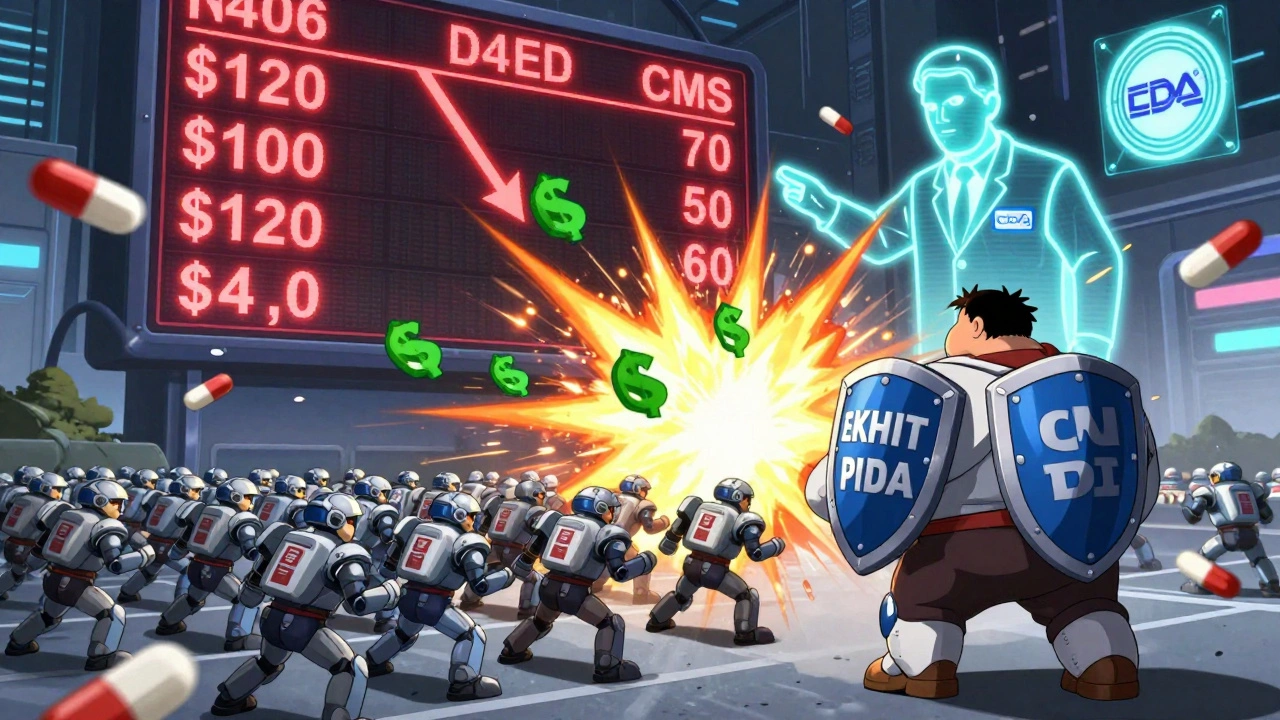
Generic drugs aren’t just copies. They’re the market’s natural check on brand-name drug prices. Once a patent expires, any qualified manufacturer can produce the same drug at a fraction of the cost. And when multiple companies enter the market, prices don’t just dip-they plummet. Studies show that when six generic manufacturers sell the same drug, prices drop by an average of 90.1%. With nine competitors, that jump to 97.3%. That’s not a suggestion. That’s a law of supply and demand playing out in real time.Take the cholesterol drug simvastatin. When it went generic in 2006, the brand version cost about $120 a month. Within two years, with over 100 generic makers producing it, the price fell to under $4. That’s the power of competition. Buyers don’t need to haggle with the brand-name company-they just point to the generics and say, “Here’s what this drug actually costs.”
How Medicare Uses Generic Competition to Set Prices
The 2022 Inflation Reduction Act gave Medicare the legal right to negotiate prices for certain high-cost drugs. But here’s the twist: Medicare can’t directly negotiate with brand-name companies if there are already generic versions on the market. Instead, it uses generics as a benchmark. In its June 2023 guidance, the Centers for Medicare & Medicaid Services (CMS) said it will look at the average price of all approved generic alternatives when deciding what to offer for a brand-name drug.For example, if a brand-name diabetes drug has three generic versions selling for $15, $18, and $20 per 30-day supply, CMS won’t offer the brand company more than $20. It might even go lower, depending on clinical data. This isn’t just a trick-it’s a structural shift. The brand company now has to prove its drug is worth more than the generics, not just that it’s “innovative.”
This approach is working. CMS estimates that the first 10 drugs negotiated under this system will save Medicare beneficiaries $6.8 billion annually. That’s money staying in patients’ pockets instead of going to drugmakers.
Canada’s Tiered Pricing Model: A Different Approach
Not all countries use the same playbook. Canada’s system, updated in 2014, is built around a tiered pricing model. If a drug has no generic competitors, the government allows a higher price. But as more generics enter the market, the maximum allowable price drops. It’s like a sliding scale based on competition.This system rewards generic manufacturers by giving them a clear path to profitability. If you’re the first generic to enter a market, you get a decent price. If you’re the fifth, you still make money-but less. The system doesn’t force prices down overnight. It lets them fall naturally as competition grows.
Compare that to the U.S. model, where prices can crash overnight when a generic hits. Canada’s approach is slower but more stable. It avoids the boom-and-bust cycles that sometimes scare off manufacturers from entering markets with too much competition.
How Brand Companies Fight Back
Brand-name drugmakers aren’t sitting still. They’ve spent decades building strategies to delay generic entry. One common tactic? “Product hopping.” That’s when a company makes a tiny change to a drug-like switching from a pill to a capsule-and markets it as “new and improved.” Then they stop selling the old version, forcing patients to switch. This resets the patent clock and pushes back generic competition.Between 2015 and 2020, there were 1,247 of these maneuvers, according to the Federal Trade Commission. Another tactic? Reverse payments. In these deals, the brand company pays a generic manufacturer to delay launching its cheaper version. The FTC found 106 such deals between 2010 and 2020. These aren’t just shady-they’re illegal. But they still happen.
And now, with Medicare starting to set prices, some brand companies are pushing back harder than ever. Pharmaceutical Research and Manufacturers of America (PhRMA) has hired over 300 lobbyists to fight the new rules. They argue that price controls will hurt innovation. But the data tells a different story: generic drugs account for 90% of all prescriptions in the U.S. but only 22% of total drug spending. That means innovation isn’t being killed-it’s being separated from inflated pricing.
The Real Cost of Delaying Generic Entry
Every month a generic drug is blocked from entering the market, patients pay more. And so do taxpayers. When a drug stays brand-only for an extra year, Medicare and private insurers spend an additional $1.2 billion on average across all affected drugs, according to Avalere Health.That’s why the proposed EPIC Act-Enhancing Generic and Incentivizing Competitive Drugs Act-is gaining traction. It would delay Medicare’s price negotiations until after generic competition has had a chance to develop. That way, the government doesn’t accidentally set a price so low that no generic manufacturer can afford to enter the market.
Think of it this way: if you set the price of a smartphone at $50 before any competitors show up, no one will build a better phone. But if you let the market compete first, then set a fair price based on what’s already out there, you get innovation and affordability.

Who Wins and Who Loses
Patients win. Medicare wins. Taxpayers win. Generic manufacturers win-when the system works. But there’s a catch. Some generic makers, especially those producing complex drugs like inhalers or injectables, say they’re being squeezed. These drugs cost more to make. They need specialized equipment and rigorous testing. But when the government sets a low price based on simple pills, these manufacturers can’t cover their costs.That’s why the market isn’t just about quantity-it’s about quality. The FDA reports that while 90% of prescriptions are for generic drugs, only 45% of biosimilars (the next generation of generics for biologic drugs) are being used. Why? Because pricing models haven’t caught up. Biosimilars aren’t simple copies. They’re complex biological products. Their pricing needs a different approach.
Meanwhile, the biggest generic manufacturers-Teva, Sandoz, and Viatris-control 35% of the global market. They have the scale to compete. But over 1,200 smaller companies are trying to break in. Many can’t afford the legal battles or the regulatory delays. That’s why transparency matters. If buyers like CMS and PBMs make their negotiation rules clear, more small manufacturers can play.
What This Means for You
If you’re on a prescription drug, especially a chronic one like blood pressure medicine or insulin, you’re already benefiting from this system-even if you don’t realize it. The reason your co-pay is $10 instead of $100 isn’t because your doctor is nice. It’s because someone else, somewhere, is using the threat of generic competition to keep prices down.Next time you pick up a generic prescription, ask your pharmacist: “Is this the only version available?” If the answer is no, you’re in a competitive market. That’s good. It means the system is working. If it’s the only one? That’s a red flag. It could mean patent issues, limited competition, or even a reverse payment deal hiding in the background.
And if you’re part of a health plan or employer group that negotiates drug prices? Push for transparency. Ask for data on how many generics are competing for each drug. Demand that your pharmacy benefit manager (PBM) explain how they’re using competition to drive savings. Most don’t. But the ones that do save their clients 20-30% more.
The Future of Generic Competition
The next five years will test whether this system can scale. Real-world data-like how well a drug works in actual patients, not just clinical trials-is becoming part of pricing decisions. By 2025, 73% of health agencies plan to use this kind of evidence. That’s a big shift. It means price won’t just be about how many generics exist-it’ll be about how well they perform.And as more countries adopt reference pricing-setting prices based on what other nations pay-the pressure on U.S. drugmakers will grow. Germany gets 72% generic use. Japan only 58%. Why? Because Japan’s system protects brand prices longer. The U.S. is moving toward Germany’s model, not Japan’s.
The goal isn’t to kill innovation. It’s to stop paying for it twice. You shouldn’t pay $1,000 for a drug because the brand company spent $1 billion on R&D. You should pay $10 because five companies are making the same thing. That’s fairness. That’s efficiency. That’s how markets should work.
Generic competition isn’t just a pricing tool. It’s a public health strategy. And the people who understand it best aren’t the drugmakers. They’re the buyers-the insurers, the government programs, the pharmacies-who are finally using it to take back control.
How do generic drugs lower prices so dramatically?
When multiple manufacturers produce the same generic drug, they compete on price. The first generic may sell at a 30-50% discount. But as more enter-say, six or nine-the price drops to 90-97% below the brand-name version. This happens because production costs for generics are low, and manufacturers are willing to sacrifice profit margins to gain market share.
Can Medicare negotiate prices for drugs that already have generics?
No, Medicare cannot directly negotiate the price of a brand-name drug if generic versions are already on the market. But it can use the prices of those generics as a benchmark to set a lower starting offer for the brand drug. This indirect leverage still drives prices down without violating the law.
Why do some generic drugs still cost a lot?
Some generics stay expensive because there’s little competition-often due to patent barriers, manufacturing complexity, or reverse payment deals. Complex drugs like inhalers, injectables, or extended-release pills require more advanced technology, so fewer companies can make them. Without enough competitors, prices don’t fall.
What is a reverse payment in drug pricing?
A reverse payment is when a brand-name drug company pays a generic manufacturer to delay launching its cheaper version. It’s a way to extend a monopoly. The FTC has found over 100 such deals between 2010 and 2020, and they’re illegal under antitrust law-but enforcement is inconsistent.
How can I tell if my drug has real generic competition?
Ask your pharmacist how many generic manufacturers make your drug. If there are five or more, you’re in a competitive market and prices should be low. You can also check the FDA’s Orange Book online to see how many generic applicants have been approved. More approvals usually mean more competition.
Do generic drugs work as well as brand-name ones?
Yes. The FDA requires generics to have the same active ingredient, strength, dosage form, and route of administration as the brand-name drug. They must also prove they’re absorbed in the body at the same rate and extent. Over 90% of U.S. prescriptions are for generics, and they’re used safely every day by millions.
Will Medicare’s price negotiations hurt innovation?
There’s no evidence that negotiating prices based on generic competition reduces innovation. Most new drugs are still profitable even after price cuts. What’s being cut is the excessive pricing that happens when there’s no competition. Innovation thrives when companies compete on value, not just monopoly control.



Marvin Gordon
December 4, 2025 AT 19:14Finally, someone lays out how this actually works. I’ve been on statins for years and never realized my $10 co-pay was the result of 100+ companies fighting over pennies. This isn’t magic-it’s capitalism done right.
Thanks for the clarity.
Lucy Kavanagh
December 5, 2025 AT 11:09Oh sure, let’s just let the government set prices like some socialist utopia. Meanwhile, China’s manufacturing the generics and we’re handing them the playbook. This is how we lose the pharmaceutical war.
Wake up, America. They’re not here to help you-they’re here to replace you.
Krishan Patel
December 6, 2025 AT 07:31The fundamental error lies in conflating commodification with justice. A molecule does not possess moral agency, yet we assign it value based on corporate calculus. The real tragedy is not the price of simvastatin-it is that we have reduced human health to a ledger line in a spreadsheet owned by shareholders who have never held a dying patient’s hand.
Competition is not liberation. It is merely the redistribution of exploitation.
Juliet Morgan
December 6, 2025 AT 12:23My mom’s insulin used to cost $450. Now it’s $35. I cried when she told me. This isn’t policy-it’s survival. Thank you for writing this.
sean whitfield
December 7, 2025 AT 04:30Generics work. Cool. So why do I still pay $20 for a 30-day supply of metformin? Oh right. Because the pharmacy is owned by the same company that owns the brand. So they just moved the profit around. Genius.
Michael Dioso
December 7, 2025 AT 23:37You people are missing the point. The real scam isn’t the brand-name drugs-it’s the FDA’s approval process. They let 90 companies make the same pill, but only 3 get approved for Medicare. That’s not competition. That’s a cartel with paperwork.
And don’t get me started on PBMs. They’re the real villains. Nobody talks about them because they don’t have logos.
Also, generic insulin is still too expensive because the FDA won’t let the cheap Chinese versions in. But hey, let’s blame the drugmakers. Classic.
Chris Brown
December 9, 2025 AT 08:36Let me be the first to say this: this article reads like a lobbying brochure written by a former CMS intern.
Generic drugs are not ‘a public health strategy.’ They’re a legal loophole exploited by multinational corporations who have no interest in patient outcomes-only market share.
And you think Medicare’s ‘benchmarking’ is fair? Try telling that to the single mother who needs a biosimilar for rheumatoid arthritis and can’t find one because the price is set at $50 but the actual production cost is $72.
This isn’t reform. It’s redistribution with a PowerPoint.
Deborah Jacobs
December 9, 2025 AT 23:10My heart just did a little flip reading about simvastatin dropping from $120 to $4. That’s not a price drop-that’s a revolution. I used to skip doses just to make it last. Now I take it like it’s water.
And the part about reverse payments? Yeah. That’s the real horror story. Companies paying each other to NOT give people cheaper medicine. That’s not capitalism. That’s organized crime with a PhD.
Also-why does no one talk about how the FDA’s slow approval process for complex generics is basically a backdoor patent extension? Someone needs to write a book on this. I’d buy ten copies.
Stephanie Fiero
December 10, 2025 AT 10:59Wait so if my drug has only one generic, does that mean someone got paid to not make more? 😳 I just checked my pill bottle and it says ‘teva’ only… that’s not right. I’m calling my pharmacist.
Stephanie Bodde
December 12, 2025 AT 10:56Thank you for this!! 🙏 I’ve been trying to explain this to my dad for years and he kept saying ‘drugs are expensive because science is hard.’ Now I can send him this. He’s gonna cry. (I’m crying now.)
William Chin
December 12, 2025 AT 16:08Let’s be clear: this isn’t about ‘fair pricing.’ It’s about power. The pharmaceutical industry spent $400 million lobbying last year to prevent exactly this. They don’t fear competition-they fear accountability.
When Medicare uses generics as a benchmark, it’s not ‘negotiating.’ It’s finally enforcing the antitrust laws they’ve ignored for 30 years.
And if you think this will hurt innovation, ask yourself: how many of those ‘breakthrough’ drugs are just minor tweaks to existing molecules? How many are actually life-saving versus lifestyle-enhancing?
Stop romanticizing monopoly profits. The system was rigged. We’re just turning the key.
Carole Nkosi
December 13, 2025 AT 02:38Competition is not the solution. It is the symptom of a deeper sickness. We have allowed medicine to become a commodity, and in doing so, we have severed the sacred bond between healer and healed.
When a drug’s worth is measured only by how many companies can make it, we have lost something irreplaceable.
Let us not celebrate the fall of the brand-name drug-let us mourn the death of care.