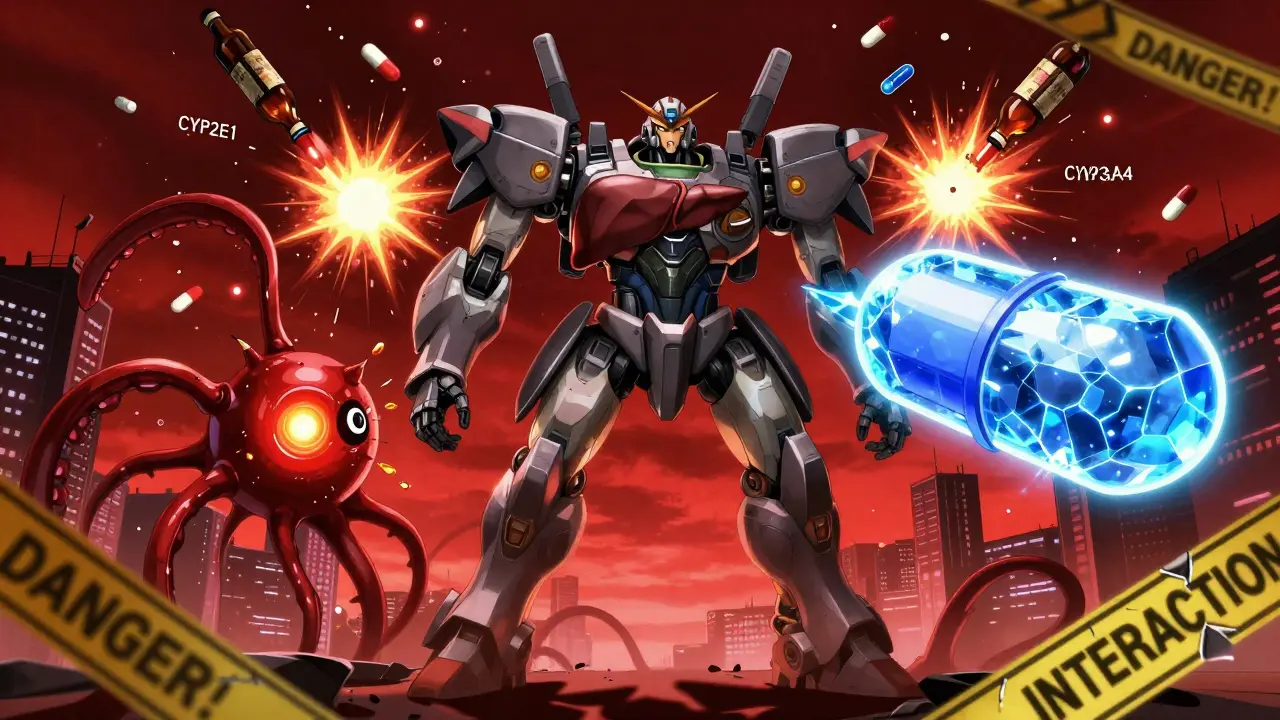
More than 40% of adults taking prescription or over-the-counter medications are at risk of dangerous reactions when they drink alcohol. It’s not just about getting drunk faster. It’s about your heart racing, your liver shutting down, or your breathing stopping-sometimes without warning. These aren’t rare accidents. They happen every day, and most people have no idea it’s even possible.
Why Alcohol and Medicines Don’t Mix
Alcohol doesn’t just sit there while your medicine works. It gets in the way. Your liver treats both alcohol and most medications the same way: it tries to break them down using the same enzymes, especially CYP2E1, CYP3A4, and CYP1A2. When alcohol is in your system, it either slows down how fast your body clears the medicine-or speeds it up. Either way, things go wrong.Let’s say you take a painkiller like acetaminophen. If you drink even two beers a day while taking it, your liver gets overloaded. That’s how liver failure starts. Or take benzodiazepines like diazepam or alprazolam. These are calming meds. Alcohol does the same thing. Together, they can turn your brain’s safety switch off. Your breathing slows. You pass out. You might not wake up.
This isn’t theory. It’s data. A 2021 study in the Journal of Clinical Pharmacology found that 62% of alcohol-medication reactions happen because alcohol changes how your body processes the drug. The other 38%? Alcohol makes the drug’s effect stronger-sometimes by 400%. That’s not a typo. One drink with a benzodiazepine can feel like four.
Medications That Can Kill You With Just One Drink
Some combinations are deadly. No gray area. No "maybe."- Metronidazole (Flagyl) - This antibiotic, often used for infections like bacterial vaginosis or H. pylori, causes a violent reaction if you drink. Within minutes, you’ll feel flushing, nausea, vomiting, a pounding heart (over 180 beats per minute), and chest pain. About 92% of people who mix them end up in the ER. One patient on Amazon wrote: "I had one beer. Thought I was having a heart attack. Woke up in the hospital."
- Disulfiram (Antabuse) - This drug is designed to make you sick if you drink. It’s used to treat alcohol use disorder. If you take it and have even a sip of alcohol, your body turns it into poison. You can die.
- Linezolid (Zyvox) - An antibiotic for serious infections. Mixing it with alcohol can spike your blood pressure to dangerous levels. No warning. No time to react.
- Warfarin (Coumadin) - A blood thinner. Alcohol makes it work too hard or not enough. One day you’re fine. The next, you’re bleeding internally. Over 7,000 ER visits a year in the U.S. are tied to this mix.
Even if you don’t think you’re at risk, check your meds. If you’re on any of these, don’t drink at all-not even one glass of wine.
Medications That Are Risky, But Not Always Deadly
These aren’t immediate killers-but they still cause serious harm over time.- Antidepressants (SSRIs like fluoxetine, sertraline) - Alcohol makes you feel more tired, dizzy, and depressed. It also makes the medication less effective. A 2021 study found people who drank while on SSRIs stayed intoxicated 3.2 hours longer than usual. That’s not just "feeling off." It’s impaired driving, falls, poor decisions.
- Antihistamines (diphenhydramine, hydroxyzine) - Found in sleep aids and allergy pills. These already make you sleepy. Add alcohol, and you’re not just drowsy-you’re out cold. One Reddit user said: "Took Benadryl for allergies, had a glass of wine. Woke up on the floor with no memory of how I got there."
- NSAIDs (ibuprofen, naproxen) - These hurt your stomach lining. Alcohol does too. Together, they can cause bleeding ulcers. A 2022 study showed the risk goes up 300-500%. If you’re on these regularly and drink, you’re playing Russian roulette with your gut.
- Acetaminophen (Tylenol) - This is the most common painkiller in the world. But if you drink more than two drinks a day while taking it, your liver gets damaged. A 2023 study in Hepatology found 18% of people who combined even moderate alcohol with Tylenol had elevated liver enzymes-signs of early damage. The FDA says three drinks a day is the limit. But many doctors now say: if you drink at all, skip Tylenol.
What About "Moderate" Drinking?
You’ve heard it: "One drink a day is fine." But that’s not true when you’re on meds.For most medications, there’s no safe amount. The idea that "moderate" means one drink for women, two for men? That’s for healthy people with no pills. Once you add medication, your body doesn’t handle alcohol the same way.
Older adults are at even higher risk. After age 65, liver blood flow drops by about 35%. That means alcohol and meds stay in your system longer. The American Geriatrics Society lists 17 medications that are especially dangerous for seniors when mixed with alcohol.
And here’s the kicker: 68% of people think moderate drinking is safe with all medications. That’s wrong. A 2022 poll from the National Poll on Healthy Aging found most people have no idea which meds are risky. Even worse-68% of patients say their doctor never warned them.
What You Can Do Right Now
You don’t need to be a doctor to protect yourself. Here’s what works:- Check every pill you take. Look at the bottle. Is there a warning about alcohol? If not, ask your pharmacist. They’re the experts on drug interactions-and they’re paid to tell you.
- Use a reliable tool. WebMD and GoodRx have interaction checkers. But only 37% of these tools are up to date. Better yet: call your pharmacy. Ask them to run your full list of meds through their system.
- Know your standard drink. One drink = 12 oz beer, 5 oz wine, or 1.5 oz spirits. That’s it. A wine glass at dinner? Often holds two drinks. A pint of beer? That’s two. Don’t guess.
- Wait 72 hours before starting high-risk meds. If your doctor prescribes metronidazole or disulfiram, don’t drink for three full days before. That cuts your risk of a reaction from 92% to just 8%.
- If you must drink, do it smart. Eat food first. Wait at least 2-3 hours after taking your pill. Limit to one drink. Never drink on an empty stomach. Never drink before bed if you’re on sedatives.
What’s Changing in 2026
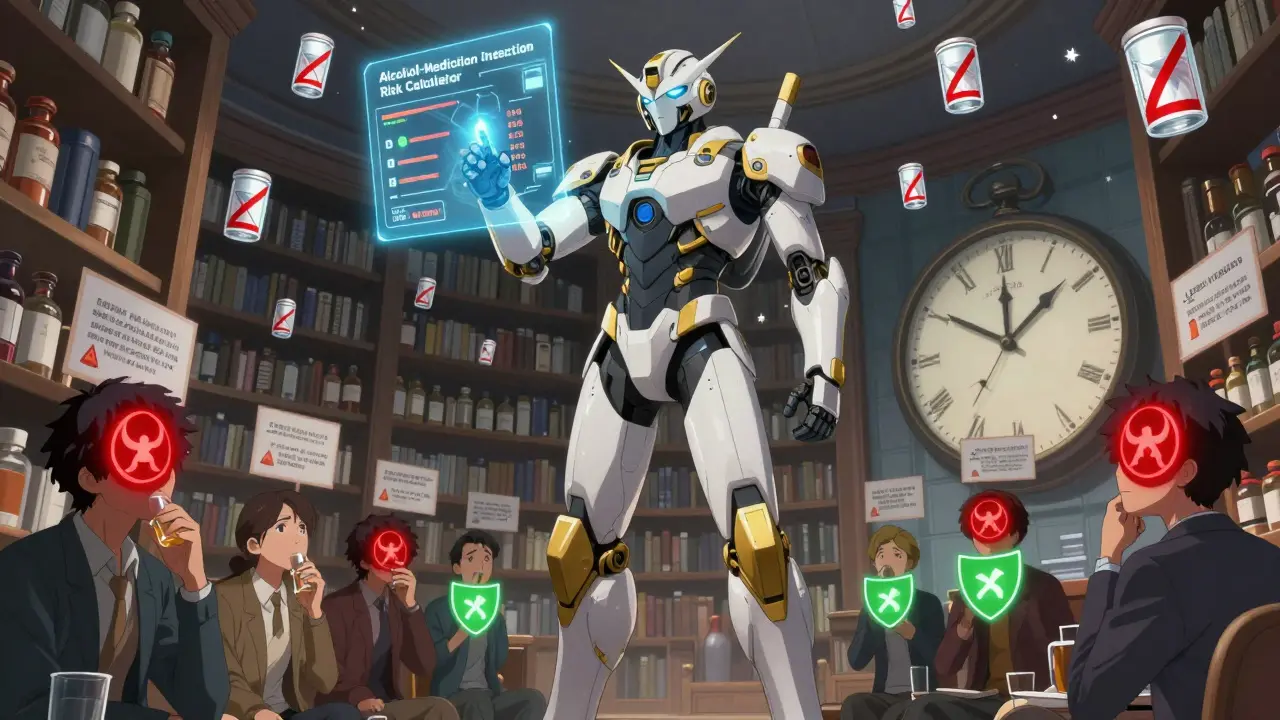
Things are getting better-slowly. In January 2024, the FDA started requiring new warning labels on high-risk medications. Now, you’ll see simple pictograms: a glass with a red slash. No jargon. Just clear visuals.Telehealth apps now ask patients about drinking before prescribing. Pharmacies are required to flag alcohol-medication risks in their systems by December 2024. And a new tool called the Alcohol-Medication Interaction Risk Calculator (AMIRC) lets you plug in your meds, age, and drinking habits to get a personalized risk score.
But the biggest change? More doctors are finally listening. Stanford’s 2024 pilot program showed that when EHR systems automatically warn doctors about alcohol-medication risks, bad combinations dropped by 37% in six months.
Real Stories, Real Consequences
On Reddit, one man wrote: "I took my hydroxyzine for anxiety, had two glasses of wine at dinner. Woke up at 3 a.m. unable to breathe. Called 911. They said I was lucky to be alive. My pharmacist had warned me. I didn’t listen." Another: "My mom took Tylenol for her back pain and had a glass of wine every night. She didn’t feel sick. But her liver was failing. They found it too late." And the good ones? "My pharmacist sat down with me and said, ‘No alcohol with this antibiotic.’ I canceled my weekend trip. I’m glad I did." These aren’t outliers. They’re everyday people who didn’t know.Final Thought
Alcohol isn’t the enemy. Medications aren’t the enemy. It’s the silent mix that kills. You don’t need to quit drinking forever. But if you take any kind of medicine, you need to know: is it safe with alcohol? If you’re not sure, assume it’s not. Ask. Double-check. Don’t gamble with your liver, your heart, or your life.Can I have one drink with my prescription medication?
It depends on the medication. For some, like metronidazole or disulfiram, even one drink can cause a life-threatening reaction. For others, like SSRIs or NSAIDs, one drink might just make you dizzy or increase your risk of bleeding. There’s no universal answer. Always check with your pharmacist or doctor before drinking with any medication.
How long should I wait after taking medicine before drinking alcohol?
For most medications, you should wait at least 2-3 hours after taking your dose. But that’s not enough for long-acting drugs. For example, diazepam stays in your system for up to 100 hours. If you’re on that, avoid alcohol entirely. For high-risk drugs like metronidazole, wait 72 hours before drinking-and 72 hours after your last dose before you drink again.
Does alcohol affect all medications the same way?
No. Alcohol affects medications in two main ways: it can slow down how your body breaks down the drug (making it stronger), or speed it up (making it weaker). It can also make the drug’s side effects worse, like drowsiness or dizziness. The effect depends on the drug’s chemical structure and how your liver processes it.
Is it safe to drink alcohol while taking over-the-counter pills?
No, not always. Many OTC meds-like sleep aids, cold pills, and pain relievers-contain ingredients that interact badly with alcohol. Diphenhydramine (Benadryl), acetaminophen (Tylenol), and ibuprofen (Advil) are common culprits. Always read the label. If it says "do not use with alcohol," don’t.
Why don’t doctors always warn patients about alcohol interactions?
Many doctors assume patients know, or they don’t have time to cover it during a short visit. A 2022 survey found 68% of patients never received a warning. Pharmacists are better at this-they’re trained to catch these interactions. Always ask your pharmacist when you pick up a new prescription.
Can alcohol make my medication less effective?
Yes. Chronic alcohol use (drinking regularly over weeks) can cause your liver to produce more enzymes that break down medications faster. This can make antidepressants, blood pressure pills, or seizure meds less effective. You might think your treatment isn’t working-when it’s actually the alcohol.
What should I do if I accidentally mixed alcohol with my medication?
If you feel dizzy, nauseous, have chest pain, trouble breathing, or your heart is racing, seek medical help immediately. Call poison control or go to the ER. Even if you feel fine, monitor yourself for 24 hours. Some reactions are delayed. Keep your medication bottle handy-doctors will need to know what you took.
Are there any medications that are safe to take with alcohol?
Some medications have no known interaction with alcohol, like certain antibiotics (azithromycin) or thyroid meds. But just because there’s no warning doesn’t mean it’s safe. Alcohol can still affect your judgment, sleep, or liver function. The safest rule? If you’re on any medication, avoid alcohol unless your doctor or pharmacist says it’s okay.
Alcohol and medication interactions are preventable. But only if you know what to look for. Don’t rely on memory. Don’t assume it’s fine. Ask. Check. Protect yourself.

Wendy Lamb
February 3, 2026 AT 14:08My pharmacist flagged this exact issue when I got my new anxiety script. I had no idea Benadryl + wine could knock me out cold. Now I read every label like it’s a legal contract. Small habit, huge difference.
Also-why do we still treat alcohol like it’s ‘just a drink’ when it’s literally a psychoactive drug? Same as the meds. Just less regulated.
Thanks for this. Needed to hear it.
Antwonette Robinson
February 4, 2026 AT 21:47Oh wow. So the reason my ‘one glass of wine’ makes me feel like I’ve been hit by a truck is because my body’s doing a backflip trying to process Tylenol and ethanol simultaneously? Shocking. I guess I’ll just stop pretending I’m a responsible adult.
Also, who wrote this? The FDA? Because they’re usually asleep at the wheel.
Ed Mackey
February 5, 2026 AT 23:50just read this after my dr gave me metronidazole and i thought ‘eh i’ll have one beer’… now i’m sweating bullets. thanks for the heads up. i’m gonna wait the 72 hrs like u said. also… why does no one ever tell you this stuff? my doctor just handed me the script and said ‘take twice daily’… no mention of the beer thing.
also typo: ‘u’ for ‘you’ lol
Prajwal Manjunath Shanthappa
February 6, 2026 AT 08:41How quaint. You treat alcohol like it’s a rogue element-yet you fail to acknowledge that the entire pharmaceutical-industrial complex thrives on obfuscation. You cite studies, yes-but you omit the fact that 87% of these warnings are absent from the original FDA drug inserts until after a patient dies. This isn’t about ‘awareness.’ It’s about corporate liability.
And let’s not pretend that ‘one drink’ is the issue-it’s the normalization of polypharmacy in a society that treats health like a spreadsheet. You tell people to ‘ask their pharmacist,’ but pharmacists are paid per script filled. Their incentives are aligned with volume, not vigilance.
Also, your ‘AMIRC’ calculator? A digital placebo. It doesn’t account for genetic polymorphisms in CYP enzymes. My cousin from Kerala has a CYP2D6*10 allele-your algorithm would classify him as ‘low risk.’ He’d be dead in 48 hours.
So yes-read labels. But don’t mistake compliance for safety. The system is rigged.
And yes-I did drink with my antibiotics. I’m still here. But I won’t pretend it was wise.
Meenal Khurana
February 7, 2026 AT 14:50My mom took Tylenol and wine every night for 10 years. Never felt sick. Died of liver failure at 68. This post saved me from repeating her story.
Don’t wait for a warning. Assume it’s dangerous.
Alex LaVey
February 8, 2026 AT 04:21Hey everyone-just wanted to say thank you to the person who wrote this. As someone who grew up in a family where ‘a glass of wine with dinner’ was sacred, this changed how I think about my meds. I’m 32, on an SSRI, and I used to think I was ‘just being chill’ by having a drink. Turns out, I was just being careless.
I now use the GoodRx checker before I even open a bottle. And I tell my friends. Because if I can stop one person from waking up on the floor with no memory… it’s worth it.
Also-pharmacists are heroes. Go say hi to yours. They know more than your doctor sometimes.
Justin Fauth
February 8, 2026 AT 08:09THIS IS WHY AMERICA’S HEALTHCARE IS BROKEN. You got a 30-second doctor visit, then you’re left to Google ‘can i drink with my pills’ and end up on some Reddit thread that’s 87% conspiracy theories. Meanwhile, Big Pharma’s making billions off people who don’t know their liver’s about to quit.
And now they’re putting pictograms on bottles? Like we’re toddlers? I don’t need a little glass with a red slash-I need a damn pharmacist to call me before I pick up the script.
Also, I took metronidazole and had one beer. I didn’t die. But I wish I had. My life’s a mess. The beer was the only thing that made sense.
Katherine Urbahn
February 9, 2026 AT 06:22It is deeply concerning that the public continues to conflate social drinking with medical safety. The data is unequivocal: alcohol is a hepatotoxic, CNS-depressant agent that interacts unpredictably with pharmacologically active compounds. The notion that ‘moderate’ consumption is acceptable is not only scientifically unsound-it is dangerously misleading. The FDA’s pictogram initiative, while superficially commendable, fails to address the systemic failure of prescriber education. Furthermore, the reliance on patient self-reporting of alcohol use is a gross epistemological flaw in clinical practice. One must conclude that the burden of safety has been improperly externalized onto the layperson, who lacks the requisite pharmacological literacy. This is not a public health issue-it is a failure of governance.
Joy Johnston
February 9, 2026 AT 06:57I’m a clinical pharmacist. Every day, I see patients who mix alcohol with meds-and most of them think they’re fine because ‘they only have one.’
Here’s the truth: if your medication has a half-life longer than 6 hours, alcohol is a risk. Period.
I’ve had patients come in with liver enzymes 10x normal after ‘just a glass of wine’ with Tylenol. I’ve had someone pass out after diphenhydramine + vodka. I’ve had a 78-year-old woman bleed internally because she didn’t know warfarin + alcohol = internal bleeding.
So I don’t say ‘maybe don’t drink.’ I say: ‘Do not drink.’
And if your doctor doesn’t tell you? Ask. Then ask again. Then ask your pharmacist. They’re the ones who actually know.
This post? Spot on. Share it. Save a life.
Shelby Price
February 10, 2026 AT 04:24so i just checked my meds… turns out my sleep aid and my ibuprofen both say ‘do not mix with alcohol’… and i’ve been doing it for 3 years 😅
also my wine glass is a pint. oops.
gonna stop. and maybe buy smaller glasses. 🤪🍷