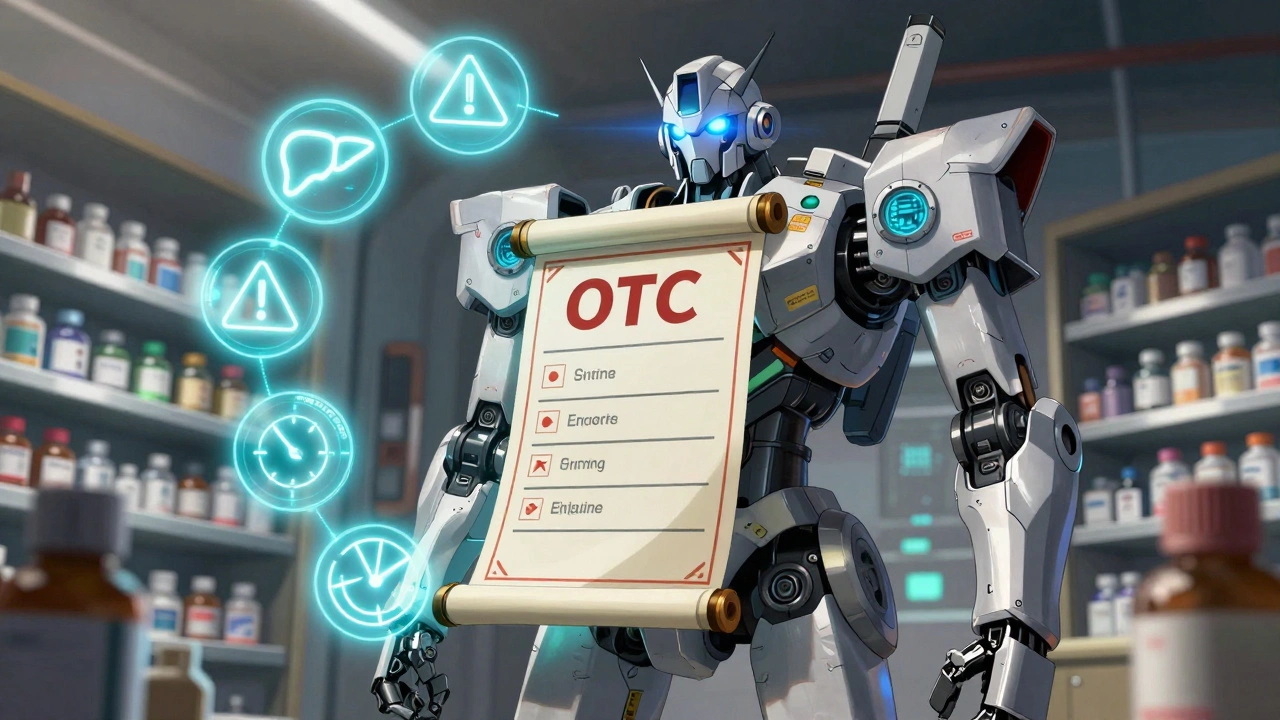
Every year, millions of Americans grab an OTC medicine off the shelf without thinking twice. Maybe it’s for a headache, a cold, or trouble sleeping. But here’s the problem: OTC drug facts labels are designed to be clear - but most people don’t read them right. And that’s how accidental overdoses, dangerous interactions, and avoidable hospital visits happen.
You don’t need a pharmacy degree to understand these labels. You just need to know where to look - and what to ignore. The U.S. Food and Drug Administration (FDA) made these labels standard in 2017 after years of consumer confusion. Before that, one brand might list ingredients in tiny print, another in random order. Now? Every single OTC medicine - from Tylenol to Advil to store-brand allergy pills - follows the same format. Seven sections. Always in the same order. If you learn how to read them, you’ll avoid mistakes that land people in the ER.
Start with the Active Ingredients
This is the most important part of the label - and the one most people skip. The active ingredient is the chemical that actually does the work. It’s not the brand name. It’s not the fancy packaging. It’s the substance inside.
Look for the line that says something like: "Acetaminophen 325 mg" or "Ibuprofen 200 mg". That’s your active ingredient. If you see more than one - like "Acetaminophen 325 mg, Dextromethorphan 10 mg, Phenylephrine 5 mg" - you’re looking at a multi-symptom product. That’s fine… as long as you know what you’re taking.
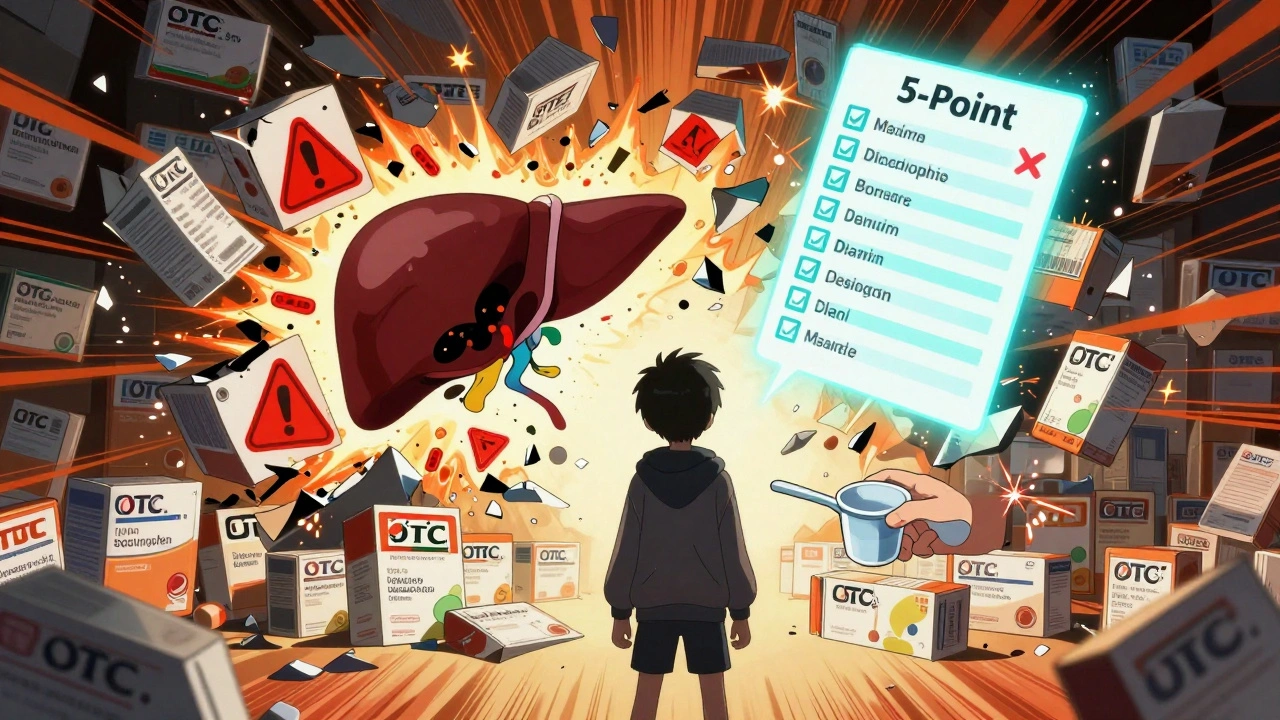
Here’s where people get hurt: they take two different medicines thinking they’re helping different symptoms. But if both contain acetaminophen - say, Tylenol Cold and a store-brand pain reliever - they’re doubling up. The FDA says the max safe daily dose of acetaminophen is 4,000 mg. Take 8,000 mg? You could seriously damage your liver. In 2023, over 127,000 reports of OTC medication errors were filed with the FDA. A huge chunk of those? People didn’t check the active ingredient.
What the Product Is Supposed to Do
The next section, labeled "Uses," tells you exactly what symptoms the medicine is approved to treat. No fluff. No marketing. Just facts.
It might say: "Temporarily relieves minor aches and pains due to headache, toothache, menstrual cramps, and the common cold." That’s it. If your symptom isn’t listed, the medicine won’t help - or worse, it might make things worse.
Let’s say you have a sore throat and a cough. You grab a "Cold & Flu" medicine that says it treats sore throat, cough, and runny nose. Good. But if you also have high blood pressure, you need to check the next section - because that same product might contain phenylephrine, a decongestant that can raise your blood pressure. The "Uses" section tells you what it’s for. The "Warnings" section tells you when not to use it.
Warnings: Don’t Skip This
This is where the label saves lives. The FDA requires this section to be clear, bold, and impossible to miss. It’s not just "may cause drowsiness." It’s specific.
Look for:
- "Do not use if you have ever had an allergic reaction to [ingredient]."
- "Ask a doctor before use if you have liver disease, high blood pressure, or take blood thinners."
- "Liver warning: This product contains acetaminophen. Severe liver damage may occur if you take more than directed."
- "May cause drowsiness. Do not operate machinery or drive."
According to the American Pharmacists Association, 89% of pharmacists say the Warnings section is the most critical part of the label. Why? Because it stops people from taking something that could kill them. A 2024 CDC study found that pediatric acetaminophen overdoses dropped 43% after the new label format rolled out - because parents finally saw the liver warning.
And don’t ignore the "Do not use" lines. If you’re pregnant, have kidney disease, or take a prescription medication, that warning might be talking directly to you. If you’re unsure, don’t guess - ask a pharmacist.
Directions: Dosage Isn’t What You Think
"Take one tablet every 4 to 6 hours." Sounds simple. But here’s the trap: people think "every 4 hours" means they can take 6 doses in 24 hours. Not always. Sometimes the label says "do not exceed 6 doses in 24 hours," but each dose is two tablets. That’s 12 tablets - not 6.
Pay attention to:
- How much to take (e.g., "2 caplets")
- How often (e.g., "every 6 hours")
- Maximum per day (e.g., "Do not take more than 12 caplets in 24 hours")
- Age limits (e.g., "For adults and children 12 years and older")
- Duration (e.g., "Do not use for more than 10 days unless directed by a doctor")
Also watch out for "per 5 mL" on liquid medicines. That’s one teaspoon. A 4-ounce bottle isn’t four doses - it’s about 24 doses. If you’re giving this to a child, use the measuring cup that came with it - never a kitchen spoon. A teaspoon from your kitchen can hold anywhere from 3 mL to 7 mL. That’s a 130% difference.
And if you see "PM" on the label - like "Advil PM" or "Tylenol PM" - that means it contains diphenhydramine, an antihistamine that causes drowsiness. It’s not just a pain reliever. It’s a sleep aid. Don’t take it during the day unless you want to fall asleep at your desk.
Inactive Ingredients: Allergies and Hidden Triggers
This section lists everything that’s not the medicine - fillers, dyes, preservatives, flavorings. Most people think this doesn’t matter. But if you’re allergic to soy, gluten, or red dye #40, it does.
Look for ingredients like:
- "Croscarmellose sodium" (a binder)
- "Povidone" (a stabilizer)
- "FD&C Red No. 40" (a dye)
- "Sodium" (some pills have 2-5 mg per tablet - fine for most, but dangerous if you’re on a low-sodium diet)
One study found that 18% of adults with food allergies accidentally took a medicine containing an ingredient they were sensitive to - because they never checked the inactive list. If you have allergies, keep a short list of ingredients to avoid handy. When you’re at the store, scan this section first.
Other Information: Storage and Extra Details
This tiny section often gets ignored - but it matters. It tells you how to store the medicine (e.g., "Store between 68°F and 77°F") and sometimes gives you nutritional info like sodium content or sugar levels.
Why does this matter? Because heat and moisture ruin medicine. If you keep your pills in the bathroom medicine cabinet, they’re getting steamy every time you shower. That can make them less effective. Store them in a cool, dry place - like a bedroom drawer.
Also, some products list how much sodium is in each dose. If you’re on a heart-healthy diet, that adds up. One pill with 2 mg sodium might not seem like much. But if you take four a day? That’s 8 mg. Not huge - but if you’re on a strict 1,500 mg daily limit, every bit counts.
Use the 5-Point Check Every Time
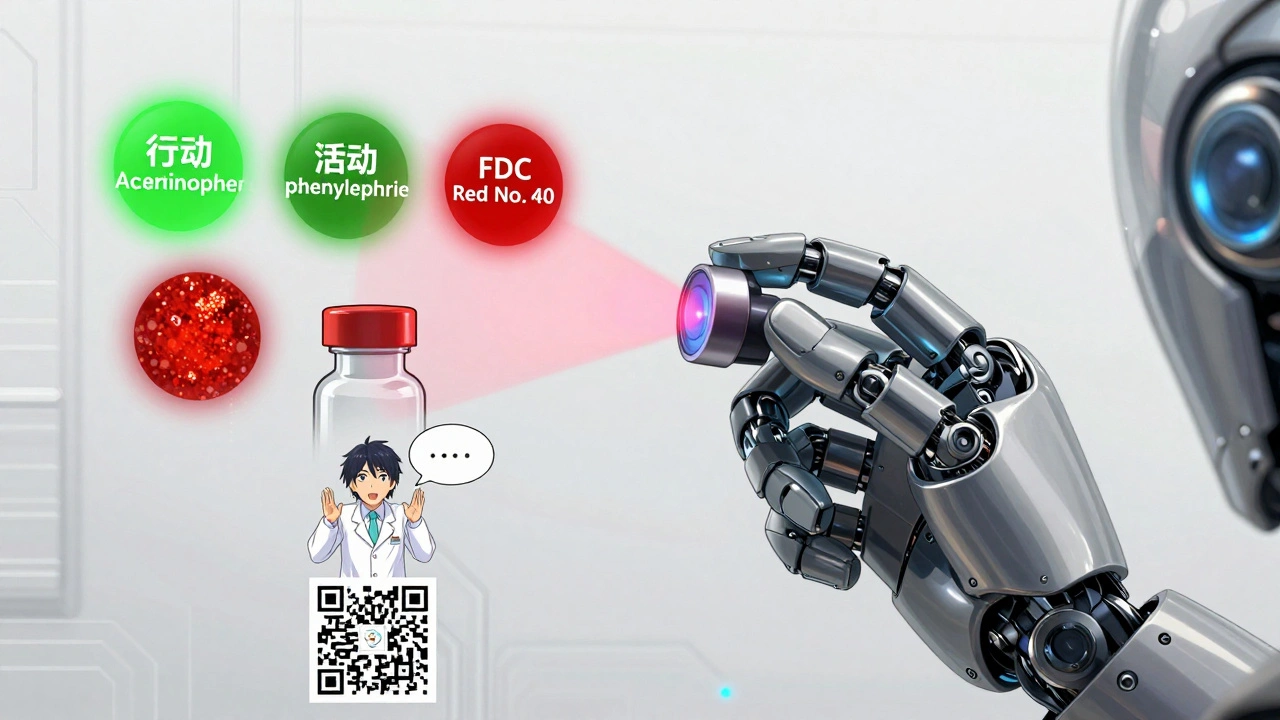
Pharmacists at CVS Health created a simple system called the "5-Point Check" to help people read labels safely. It takes about 50 seconds - and it cuts medication errors by 68%.
- Identify active ingredients - What’s actually in it? Write it down if you need to.
- Verify uses - Does this match your symptom?
- Read all warnings - Are you in a high-risk group? Are you taking other meds?
- Check directions - How much? How often? For how long?
- Review inactive ingredients - Any allergens or additives you avoid?
Do this every time you buy a new OTC medicine - even if it’s the same brand. Manufacturers change formulas. A "new and improved" version might have a different active ingredient or higher dose.
What’s Changing Soon
The FDA isn’t done. In 2024, Congress passed the OTC Drug Label Modernization Act, requiring new labels by the end of 2025. These will include:
- Color-coded sections (red for warnings, green for uses)
- Icons for high-risk alerts (like a liver symbol for acetaminophen)
- Larger font for active ingredient concentration
Some brands are already adding QR codes that link to video explanations. Scan one, and you’ll see a pharmacist walk you through the label in 30 seconds. It’s a game-changer.
But here’s the truth: no matter how good the label gets, you still have to read it. Technology helps - but your eyes and brain are still the most important tools.
What to Do If You’re Still Confused
Don’t guess. Don’t rely on friends or Google. Go to a pharmacist.
Walgreens reported a 40% increase in OTC medication consultations after launching their "Label Literacy" campaign in 2023. Pharmacists are trained to read these labels faster than anyone. They know which ingredients interact with which prescriptions. They know which products are safe for diabetics, pregnant women, or seniors.
And if you’re still unsure? Download the free FDA Drug Label Decoder app. It lets you scan a label or type in the name of a medicine and pulls up the official label with highlighted key info. Over 1.2 million people have used it since it launched in August 2023.
OTC medicines are safe - when used right. The labels are designed to protect you. But they only work if you read them. Take 50 seconds. Ask one question. Save yourself from a mistake you’ll regret.
What should I do if I accidentally take too much of an OTC medicine?
Call Poison Control immediately at 1-800-222-1222. They’re available 24/7 and can tell you what to do based on the medicine, how much you took, and your age or health condition. Don’t wait for symptoms to appear. Even if you feel fine, some overdoses (like acetaminophen) don’t show signs until liver damage is already happening.
Can I trust store-brand OTC medicines?
Yes - if the active ingredient matches the name-brand version. Store brands are required by law to have the same active ingredients, strength, dosage form, and warnings as name-brand products. The only differences are in inactive ingredients, packaging, and price. If you’re not allergic to anything on the label, store brands are just as safe and effective - and often half the cost.
Why do some OTC labels say "acetaminophen" and others say "paracetamol"?
They’re the same thing. "Acetaminophen" is the U.S. name. "Paracetamol" is used in the UK, Canada, and many other countries. If you’re traveling or buying medicine from outside the U.S., look for paracetamol - it’s the same drug as acetaminophen. Always check the dose: 500 mg paracetamol = 500 mg acetaminophen.
Is it safe to take OTC medicine with my prescription drugs?
Not always. Many OTC medicines interact with prescriptions. For example, ibuprofen can interfere with blood pressure meds. Antihistamines can make sedatives stronger. Always check the "Warnings" section for drug interactions - and when in doubt, ask your pharmacist. They have access to databases that flag dangerous combinations.
How do I know if I’m giving my child the right dose?
Never use age alone. Use weight. Most pediatric OTC medicines list dosing by weight ranges (e.g., "For 24-35 lbs: 5 mL"). If you don’t know your child’s exact weight, ask your pediatrician. Never guess. Use the dosing device that came with the bottle - never a kitchen spoon. A child’s liver is much more sensitive to overdoses than an adult’s.




Evelyn Pastrana
December 10, 2025 AT 08:32So let me get this straight - we’re supposed to read a label that’s basically designed by lawyers who think we’re all idiots, but somehow we’re supposed to magically understand it? 🙄 I took NyQuil last week and didn’t realize it had acetaminophen until my mom screamed at me from the kitchen. Now I keep a sticky note on my fridge: ‘IF IT’S BLUE AND HAS ‘PM’ ON IT, DON’T TAKE IT WHILE DRIVING.’
Lisa Whitesel
December 11, 2025 AT 00:42People die because they can’t read a label. That’s it. No excuses. No ‘I didn’t know.’ If you can’t tell the difference between active and inactive ingredients you shouldn’t be allowed to buy aspirin. The FDA did their job. You failed yours.
Simran Chettiar
December 12, 2025 AT 03:40It is fascinating to observe how modern society has outsourced its responsibility for personal health to corporate packaging and regulatory compliance. The OTC label, in its bureaucratic perfection, becomes a mirror of our collective alienation from bodily wisdom. We no longer listen to our bodies - we scan barcodes and hope the FDA got it right. But is safety truly found in font size and bolded warnings, or is it cultivated through mindfulness, ancestral knowledge, and quiet self-awareness? Perhaps the real epidemic is not overdose - but the surrender of agency to ink on plastic.
Richard Eite
December 13, 2025 AT 22:41USA makes the best drug labels in the world and people still mess it up? You gotta be kidding me. Other countries can’t even get the basics right. We standardized this for a reason. If you can’t read it, go back to school. Not my problem.
Katherine Chan
December 14, 2025 AT 01:18Y’all are making this way too complicated 😊 I just look for the big bold stuff - acetaminophen? Check the dose. PM? That’s sleep mode. Store it away from the shower. Done. If you’re unsure? Ask the pharmacist. They’re literally paid to help you. No shame in that. We’re all learning. 💪
Philippa Barraclough
December 14, 2025 AT 08:02It’s interesting how the structural consistency of the FDA’s label format reflects broader trends in consumer protection policy - a move toward standardization as a mechanism for reducing cognitive load in high-stakes decision-making. However, the persistence of errors despite this standardization suggests that the problem is not merely informational but behavioral. The cognitive dissonance between perceived safety and actual risk remains unaddressed. One might argue that the label, however well-designed, is insufficient without accompanying educational interventions that target health literacy at the community level.
Tim Tinh
December 16, 2025 AT 05:38biggest thing i learned? if it says 'acetaminophen' and you're on a drinkin' night, just don't. i used to think 'oh it's just tylenol' but then i saw my buddy in the hospital. now i always check. even if it's the same brand. sometimes they change the formula. dumb but true.
Ruth Witte
December 16, 2025 AT 07:46OMG YES THIS!!! 🙌 I used to grab ‘Cold & Flu’ and ‘Pain Relief’ at the same time… then I did the math and realized I was eating 1600mg of acetaminophen every 4 hours. My liver was screaming. Now I keep a little notepad in my purse with all the active ingredients I avoid. Saved my life. 🥹💖
Katherine Rodgers
December 16, 2025 AT 09:34So you're telling me after 8 years of seeing the same label format people still can't read it? That's not ignorance. That's laziness. You don't need a degree. You need to stop scrolling and look at the damn thing. The FDA didn't make this hard. You did.
Lauren Dare
December 17, 2025 AT 04:03Let’s be real - the ‘5-Point Check’ is just a marketing gimmick dressed up as public health. The real issue is that pharmaceutical companies still bury critical warnings in legalese while marketing the product like a spa day. ‘Relieves minor aches’ - minor? My aches are screaming. And don’t get me started on ‘inactive ingredients.’ Who approved ‘FD&C Red No. 40’ as safe for daily consumption? This isn’t safety. It’s performative compliance.
Lola Bchoudi
December 18, 2025 AT 03:45As a clinical pharmacist, I see this daily. The most common error? Polypharmacy - taking multiple OTCs with overlapping active ingredients. The label is clear, but patients often don’t connect the dots. We need more pharmacy-led in-store education, not just posters. A 30-second verbal cue at checkout - ‘Hey, this has acetaminophen, you taking anything else?’ - cuts errors by half. It’s not about literacy. It’s about human connection.
Taya Rtichsheva
December 18, 2025 AT 12:40the fact that i have to check if my painkiller has sleep juice in it just shows how broken our system is. why is everything a combo pack? why can't i just buy a pill that does one thing? i just want my head to stop hurting not fall asleep at my desk. also i keep my meds in the bathroom because its the only cabinet that closes. i guess im just doomed
Christian Landry
December 19, 2025 AT 00:50the qr code thing is actually kinda cool 😎 scanned one last week and a pharmacist explained the label in 25 sec. no jargon. just ‘this is what’s in it, don’t take it if you’re on blood pressure meds.’ wish all meds had that. also store brands are fine. i’ve been using them for 10 years. same pill. cheaper. no drama.
Katie Harrison
December 20, 2025 AT 19:29While I appreciate the intent behind the standardized label format, I must express concern regarding the implicit assumption that all consumers possess equal access to literacy, vision, or cognitive bandwidth. For elderly users, non-native speakers, or those with neurodivergent conditions, even a ‘clear’ label may be inaccessible. The push for color-coding and icons is a step forward - but true equity requires audio descriptions, tactile formats, and multilingual support. Safety should not be a privilege of fluent English speakers.
Michael Robinson
December 22, 2025 AT 01:56Labels are just instructions. The real question is: why do we feel like we need to fix ourselves with chemicals in the first place? Maybe the real solution isn’t reading the label better - it’s asking why we’re so sick we need to take something every day. But I guess that’s too philosophical for a Walmart aisle.