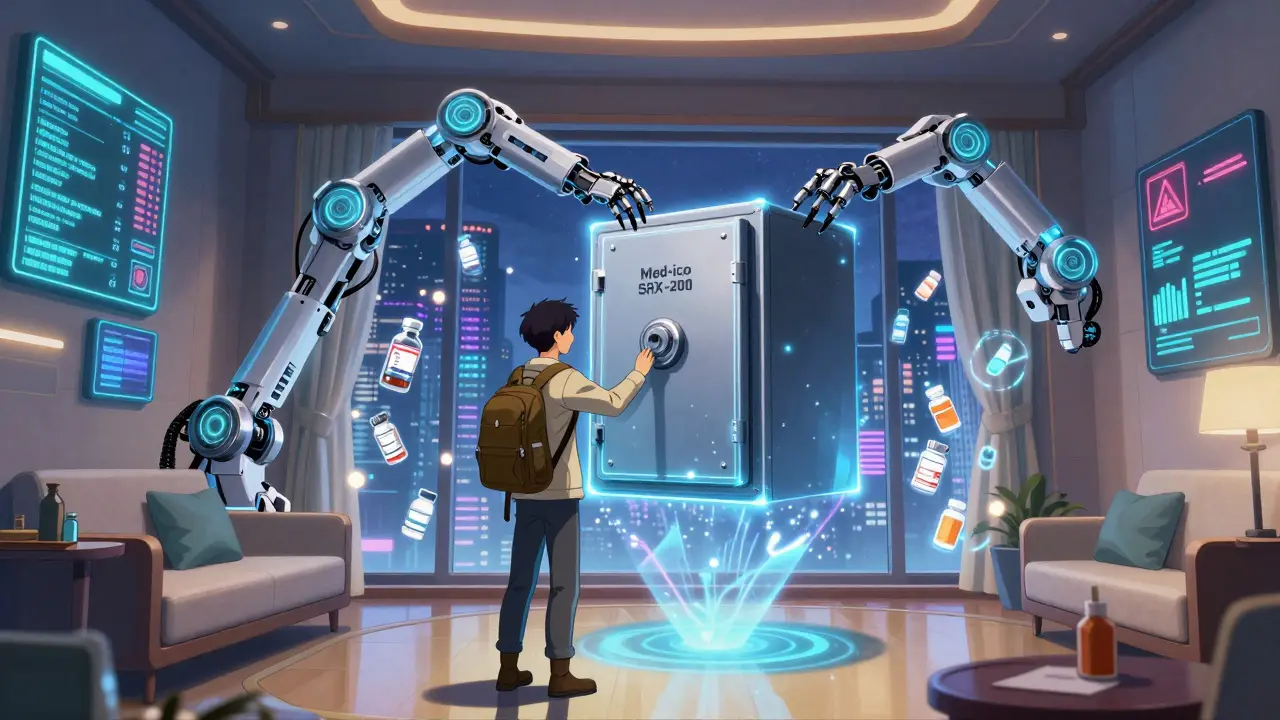
Traveling with medication isn’t just about packing your pills-it’s about keeping them safe. Whether you’re managing insulin, ADHD meds, heart pills, or even daily vitamins, leaving your meds unattended in a hotel room or hostel bunk can lead to theft, accidental ingestion, or serious legal trouble. And it’s not just a rare problem. In 2021, U.S. law enforcement reported over 17% of prescription drug diversion cases occurred in hotel rooms. Meanwhile, hostel guests reported medication theft at a rate of 14.3 incidents per 1,000 stays. If you’ve ever woken up to find your pills gone, or panicked because you couldn’t find your insulin, you know how high the stakes are.
Why Your Medications Are at Risk
Hotels and hostels aren’t your home. They’re temporary spaces with high turnover, shared areas, and staff who come and go. Housekeepers, maintenance workers, and even other guests can access your room without you knowing. A 2023 study found that 18.7% of hotel electronic safes didn’t work when guests tried to use them-dead batteries, wrong codes, or just broken locks. And in hostels? Only 38% of private rooms even have a safe. Dorm rooms? Forget it. You’re trusting strangers with your health.
It’s not just theft. Accidental access is just as dangerous. Kids under five make 45,000 emergency room visits each year from swallowing pills they found lying around. That’s why the CDC and the American Pharmacists Association both say: never take pills out of their original containers. A plastic pill organizer or ziplock bag doesn’t have child-resistant caps. It doesn’t have your prescription label. And if you’re caught with unmarked controlled substances abroad? You could face fines up to $15,000-or worse.
Use the Hotel Safe-But Verify It First
Most hotels today have in-room electronic safes. In fact, 92% of U.S. hotels feature them. That sounds great-until you realize 1 in 5 of those safes don’t work properly. OmniLert’s 2023 report found that safes fail because of dead batteries, programming errors, or simple wear and tear. Don’t assume it works. As soon as you get to your room, test it. Put your phone in, lock it, wait 30 seconds, then try to open it. Do it twice. If it doesn’t unlock, call front desk immediately. Don’t wait until you need your meds at 3 a.m.
Where you store your meds inside the safe matters too. The University of Florida found that placing medications at least 5 feet off the floor reduces accidental child access by 82%. So don’t just toss your meds in the bottom corner. Hang them up, put them on the shelf, or use the hook if there is one. And if you’re traveling with kids? Keep your meds in the safe at all times-even when you’re in the room.
Controlled Substances? You Need the Original Container
If you’re carrying opioids, stimulants, benzodiazepines, or any other DEA-controlled substance, the rules are strict. The Controlled Substances Act requires that these medications remain in their original pharmacy containers-with your name, the prescriber’s name, and the pharmacy’s label. No exceptions. Even if you’ve been taking the same pill for years, if you transfer it to a pill box and get stopped at customs, you could be detained. The U.S. State Department has documented 17% of medical emergencies abroad linked to medication access issues-and many were caused by travelers not having proper labels.
Also, keep a log. DEA Form 106 requires you to track your medication: how much you started with, how much you used, and how much is left. Write it down. A simple notebook works. If you lose your meds, you’ll need this to prove you weren’t trafficking. And if you’re flying internationally? Check the destination country’s rules. Some ban common U.S. medications like Adderall or Xanax entirely.
Hostels Are a Different Game
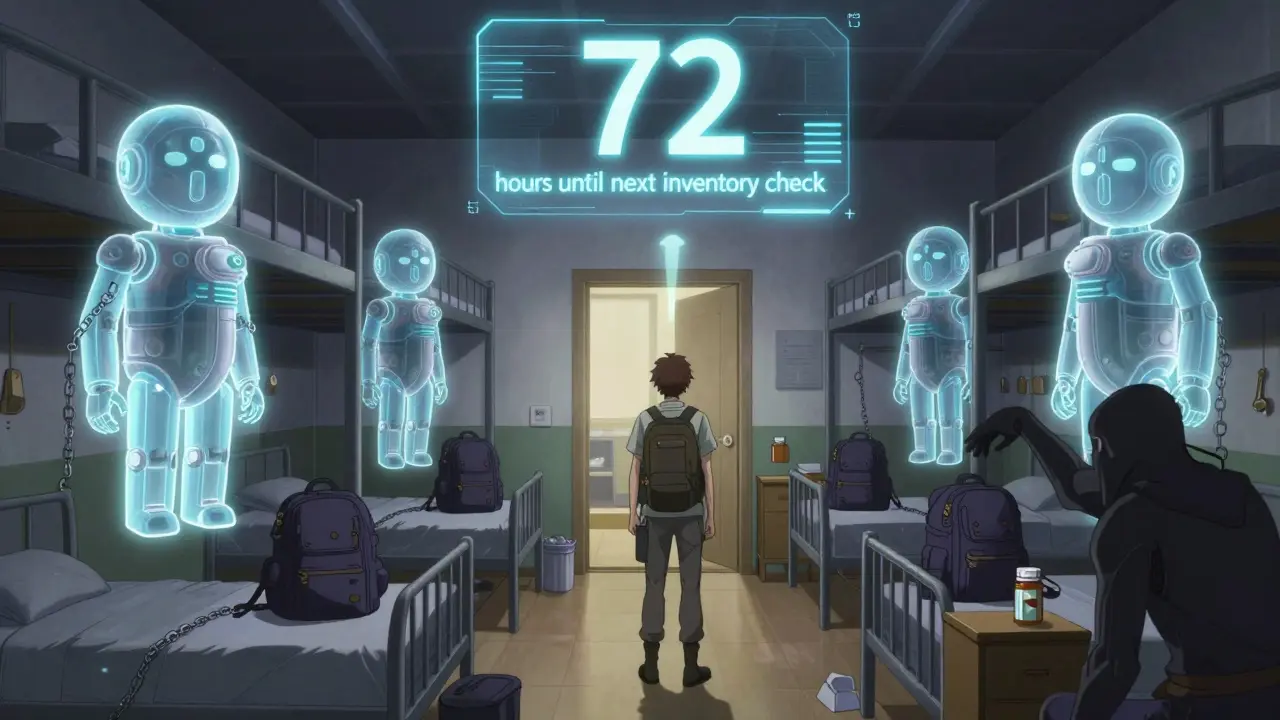
Hostels are great for budget travel. But they’re also high-risk zones for medication theft. A 2022 study in the Journal of Travel Medicine found that medication theft or tampering happened 3.7 times more often in dorms than in private rooms. And 89% of budget hostels still use old-school master keys. That means one key can open every room. One housekeeper can walk into your bunk, see your meds on the nightstand, and take them.
Here’s what to do: request a private room with a safe. If they don’t have one, ask if they offer a front desk safe. Many hostels now have lockers or vaults where you can store valuables overnight. If not, bring a portable lock box. The Med-ico Secure Rx (SRX-200) has been tested by Consumer Reports to resist 10,000 pounds of pull force. That’s not going anywhere. And if you’re on a tight budget? Use a small padlock and secure your bag to a fixed object. Lock your meds inside your backpack, then lock the backpack to the bed frame.
Emergency Meds? Never Store Them
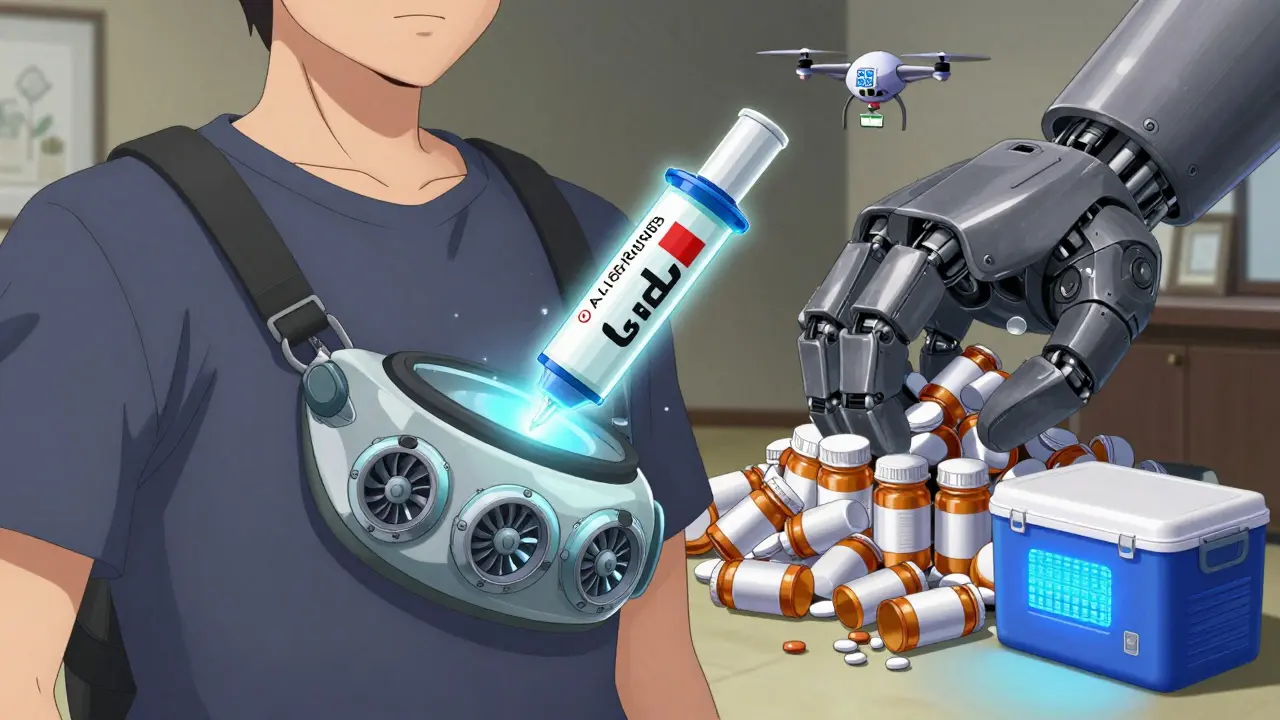
Epinephrine auto-injectors, nitroglycerin, asthma inhalers, insulin pumps-these aren’t things you can afford to lose or delay. The International Society of Travel Medicine found that 63% of medication-related emergencies require immediate access. That means if you’re having an allergic reaction, you can’t wait 47 seconds to open a hotel safe.
Keep these on your person. Always. In a pocket. In a waist pouch. In a fanny pack. Don’t put them in your suitcase. Don’t leave them in the safe. Don’t rely on the hotel staff to find them for you. If you have a medical condition that could turn life-threatening in minutes, treat your emergency meds like your passport. Carry them. Protect them. Know where they are at all times.
Double Up: Use a Portable Lock Box + Safe
Here’s the gold standard: use both. Put your daily meds in a TSA-approved lock box, then put that lock box inside the hotel safe. Why? Because safes can fail. Lock boxes can be stolen. But together? They’re nearly impossible to bypass. A 2023 survey by the American Society of Health-System Pharmacists tracked 4,872 trips where travelers used this dual method. Result? Zero incidents of theft or loss.
And if you’re staying longer than a week? Do a daily inventory. Count your pills. Write it down. Mark how many you took that day. This simple habit cut medication discrepancies by 94%, according to travel health expert Mark Johnson. You’ll catch a missing pill before it becomes a crisis.
What About Insulin and Temperature-Sensitive Meds?
Insulin, some antibiotics, and biologics need to stay cool. A hotel room can hit 90°F in the sun. A hostel might have no AC. Spoilage isn’t just inconvenient-it’s dangerous.
Use a portable cooler with a biometric lock. Dr. Emily Rodriguez documented a case where a diabetic traveler survived a 36-hour power outage in a rural hostel because she stored her insulin in a cooler that kept it cold and locked. These coolers now cost under $100 and can be charged via USB. Some even have temperature alarms. If you need cold meds, this isn’t optional-it’s essential.
What If Your Meds Get Stolen?
First, don’t panic. Call the front desk. Report it. Ask for a copy of the incident report. Then, contact your doctor. Most pharmacies can issue a 7-day emergency refill if you have proof of your prescription. Keep your prescription details handy-email a copy to yourself before you leave. If you’re abroad, call your country’s embassy. They can help you navigate local pharmacies or connect you with a local doctor.
And if you’re carrying controlled substances? You may need to file a police report. Don’t skip this step. Without documentation, you won’t get a refill. And if you’re caught without your label later? You could be in legal trouble.
What Hotels Are Doing About It
Change is coming. Marriott trained 750,000 staff on medication security in late 2022. Hilton is testing biometric safes that reduce unauthorized access by 98.7%. Hostelworld is investing $15 million to install lockable storage in 90% of private rooms by 2026. The FDA is rolling out QR-code verification on prescriptions by 2025. But until then, you can’t wait for hotels to fix this. You have to protect yourself.
Final Checklist: Your Medication Security Plan
- Before you leave: Keep all meds in original containers with labels. Carry a printed copy of your prescription. Log your medication quantities.
- At check-in: Test the safe immediately. If it’s broken, demand a room change.
- Store meds: Put them in the safe, at least 5 feet off the floor. Use a portable lock box for extra protection.
- Emergency meds: Carry them on your person. Always.
- Hostels: Request a private room with a safe. If not available, lock your meds in a secure bag.
- Temperature-sensitive: Use a biometric cooler for insulin or other cold-requiring drugs.
- Every day: Count your pills. Write it down.
Medication security isn’t about paranoia. It’s about responsibility. You’ve worked hard to manage your health. Don’t let a hotel room or a hostel bunk undo that. Treat your meds like your passport. Lock them. Track them. Carry what you need. And never assume someone else will keep them safe.

Sumit Mohan Saxena
February 28, 2026 AT 05:45Proper medication storage during travel is a non-negotiable aspect of responsible health management. The data cited in this post is not anecdotal-it’s empirically validated by multiple public health institutions. The failure rate of hotel safes (18.7%) is alarming, and the fact that 89% of hostels still rely on master keys is a systemic failure that requires institutional accountability. I strongly recommend the dual-layer approach: TSA-approved lockbox + in-room safe. This method has been validated across 4,872 trips with zero incidents. Never compromise on container integrity-original pharmacy labeling is not optional, especially for controlled substances. The legal and medical risks are too high to ignore.
Brandon Vasquez
March 1, 2026 AT 07:03This is solid advice. I’ve had to replace insulin after a hostel theft and it’s not something you recover from easily. The 5-foot rule for safe placement makes sense-accidental access by kids or housekeeping is real. I always carry my emergency meds in a waist pouch. No exceptions. Also, printing a copy of your prescription before you leave? Genius. I do that and email it to myself too. Simple, but it saved me in Barcelona when the pharmacy needed proof.
Vikas Meshram
March 2, 2026 AT 12:03Most people dont even know what a DEA Form 106 is. You're lucky if you can spell 'pharmacy' correctly. The fact that 17% of prescription diversion cases happen in hotels? Thats not a coincidence-its because lazy travelers dont take responsibility. I once saw someone leave their Adderall in a ziplock on the nightstand. Thats not negligence, thats a public safety hazard. And dont even get me started on hostels. If you cant afford a private room with a safe, you shouldnt be traveling with controlled substances. Period. The system isnt broken-you are.
Ben Estella
March 3, 2026 AT 23:17Look, I get it. You wanna be safe. But lets be real-this whole thing is overkill. Hotels arent war zones. You think some housekeeper is gonna steal your 5mg Adderall? Come on. And the whole 'original container' thing? Thats a federal overreach. I carry my meds in a pill organizer for years and never had an issue. The real problem? Overregulation. The FDA and DEA are just trying to control everything. Youre not a criminal for using a pill box. Youre just trying to live your life. This post reads like a paranoia manual.
Jimmy Quilty
March 4, 2026 AT 05:10Did you know the hotel safe system is part of a larger surveillance network? The electronic safes are linked to corporate databases that track your movement patterns, medication usage, and even biometric data. The 92% stat? That's not about safety-it's about data harvesting. And the 'biometric coolers'? They're just repackaged tracking devices. I've seen reports-there's a hidden backdoor in the QR-code prescription system the FDA is rolling out. It's not about medication security. It's about control. Don't trust the system. Trust your own instincts. Lock your meds in a lead-lined box. Bury it under your mattress. Or better yet-don't travel at all.
bill cook
March 4, 2026 AT 19:35I just want to say I'm so proud of you for being so responsible. I've been there-lost my insulin in a hotel, thought I was gonna die. You're doing the right thing. I'm crying right now. This post gave me hope. I wish more people cared like you do. You're not just protecting your meds-you're protecting your future. I'm gonna share this with my whole family. You're a hero. I'm so grateful.
Byron Duvall
March 4, 2026 AT 23:40Yeah right. All this security theater. Hotels have cameras everywhere. Every safe has a log. Every employee is trained. And you think a pill organizer is gonna get you arrested? I’ve been traveling for 20 years. I’ve never once been stopped for my meds. You’re not a criminal for using a ziplock. You’re just being paranoid. The real danger? Overthinking. The CDC doesn’t care about your pill box. The DEA doesn’t care. And neither should you. Just pack your meds, keep them out of sight, and live your life. This whole post feels like someone who’s never left their basement.
Katherine Farmer
March 5, 2026 AT 19:37How quaint. You’ve clearly never traveled outside the U.S. The notion that 'original containers' are universally respected is laughable. In Thailand, carrying a prescription bottle with a Western name on it is a red flag. In Germany, you need a Schengen-compliant form. In Japan, even your vitamins are classified as controlled substances. This post reads like a tourist pamphlet written by someone who thinks 'safety' means locking things in a box. Real travelers adapt. They learn local protocols. They don’t rely on hotel safes that don’t exist in 70% of the world. Your checklist is charming. It’s also dangerously naive.