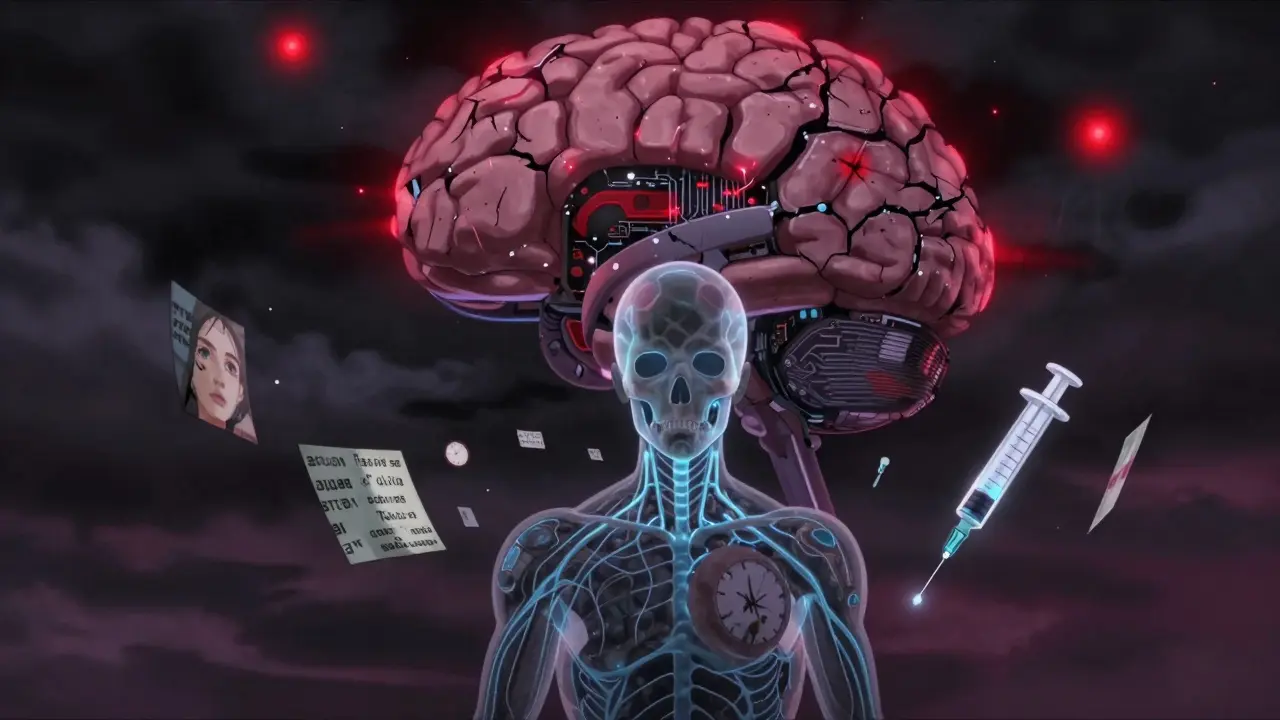
When someone overdoses on medication, the emergency team rushes in, administers naloxone or activated charcoal, and stabilizes the patient. They’re discharged with a warning: don’t do it again. But what no one tells you is that surviving an overdose doesn’t mean you’re back to normal. For many, the real battle begins after they leave the hospital.
Brain Damage Isn’t Always Obvious
The most silent and lasting damage from a medication overdose happens inside the brain. When breathing slows or stops - even for a few minutes - the brain is starved of oxygen. This isn’t just a scare tactic. After just four minutes without oxygen, brain cells start dying. And it doesn’t matter if you were on prescription opioids, benzodiazepines, or even an overdose of over-the-counter painkillers like paracetamol. The result is the same: hypoxic or anoxic brain injury.People who survive often don’t realize what’s changed until weeks or months later. They forget names mid-conversation. They can’t focus at work. Simple decisions - what to wear, what to eat - take forever. A 2023 clinical analysis found that 63% of overdose survivors struggle with memory loss. Nearly half have trouble with balance, leading to falls. One in three can’t speak clearly or understand others. These aren’t temporary side effects. They’re permanent changes.
And it’s not just oxygen. The drugs themselves poison the brain’s chemistry. Studies show that 78% of overdose survivors have lasting changes in their neurotransmitters - the brain’s messaging system. Dopamine, serotonin, GABA - all disrupted. That’s why many survivors say they feel like they’re walking through fog, even when they’re physically healed.
Organs Don’t Heal the Same Way
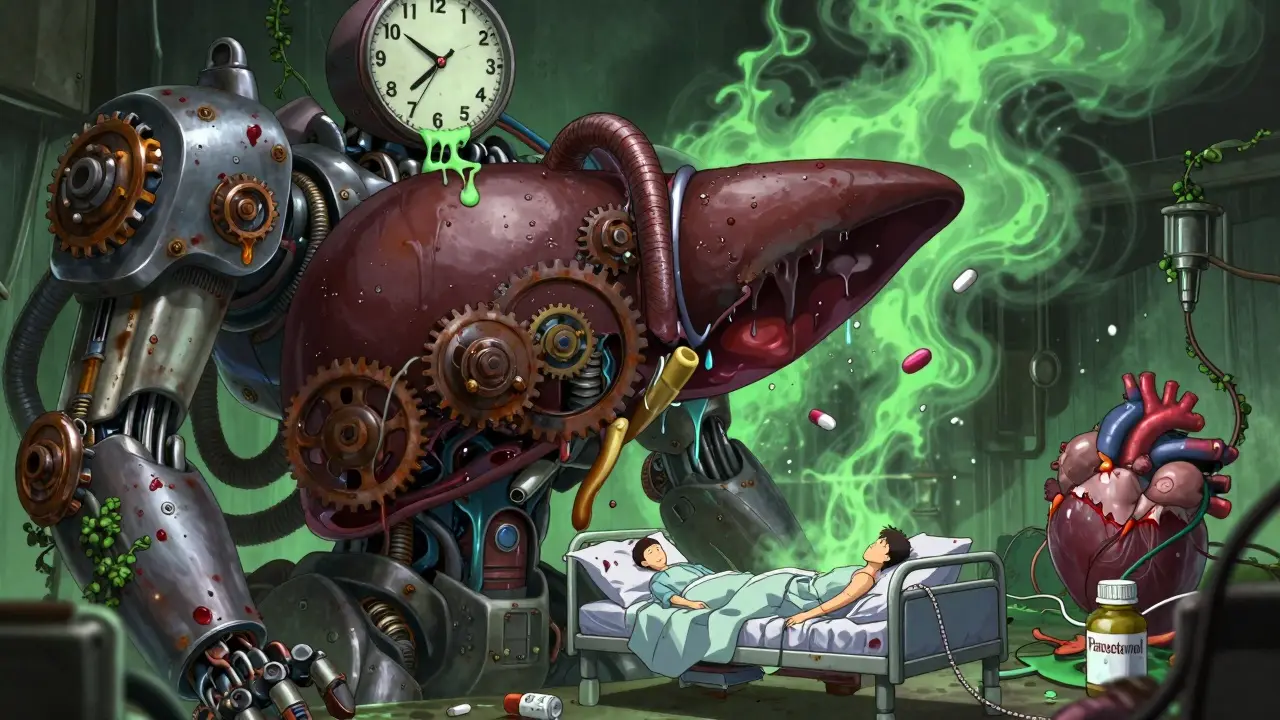
Your liver, kidneys, heart - they don’t get a pass just because you didn’t die. Each class of drug leaves its own signature of damage.Take paracetamol (acetaminophen). It’s safe at the right dose. But take too much - even just 15 pills - and it turns toxic. The liver starts breaking down the drug into a poison. Symptoms? None for the first 24 hours. By the time nausea and vomiting show up, it’s often too late. A 2022 study in the Journal of Hepatology found that 45% of people who waited more than eight hours to get treatment developed chronic liver disease, including cirrhosis. That’s not a guess. That’s data from real patients.
Opioids like oxycodone or tramadol cause breathing to slow so much that oxygen drops to dangerous levels. The kidneys suffer. The heart gets stressed. In one study of non-fatal overdoses, 22% of survivors ended up with kidney damage. Eight percent had strokes. Fifteen percent developed fluid in the lungs. These aren’t rare outcomes. They’re expected complications.
Benzodiazepines - Xanax, Valium - don’t just knock you out. They depress the central nervous system for hours. Survivors often report brain fog that lasts over a year. One 2023 review found that 27% of people who overdosed on these drugs still had trouble with memory and decision-making six months later.
Stimulants like Adderall or Ritalin? They overwork the heart. Survivors are 31% more likely to develop high blood pressure or irregular heart rhythms. These aren’t temporary spikes. They’re long-term conditions that need lifelong management.
The Mental Health Toll Is Real
You survive the overdose. But then you start reliving it.Over 70% of survivors develop a new mental health condition. PTSD. Depression. Anxiety. The trauma of nearly dying - the panic, the helplessness, the feeling of your body shutting down - doesn’t vanish when you wake up in the hospital.
One woman on Reddit shared: “Two years later, I still forget conversations from 10 minutes ago. My balance is so bad I’ve fallen three times this year.” Another wrote: “Every day feels like walking through fog. Simple decisions take me 10 minutes.” These aren’t dramatic stories. They’re common.
And here’s the worst part: only 28% of overdose survivors get proper mental health care within 30 days of leaving the hospital. The system treats the overdose like a one-time event. But for most, it’s the start of a new, longer illness.
Why Nobody Talks About the Aftermath
Emergency rooms are trained to save lives. That’s their job. But once the patient is stable, the focus shifts. No one checks for brain injury. No one orders a neurological exam. No one refers them to a therapist who understands overdose trauma.A 2022 study of hospital discharge records found that 41% of overdose survivors were sent home with no plan for follow-up care - not even a referral. That’s not negligence. It’s systemic failure.
Doctors don’t always know what to look for. A 2022 survey showed only 38% of regular people could identify the three signs of opioid overdose: unresponsiveness, pinpoint pupils, slow breathing. If laypeople can’t recognize it, how can medical staff be expected to predict the long-term damage?
And even when they do, resources are scarce. Only 31% of U.S. counties have specialized rehab programs for neurological recovery after overdose. In rural areas, it’s worse. People wait weeks just to get a brain scan. By then, the window to prevent further damage has closed.
It’s Not Just About the Drug - It’s About the Delay
Time is everything.For opioid overdoses, giving naloxone within 4 to 5 minutes can prevent brain damage. But the average time to treatment? Over 11 minutes. In rural towns, it’s more than 22 minutes. That’s not a delay. That’s a death sentence for brain cells.
For paracetamol, the magic window is 8 hours. After that, liver damage becomes irreversible. But 32% of patients don’t get help until it’s too late - because they didn’t feel sick yet.
That’s the cruel trick of overdose: you feel fine… until you’re not. And by then, it’s too late to fix what’s broken.
What Needs to Change
The good news? Things are starting to shift. In 2023, the U.S. government allocated $156 million to study long-term brain damage from overdoses - the first time this has ever been funded at a federal level. The American Medical Association now requires doctors to do neurological assessments within 72 hours of an overdose survival.But progress is slow. The Congressional Budget Office predicts that by 2030, only 22% of survivors will get the care they need. That means millions will live with brain damage, organ failure, and untreated trauma - not because they didn’t survive, but because no one looked beyond survival.
The message needs to change. Surviving an overdose isn’t a win. It’s the beginning of a long recovery - one that requires medical follow-up, mental health support, and a system that doesn’t treat this like a one-time mistake.
If you or someone you know has survived an overdose, don’t wait for symptoms to show up. Get a brain scan. Get a liver test. See a therapist who specializes in trauma. You didn’t just survive a medical emergency. You survived a life-altering event. Your body and mind deserve more than a warning sticker on a prescription bottle.
Can you recover from brain damage caused by a medication overdose?
Recovery depends on how long the brain was without oxygen. If oxygen deprivation lasted less than five minutes, some improvement is possible with rehab, therapy, and time. But if it lasted over 10 minutes, permanent damage is likely. The brain can rewire itself to some extent, but lost neurons don’t grow back. Early intervention - within weeks of the overdose - gives the best chance for recovery.
Is liver damage from a paracetamol overdose always permanent?
Not always, but it’s very common if treatment is delayed. If you get the antidote (N-acetylcysteine) within 8 hours of taking too much paracetamol, your liver can heal with little to no damage. After 8 hours, the risk of permanent scarring (cirrhosis) jumps sharply. By 24 hours, liver failure becomes a real possibility. Many people don’t feel sick until 48-72 hours later - which is why waiting to seek help is so dangerous.
Do all overdose survivors develop mental health issues?
No, but the risk is extremely high. Studies show 73% of survivors develop at least one new mental health condition - PTSD, depression, or anxiety. This isn’t just about addiction. It’s about the trauma of nearly dying. The experience of losing control, feeling your body shut down, or being revived by strangers can leave deep psychological scars. Many don’t get help because they’re told they’re “lucky to be alive,” as if that should be enough.
Can an overdose cause permanent memory loss?
Yes. Memory loss is one of the most common long-term effects. Around 63% of survivors report trouble with short-term or long-term memory. This happens because the hippocampus - the part of the brain that forms memories - is especially sensitive to oxygen loss. Some people forget conversations, names, or even how to do tasks they used to do easily. Memory rehab and cognitive therapy can help, but full recovery is rare if the overdose caused prolonged brain hypoxia.
What should you do after surviving a medication overdose?
Don’t assume you’re fine just because you’re breathing. Demand a full medical evaluation: brain imaging (MRI or CT), liver and kidney function tests, a neurological exam, and a mental health screening. Ask for referrals to specialists - neurologists, addiction psychiatrists, or trauma therapists. Join a support group for overdose survivors. And tell your doctor you’re not done healing - because you’re not. This isn’t a one-time event. It’s the start of a new chapter in your health.
Mike P
January 20, 2026 AT 20:30Look, I get it - people think overdosing is just a bad decision and they get a free pass. But here’s the thing: if you’re dumb enough to OD on Oxy, you’re probably dumb enough to not care about brain damage anyway. I’ve seen it a hundred times. Guy wakes up, acts like he’s some martyr, then goes right back to popping pills. The system’s broken, sure - but the real problem is people who treat survival like a trophy. You didn’t win. You just got lucky. Now deal with it.
Liberty C
January 22, 2026 AT 15:50Let’s be brutally honest - this isn’t a medical crisis, it’s a cultural one. We’ve turned suffering into a spectacle. People post their rehab journeys like Instagram milestones. ‘Look at me, I survived!’ Meanwhile, the brain is a ghost town and the liver’s a parking lot for toxins. And no one wants to admit that the real villain isn’t the drug - it’s the entitlement. You think your pain is unique? It’s not. It’s just the predictable outcome of a society that rewards self-destruction with sympathy.
shivani acharya
January 23, 2026 AT 21:27Oh wow, so now it’s all about ‘brain damage’? Funny how they never mention the real reason people OD - because the government’s been slipping SSRIs into the water supply since 2012 to keep us docile. I read a paper - well, a blog post - that said the CDC’s funding for ‘overdose research’ is just a front for mind control experiments. You think your memory loss is from paracetamol? Nah. It’s the fluoride. The lithium. The 5G towers syncing with your hippocampus. They don’t want you to remember who you were before the hospital. That’s why they send you home with no follow-up - because if you start asking questions, the whole system collapses. I know this because my cousin’s neighbor’s dog barked differently after the 2020 lockdowns.
Margaret Khaemba
January 25, 2026 AT 03:47I’m from Kenya and I’ve seen how little access people have to even basic care here - so reading this hit hard. I never realized how much the U.S. system fails people after they survive. In Nairobi, if you get sick, you either find a way or you don’t. But here, you survive and then get ignored? That’s not just negligence - it’s a moral failure. I’ve met people who’ve had strokes from overdoses and were told to ‘just take it easy.’ No scans. No therapy. No one asking if they can still tie their shoes. We need to stop treating recovery like an afterthought. It’s not about blame. It’s about humanity.
Malik Ronquillo
January 26, 2026 AT 00:34Alec Amiri
January 27, 2026 AT 20:51Okay but why are we even talking about this? People who OD are just weak. They chose to do it. If you can’t handle your mental health, don’t blame the system. Get therapy. Get a job. Stop being a victim. And if you’re gonna OD on Tylenol, at least do it right. Don’t make us clean up your mess.
Lana Kabulova
January 29, 2026 AT 17:37Wait - 63% memory loss? 78% neurotransmitter disruption? 45% liver damage? Are you kidding me? That’s not a statistic - that’s a genocide. And they’re not even tracking this properly. Hospitals don’t have the software to log long-term outcomes. Insurance won’t cover follow-ups. Doctors don’t get paid for it. And the worst part? We’re still treating this like a moral failing instead of a public health emergency. It’s not just broken - it’s designed to fail. And we’re all complicit.
Lauren Wall
January 30, 2026 AT 14:55Surviving doesn’t mean healing. And we act like it does. That’s the problem.
Oren Prettyman
January 31, 2026 AT 12:09While I acknowledge the compelling empirical data presented in this exposition, I must respectfully contest the underlying assumption that systemic neglect is the primary causative factor in the post-overdose morbidity trajectory. The data, though statistically significant, fails to account for individual behavioral agency, socioeconomic resilience, and the confounding variable of pre-existing neurocognitive predisposition. Moreover, the assertion that 'survival is not a win' appears to be a value-laden proposition that inadvertently stigmatizes those who have endured such trauma by implying that mere survival is insufficient. One might argue that survival, in and of itself, constitutes a biologically improbable triumph - one that ought not be diminished by subsequent expectations of perfection. The medical infrastructure may indeed be inadequate, but to conflate institutional failure with personal worth is both logically unsound and ethically perilous.