
Imagine walking into a specialist’s office for a routine check-up. You mention you’re taking a new blood thinner prescribed by your cardiologist. The specialist frowns, checks their notes, and realizes they just prescribed an anti-inflammatory that dangerously interacts with that thinner. This isn’t a movie plot; it’s a terrifying reality for millions of patients managing care across different providers.
If you see more than one doctor-whether it’s a primary care physician, a cardiologist, and a dermatologist-you are navigating a fragmented system where information often gets lost in translation. According to the Agency for Healthcare Research and Quality (AHRQ), medication errors affect 1.5 million people annually in the U.S., costing billions in additional medical costs. A significant portion of these errors stems from simple communication breakdowns between providers who don’t talk to each other.
You cannot rely on your doctors to magically know what every other specialist is prescribing. In fact, studies show that 83% of patients incorrectly assume their providers communicate regularly about medication changes. They don’t. That responsibility falls largely on you. Here is how to take control of your medication safety, prevent dangerous interactions, and ensure your care team is actually working together.
The Hidden Dangers of Fragmented Care
When healthcare is split among multiple providers, the risk of error spikes dramatically. A 2022 study published in the National Institutes of Health (NIH) found that patients with three or more providers were 3.2 times more likely to experience medication regimen conflicts than those seeing a single doctor. Why? Because specialists often focus narrowly on their specific area. Your cardiologist cares about your heart; your orthopedist cares about your knee. Neither may fully consider how their prescriptions interact with the third prescription you’re taking for anxiety.
This phenomenon is known as "polypharmacy" when it involves multiple drugs, but the real issue here is "prescribing cascade." One doctor treats a symptom caused by another doctor’s medication side effect, adding yet another pill to the mix. The NIH data reveals that specialists initiate 41% of medications that conflict with existing regimens. Furthermore, 57% of patients reported that specialists made changes to their medications without consulting their primary care provider. You are left holding the bag, trying to figure out which pill goes with which appointment.
Why don't my doctors talk to each other?
Many healthcare systems use incompatible Electronic Health Records (EHRs). Even within the same hospital, different departments might not share real-time updates. Additionally, time constraints mean specialists rarely have the luxury of calling your primary care doctor before every visit. They rely on the information you bring or the limited data available in their own system.
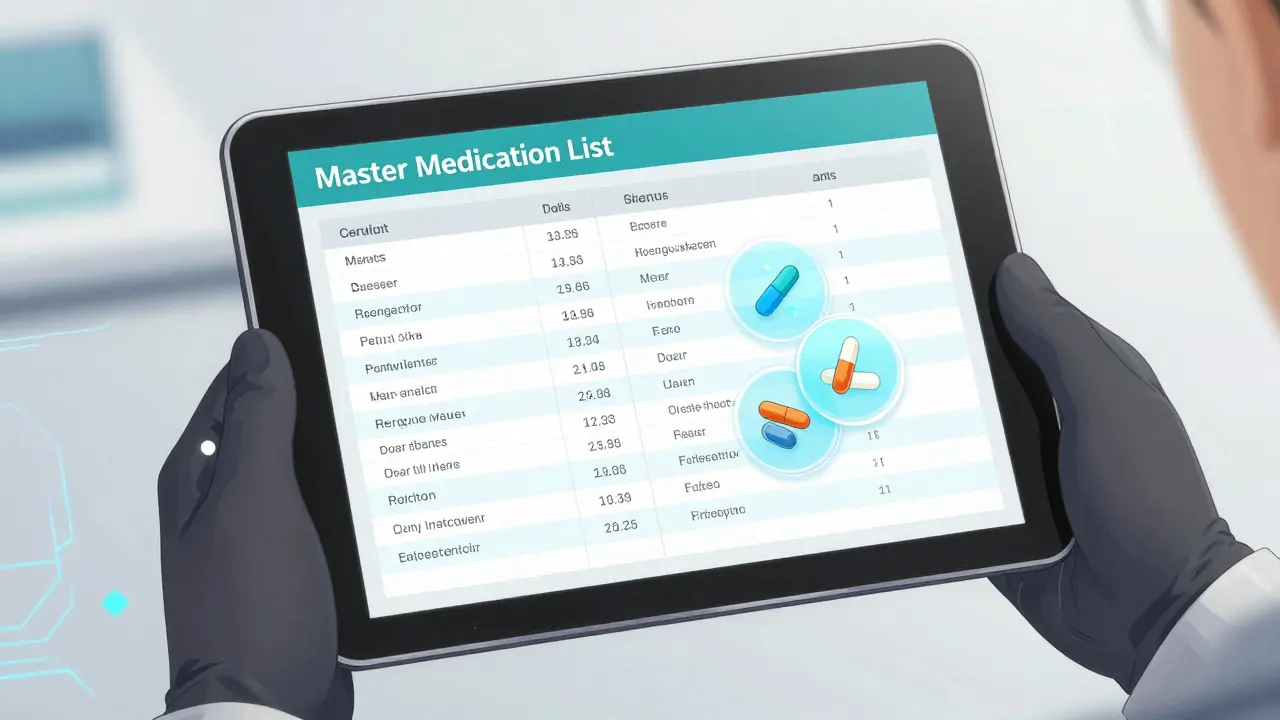
Your Master Medication List: The Single Source of Truth
The most powerful tool you have is a comprehensive, up-to-date medication list. But not just any list will do. Many patients carry a crumpled piece of paper with only brand names scribbled on it. This is insufficient. To be effective, your list must contain four critical elements for every substance you ingest:
- Name of the medication: Include both the brand name (e.g., Lipitor) and the generic name (e.g., atorvastatin). Doctors may refer to them differently.
- Dosage: Be precise. Is it 10mg, 20mg, or half a tablet? Vague dosages lead to dangerous under- or overdosing.
- Frequency: How often do you take it? Once daily? Twice a day? Only at bedtime? Specify this clearly.
- Purpose: Why are you taking it? This helps new providers understand the context. For example, knowing you take metformin for "Type 2 Diabetes" provides immediate clinical context.
Don’t forget supplements, vitamins, and over-the-counter drugs. Many patients omit these, thinking they aren’t "real" medications. However, St. John’s Wort can interfere with antidepressants, and even high-dose Vitamin E can increase bleeding risk if you’re on blood thinners. Tulane University’s Public Health research shows that maintaining a complete list reduces medication errors by 37%. Update this list immediately after every doctor’s visit or pharmacy change. Carry a printed copy to every appointment and keep a digital version on your phone.
Mastering the Art of the Doctor Visit
How you present yourself during appointments matters. Don’t wait for the doctor to ask, "What medications are you on?" If they forget, you must speak up. Start the conversation by handing them your master list. Say, "Here is everything I am currently taking, including supplements. Please check for interactions before adding anything new."
Use the "Teach-Back Method," a technique validated by the AHRQ. After the doctor explains a new prescription or change, repeat it back to them in your own words. "So, I should stop taking the old pill and start this new one at 5 mg twice a day, correct?" This simple step reduces misunderstandings by 45%. It forces clarity and ensures you leave with the right instructions.
If a specialist wants to add a new medication, ask directly: "Have you checked this against my current list? Does this interact with my blood pressure meds?" Most doctors appreciate this proactive approach because it protects them from liability and keeps you safe. If they seem rushed or dismissive, politely insist on a pharmacist review later. Never feel guilty for advocating for your safety.
Make Your Pharmacist Your Ally
Your pharmacist is arguably the most important member of your healthcare team regarding medication safety. While doctors diagnose and prescribe, pharmacists specialize in drug interactions, dosages, and therapeutic outcomes. Research from Asteroid Health indicates that involving pharmacists in medication management leads to 32% higher adherence rates and significantly fewer errors.
Consolidate all your prescriptions at one pharmacy whenever possible. When all your pills come from one source, the pharmacy’s computer system automatically flags potential interactions. If you split prescriptions between two pharmacies, that safety net disappears. The pharmacist at Pharmacy A doesn’t know what Pharmacy B dispensed.
Ask your pharmacist for a "Medication Therapy Management" (MTM) session. This is a dedicated consultation where they review your entire regimen, identify redundancies, and suggest simplifications. They can also serve as a communication hub. If your cardiologist prescribes something new, call your pharmacist first. Ask, "Does this make sense given what I’m already taking?" They can often catch issues before you even fill the prescription.

Navigating Electronic Health Records (EHRs)
We live in the digital age, so why isn’t technology solving this? The problem is interoperability. While the 21st Century Cures Act mandates better data sharing, a 2023 report found that only 38% of providers can consistently access complete patient medication histories across different systems. Your primary care doctor’s EHR might not talk to the specialist’s EHR.
Don’t assume your records are shared. Always verify. When you join a new practice or see a new specialist, ask, "Did you receive my records from Dr. Smith?" If the answer is no, provide your master list. Some health systems offer patient portals that allow you to view your own records. Use these tools to double-check what has been documented. If you see an error-like a discontinued med still listed as active-report it immediately through the portal or by calling the office.
| Strategy | Effectiveness | Effort Required | Best For |
|---|---|---|---|
| Master Medication List | High | Medium (requires maintenance) | All patients with multiple providers |
| Single Pharmacy Consolidation | Very High | Low | Catching automatic interaction alerts |
| Pharmacist MTM Consult | High | Medium (scheduling required) | Complex regimens with 5+ meds |
| Relying on EHR Sharing | Low to Moderate | None | Patients within integrated health systems only |
When to Escalate: Red Flags and Next Steps
Sometimes, despite your best efforts, things go wrong. Watch for red flags such as unexplained side effects, worsening symptoms, or confusion about which pill to take when. If you suspect a medication error, contact your primary care provider immediately. They are best positioned to oversee your overall health and coordinate with specialists.
In severe cases, such as allergic reactions or signs of overdose, seek emergency care. Bring your medication list and all pill bottles with you. Emergency room doctors need accurate information fast to stabilize you.
For long-term management, consider asking your primary care provider to act as the "quarterback" of your care. Some practices offer care coordinators who specifically manage communication between specialists. If you are enrolled in an Accountable Care Organization (ACO), you may have access to these resources. CMS data shows ACO patients experience 27% fewer medication-related hospital readmissions due to better coordination. Ask your insurer or provider network if care coordination services are available to you.
What is the "Teach-Back Method"?
The Teach-Back Method is a communication technique where you repeat back instructions in your own words to confirm understanding. For example, if a doctor says "take this twice a day," you reply, "So I’ll take one pill in the morning and one at night." This ensures you didn’t mishear or misunderstand the dosage or timing.
Should I tell my doctor about herbal supplements?
Yes, absolutely. Herbal supplements like garlic, ginkgo biloba, and St. John’s Wort can have potent chemical effects that interact with prescription drugs. Omitting them from your medication list can lead to dangerous interactions, such as increased bleeding or reduced effectiveness of other medications.
How often should I update my medication list?
Update your list immediately after any change. This includes starting a new med, stopping one, changing a dose, or switching pharmacies. Aim to review it monthly to ensure accuracy, especially if you see multiple providers throughout the month.
Can I force my doctors to share records?
You can request that your providers share records via fax or secure electronic transfer, but you cannot force interoperability between different hospital systems. Your best leverage is providing your own accurate, written list to bridge the gap until systems improve.
Who is responsible for catching drug interactions?
Technically, the prescribing doctor is responsible. However, in a fragmented system, the burden often shifts to the patient and the pharmacist. Pharmacists have specialized software to flag interactions, making them a critical safety net. Patients must advocate by presenting a complete list to enable these checks.