When you pick up a prescription for generic lisinopril, metformin, or atorvastatin, you probably assume the price is low because competition keeps it that way. But what if that low price isn’t guaranteed? What if, in some cases, a single pill costs $50 instead of $0.50 - not because of manufacturing costs, but because only two companies make it and no one is watching? This isn’t a hypothetical. It’s happening right now in the U.S. generic drug market.
How Generic Drugs Get Their Prices
Unlike brand-name drugs, which are protected by patents and can charge high prices for years, generic drugs enter the market after those patents expire. The idea is simple: more manufacturers = more competition = lower prices. And for the most part, that works. About 90% of all prescriptions in the U.S. are filled with generics. But the system isn’t as fair or stable as it sounds.The federal government doesn’t set prices for generics directly. Instead, it uses indirect tools to push prices down. The biggest one is the Medicaid Drug Rebate Program. Every company that sells generic drugs to Medicaid must give back a portion of what they charge. For generics, that rebate is either 23.1% of the average price they charge wholesalers - called the Average Manufacturer Price (AMP) - or the difference between that price and the lowest price they offer any other buyer, whichever is higher. In 2024, this program brought back $14.3 billion in rebates, and 78% of that came from generic drugs.
That money doesn’t go to patients. It goes to state Medicaid programs. But it does force manufacturers to keep prices low if they want to keep selling to Medicaid. And since Medicaid is the largest single buyer of drugs in the country, manufacturers can’t ignore it.
Medicare Part D and Out-of-Pocket Caps
If you’re on Medicare, your out-of-pocket costs for generics changed dramatically in 2025. Before, you paid 25% of the drug’s cost until you hit $8,000 in spending. Then you got catastrophic coverage. But now, thanks to the Inflation Reduction Act, your maximum out-of-pocket for all drugs - brand or generic - is capped at $2,000 per year.This change hit hardest for people taking multiple generics. Someone on five or six daily medications used to pay hundreds or even over a thousand dollars a year. Now, they pay nothing after hitting that $2,000 cap. And for low-income beneficiaries enrolled in the Low-Income Subsidy (LIS) program, generic copays are now $0 to $4.90 per prescription - a huge drop from the $12.15 cap for brand-name drugs.
But here’s the catch: even with these caps, your pharmacy might still charge you more than expected. Why? Because the price you see at the counter isn’t always the real price. Pharmacy benefit managers (PBMs) - middlemen between insurers and pharmacies - negotiate rebates with drugmakers. But those savings don’t always reach you. A 2025 Senate report found that 68% of the savings from generic drug rebates vanish into PBM profits, hidden in complex pricing structures.
The 340B Program: Hidden Savings for the Poorest
There’s one program that actually puts money back into patients’ pockets: the 340B Drug Pricing Program. It requires drugmakers to sell outpatient medications - including generics - at steep discounts to hospitals and clinics that serve low-income, uninsured, or rural patients. Discounts range from 20% to 50% below the average market price.Community health centers rely on this. In 2025, 87% of clinics using 340B reported better patient adherence because people could finally afford their meds. A diabetic patient who used to skip insulin doses because the $45 generic cost too much? Now they’re getting it for $15. That’s not policy magic. That’s direct intervention.
But 340B doesn’t help most people. Only specific clinics qualify. If you’re not treated at one of these places, you don’t benefit - even if you’re poor.
Why Some Generic Drugs Cost Too Much
The system works great when there are 10 manufacturers making the same drug. But when only one or two are left? Prices can spike - sometimes by 500%.Take pyrimethamine (Daraprim), a 60-year-old drug used to treat parasitic infections. In 2015, the price jumped from $13.50 to $750 per tablet after one company bought the rights. Even after generic versions appeared, when only two companies made it, prices stayed high because there was no real competition. That’s not a market failure - it’s a regulatory gap.
The FDA has approved over 1,200 generic drugs in 2024 alone. But approval doesn’t mean production. Many manufacturers quit making low-margin generics because the profit is too thin. A 2025 report showed 70% of generic drugmakers operate on margins below 15%. When a drug becomes unprofitable, companies stop making it. Then, when demand spikes - say, during a shortage - prices explode.
How the U.S. Compares to Other Countries
Most other wealthy countries don’t wait for competition to drive prices down. They set prices directly.In Canada, the Patented Medicine Prices Review Board negotiates prices before a drug even hits the market. In the UK, the National Institute for Health and Care Excellence (NICE) evaluates both cost and effectiveness. Germany uses a similar system. As a result, U.S. generic drug prices are 1.3 times higher than the average of 32 other OECD countries.
But here’s the trade-off: the U.S. gets generics to market faster. Because the FDA doesn’t require lengthy cost-effectiveness reviews, generics arrive within months of patent expiry. In Europe, it can take over a year. That’s why 90% of U.S. prescriptions are filled with generics, compared to 65% in Europe.
What’s Changing in 2026 and Beyond
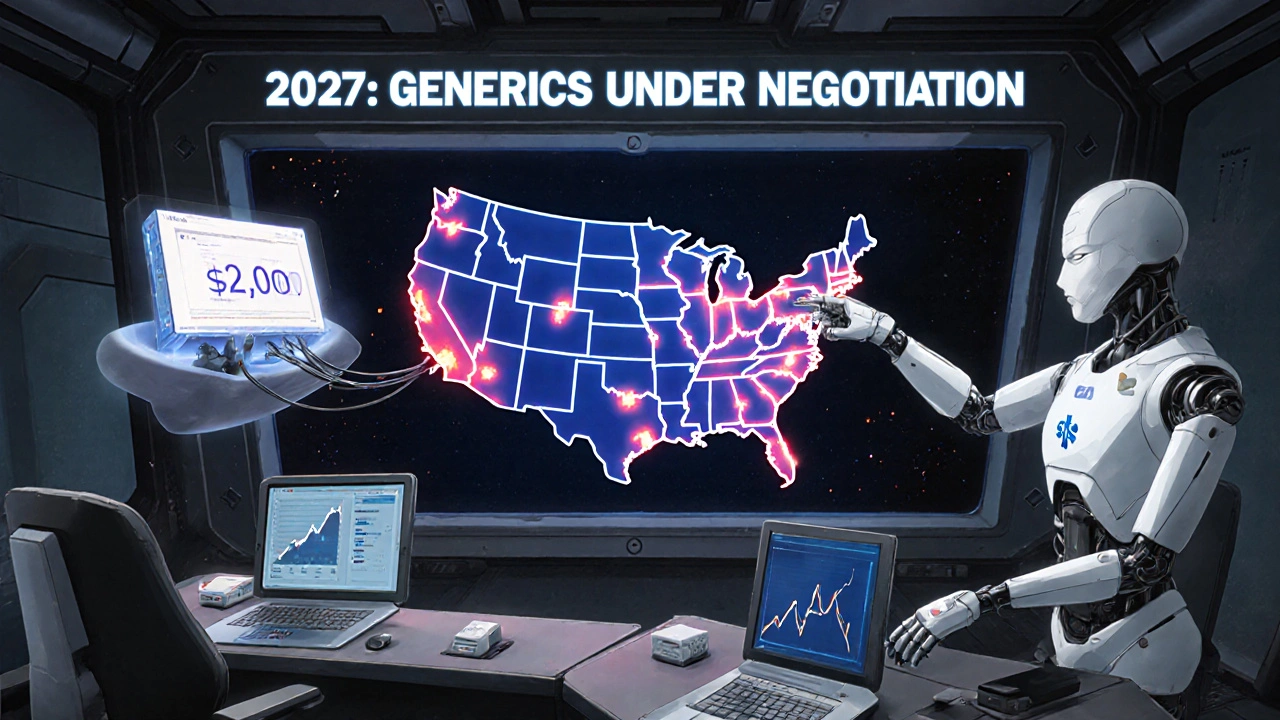
The biggest shift is coming with Medicare’s new drug price negotiation power. The Inflation Reduction Act lets Medicare negotiate prices for 10 high-cost drugs each year starting in 2026. The first round focused on brand-name drugs like insulin and blood thinners.But in 2027, Medicare will negotiate prices for two generic drugs: apixaban and rivaroxaban - both used to prevent strokes. These are off-patent drugs, but because they’re used by over 5 million Medicare patients and cost billions, the government is stepping in. Analysts predict prices could drop 25-35%.
This is a turning point. For the first time, the government is using its buying power to control prices on generics - not just through rebates, but through direct negotiation. It’s not a full price cap. But it’s a signal: the era of ignoring generic pricing is ending.
Who’s Against Government Control - and Why
Drugmakers and industry groups argue that price controls will hurt innovation. They say if manufacturers can’t make enough profit on generics, they’ll stop investing in better delivery systems, like extended-release pills or easier-to-swallow forms.The Academy of Managed Care Pharmacy says regulation creates "unintended consequences." Dr. Mark McClellan, former FDA commissioner, warns that squeezing margins too hard could push companies out of the market entirely.
But critics like Dr. Peter Bach from Memorial Sloan Kettering point out: the U.S. pays 138% more for generics than other rich countries. The VA system, which negotiates directly with manufacturers, gets discounts of 40-60%. Why can’t Medicare do the same?
The Congressional Budget Office estimates expanding Medicare negotiation to more generics could save $12.7 billion over ten years. That’s not a huge chunk of the $700 billion U.S. drug spending pie - but for patients on multiple generics, it’s life-changing.
What You Can Do Right Now
You don’t have to wait for policy changes to save money on generics.- Use the Medicare Plan Finder tool to compare Part D plans. Look for plans with $0 copays on your specific generics.
- Ask your pharmacist if they use a 340B clinic for prescriptions - some offer cash discounts even if you’re not a patient.
- Switch to mail-order pharmacies. Many offer 90-day supplies at lower prices than retail.
- Check GoodRx or SingleCare for coupons. Even if your insurance says you pay $10, you might find a cash price of $4.
- Know your formulary tier. Some plans charge more for certain generic brands, even if they’re chemically identical.
One Florida retiree paid $15 a month for her generic lisinopril - until her pharmacy switched brands without telling her. Her copay jumped to $90. She didn’t know she could ask for the original brand. She didn’t know her plan had to cover it. She didn’t know she could file a complaint.
Knowledge is your best tool. The system is broken in places. But it’s not hopeless. You just have to know where to look.
What’s Next for Generic Drug Pricing
The future of generic drug pricing isn’t about whether the government should control prices. It’s about how much control is enough.Right now, we have a patchwork: rebates for Medicaid, caps for Medicare, discounts for safety-net clinics, and wild price swings in low-competition markets. The next step might be mandatory price reporting - like the new April 2025 rule that requires manufacturers to disclose actual costs before a drug is dispensed. Transparency is the first step toward accountability.
Some experts want a "Most-Favored-Nation" model - tying U.S. generic prices to what other countries pay. Others want to force manufacturers to keep making low-profit drugs if they want to sell high-profit ones. Both ideas are being debated in Congress.
One thing is clear: the days of pretending competition alone will fix everything are over. Generic drugs are too essential to be left to the mercy of a market that sometimes fails the people who need them most.

John Biesecker
November 29, 2025 AT 18:24Genesis Rubi
November 30, 2025 AT 18:21