
You breathe roughly 20,000 times a day. Most of the time, that air is harmless. But if you work in construction, mining, or manufacturing, your lungs might be silently fighting a battle against invisible particles. Occupational lung diseases are respiratory conditions caused by inhaling harmful substances in the workplace, such as silica dust and asbestos fibers. Two of the most dangerous-and entirely preventable-are silicosis and asbestosis.
These aren't just medical terms from history books. They are active threats today. In the United States alone, silicosis kills about 1,200 workers annually, while asbestosis claimed over 1,100 lives between 2004 and 2014. The scary part? These deaths are not accidents. They are failures of safety systems that we have known how to fix for decades.
Understanding Silicosis: The Stone-Cutter’s Curse
Silicosis is a progressive lung disease caused by inhaling crystalline silica dust, leading to scarring of lung tissue. When you cut, grind, or drill stone, concrete, brick, or sand, you release tiny particles of crystalline silica into the air. These particles are so small they slip past your body’s natural defenses and embed themselves deep in your lung tissue.
Your immune system tries to fight them off, but it can’t digest silica. Instead, it forms scar tissue around the particles. Over time, this scarring hardens the lungs, making it difficult to breathe. It’s like trying to inflate a balloon made of rubber cement instead of flexible latex.
The first documented cases date back to ancient civilizations among stone workers. Formal medical recognition came in 1870 when Dr. Achille Visconti described 'miner's phthisis' in Italian literature. Despite this long history, silicosis remains prevalent. According to NIOSH data from 2018, it accounts for approximately 1,200 annual deaths in the US. The primary industries at risk include construction, mining, and manufacturing.
Asbestosis: The Invisible Fiber Threat
Asbestosis is a chronic lung disease caused by prolonged inhalation of asbestos fibers, resulting in severe scarring and reduced lung capacity. Unlike silica, which is found in many common building materials, asbestos was once widely used for its heat resistance and durability. It was common in insulation, roofing, flooring, and brake linings.
When asbestos-containing materials are disturbed-during renovation, demolition, or maintenance-they release microscopic fibers into the air. These fibers are sharp and durable. Once inhaled, they lodge in the lungs and cause inflammation and scarring. The disease progresses slowly, often taking 20 to 40 years to show symptoms after exposure.
Asbestosis was clinically identified in 1906 when Dr. H. Montague Murray performed an autopsy on a 33-year-old asbestos factory worker in London. Today, the threat persists due to aging infrastructure. The EPA estimates that 733,000 public buildings in the US still contain asbestos-containing materials. Even though new uses are banned, old structures remain a hazard for construction workers and abatement professionals.
Why Prevention Is Possible (and Necessary)
Here is the good news: both silicosis and asbestosis are 100% preventable. There is no cure for these diseases once they develop, but there is a clear path to stopping them before they start. The American Lung Association states clearly that occupational lung diseases are entirely preventable through proper workplace interventions.
The key lies in understanding the hierarchy of controls. This is a framework used by safety experts to determine the most effective way to reduce hazards. It looks like this:
- Elimination: Physically remove the hazard. For example, use synthetic abrasives instead of sand for blasting.
- Substitution: Replace the hazard with something less dangerous. Use silica-free joint compounds.
- Engineering Controls: Isolate people from the hazard. Use wet cutting methods or local exhaust ventilation.
- Administrative Controls: Change the way people work. Rotate shifts to limit exposure time.
- Personal Protective Equipment (PPE): Protect the worker with gear. Wear respirators.
Notice that PPE is at the bottom. That’s because it relies on human behavior, which can fail. Engineering controls are far more reliable. According to CDC NIOSH data, engineering controls provide 80-90% exposure reduction when properly implemented, compared to only 40-60% for PPE.
Engineering Controls: The First Line of Defense
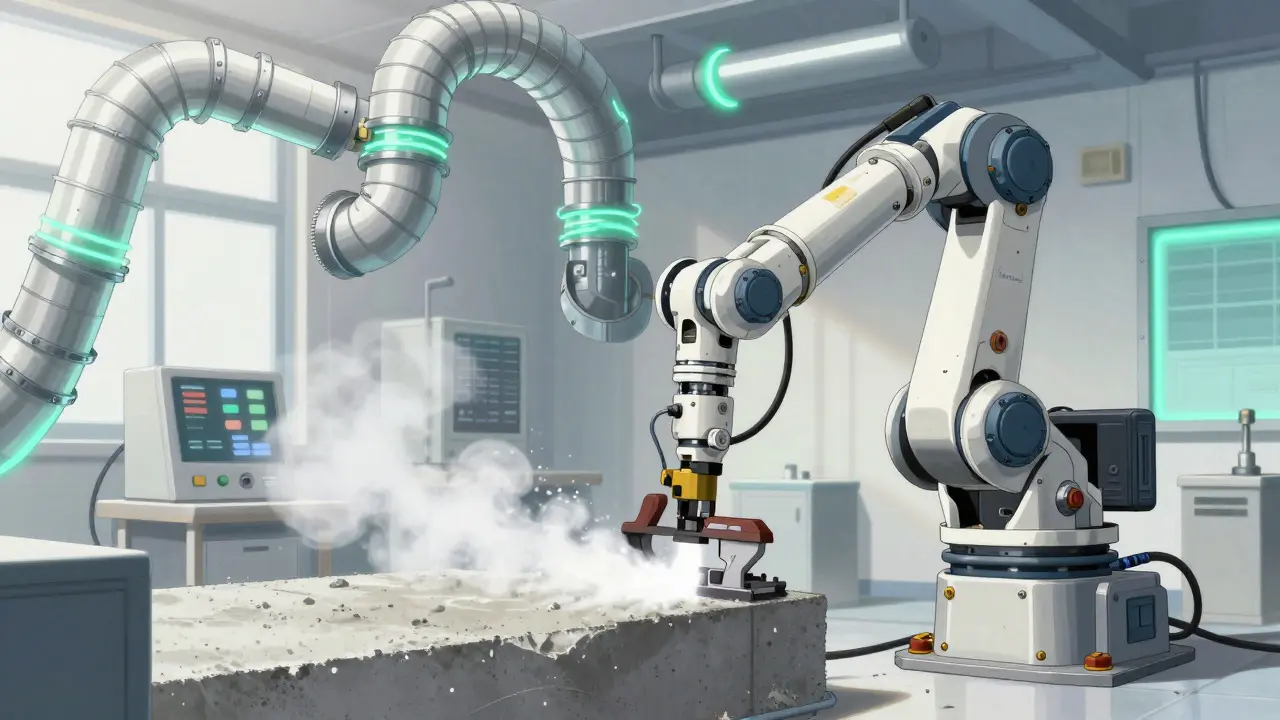
If you want to stop silica dust, don’t just rely on masks. Change the process. Wet cutting is one of the most effective methods. By adding water to the cutting surface, you trap the dust before it becomes airborne. Studies show that wet cutting reduces silica dust exposure by 90% compared to dry cutting.
Another powerful tool is local exhaust ventilation (LEV). These systems capture dust at the source before it spreads. OSHA standard 1910.94 recommends maintaining an air velocity of 100-150 feet per minute at the point of contamination to effectively capture particles. For hand tools, attaching a vacuum system can reduce exposure by 70-80%.
Sealing systems are also critical. When working with hazardous materials, enclose the operation to contain at least 95% of generated dust, as recommended by NIOSH guidelines from 2020. This might mean using containment tents during asbestos abatement or shrouds around grinding wheels.
| Control Type | Effectiveness | Example Application | Cost Consideration |
|---|---|---|---|
| Elimination/Substitution | Highest (Near 100%) | Using synthetic media instead of sand | Higher initial material cost |
| Engineering Controls | High (80-90%) | Wet cutting saws, LEV systems | $2,000-$5,000 per workstation |
| Administrative Controls | Moderate (50-70%) | Job rotation, training programs | Low direct cost, high management effort |
| PPE (Respirators) | Variable (40-60%) | N-95 or P-100 masks | Low per-unit cost, requires fit testing |
PPE: The Last Resort, Not the Only Option
When engineering controls aren’t enough, you need personal protective equipment. But not all masks are created equal. An N-95 respirator filters out 95% of particles 0.3 microns in size. A P-100 respirator filters out 99.97%. For asbestos work, P-100 is often required because the fibers are so fine and dangerous.
However, buying the right mask is only half the battle. Fit matters. OSHA mandates annual fit testing for all respirator users under standard 1910.134. If the mask doesn’t seal perfectly against your face, dust gets in. In fact, 68% of worker complaints about respiratory protection are related to improper fit or discomfort, according to the CDC’s NIOSH Health Hazard Evaluation Program.
Heat is another enemy. On hot summer days, compliance with wearing respirators drops significantly. One industrial hygienist reported that in 90+ degree heat, compliance can drop to 40%. Employers must consider comfort and climate when selecting PPE. Coolant systems for respirators or scheduled breaks in clean air zones can help.

Health Monitoring: Catching Problems Early
Prevention isn’t just about stopping exposure; it’s about monitoring health. Regular spirometry testing can detect lung function decline before symptoms appear. The American Thoracic Society’s 2021 guidelines emphasize that early detection can slow disease progression by 30-50%.
Protocols typically require baseline testing when a worker starts a job with respiratory hazards, followed by tests every five years. For those with pre-existing conditions, annual testing is recommended. This data helps employers adjust controls and protects workers by identifying issues early.
Smoking complicates things further. The American Lung Association notes that smoking increases the risk of developing occupational lung diseases by 50-70%. Creating tobacco-free workplaces is a simple administrative control that significantly boosts overall respiratory health.
Real-World Challenges and Solutions
Knowing what to do and actually doing it are two different things. Construction workers on Reddit have shared mixed experiences. One user noted, "My company finally got wet cutting saws last year and silica dust is way down, but the foreman still yells at us for taking too long with water methods." This highlights a cultural barrier: speed often trumps safety on job sites.
Small businesses face unique hurdles. Data from the Wisconsin Department of Health showed that 78% of businesses with fewer than 20 employees lacked comprehensive respiratory protection programs, compared to only 32% of larger companies. Resources are tighter, and oversight is less frequent.
Successful implementation requires buy-in from all levels. Supervisors must model proper PPE use 100% of the time. Case studies from 15 construction companies showed that when leadership prioritized safety, respiratory incidents dropped by 65% over three years. Empowering workers to report unsafe conditions without fear of retaliation is crucial, as emphasized in OSHA’s Whistleblower Protection Program.
The Future of Respiratory Safety
Technology is evolving. NIOSH launched the 'Prevent eTool' digital platform in 2023, providing industry-specific guidance for high-risk sectors. Early data shows a 40% reduction in respiratory incidents among participating companies. Wearable sensors that provide real-time dust exposure data are also emerging, allowing for immediate feedback and adjustment.
Regulatory pressure is increasing. OSHA’s National Emphasis Program on silica has conducted thousands of inspections, resulting in hundreds of citations. The European Respiratory Society has called for the global elimination of occupational lung diseases by 2030. Pilot programs in Germany have already shown a 55% reduction in new cases through mandatory health surveillance.
The goal is clear: zero cases. With current technology and knowledge, silicosis and asbestosis should be relics of the past. Achieving this requires consistent enforcement, technological innovation, and a cultural shift that values worker health above short-term convenience.
What is the difference between silicosis and asbestosis?
Both are scarring lung diseases, but they come from different sources. Silicosis is caused by inhaling crystalline silica dust found in stone, concrete, and sand. Asbestosis is caused by inhaling asbestos fibers found in older insulation, roofing, and flooring materials. Silicosis can develop faster, sometimes within years, while asbestosis typically takes 20-40 years to manifest.
Can silicosis be cured once diagnosed?
No, there is no cure for silicosis. The scarring is permanent. Treatment focuses on managing symptoms, preventing further exposure, and slowing progression. This is why prevention through engineering controls and PPE is so critical.
Is an N-95 mask enough for silica dust?
It depends on the level of exposure. An N-95 filters 95% of particles 0.3 microns in size. For lower exposure levels, it may be sufficient. However, for heavy cutting or grinding, a P-100 respirator, which filters 99.97%, is often recommended. Always follow OSHA standards and conduct fit testing to ensure the mask seals properly.
How often should workers get spirometry tests?
Workers exposed to respiratory hazards should have a baseline test when they start the job. Follow-up tests are generally required every five years. However, workers with pre-existing respiratory conditions should be tested annually to monitor for any decline in lung function.
What are the most effective ways to prevent silica exposure?
The most effective methods are engineering controls. Wet cutting reduces dust by 90%. Local exhaust ventilation captures dust at the source. Substituting silica-free materials eliminates the hazard entirely. PPE should be used as a last line of defense when other controls are not fully effective.